
BC Limits 1
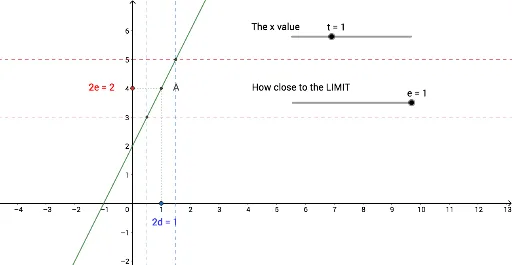
Loading the math board and drawing, please wait…
This example demonstrates the geometric phenomenon of exploring BC side limits in a triangle by constructing line segments and intersection points; Core math concepts include limits, scalene triangles, parallelograms, confidence intervals, line segments, and correlation; Construction highlights: GeoGebra commands/objects used from the summary: Intersect, Segment; Objects: f, t, e, m, h, g, B_1, B_2, C_1, C_2, A, i, j, C, B, D, E, k, l, a, n, p, text1, text2, text3, text4; Suitable for high school mathematics teaching, demonstrating the application of limit concepts in geometry.
GeoGebra Commands & Parameters
Intersect(f, g) → B_1, B_2Intersect(f, h) → C_1, C_2Intersect(f, h, 1) → DIntersect(f, g, 1) → ESegment(C, A) → nSegment(A, B) → p
AI Drawing Prompt Reference
Draw a triangle with one side intersected by two parallel lines, creating two sets of intersection points. Start with two sides of the triangle, then add two auxiliary lines parallel to the base, each crossing both sides to produce four intersection points. Next, select one intersection point on each auxiliary line near the top vertex, and connect these two points to a vertex of the triangle with line segments. The figure illustrates how the side lengths change as the parallel lines move, demonstrating the concept of limits geometrically.
The prompt above was compiled from the original drawing commands and is for reference only.