
Basic Trig Functions from the Unit Circle
Loading the math board and drawing, please wait…
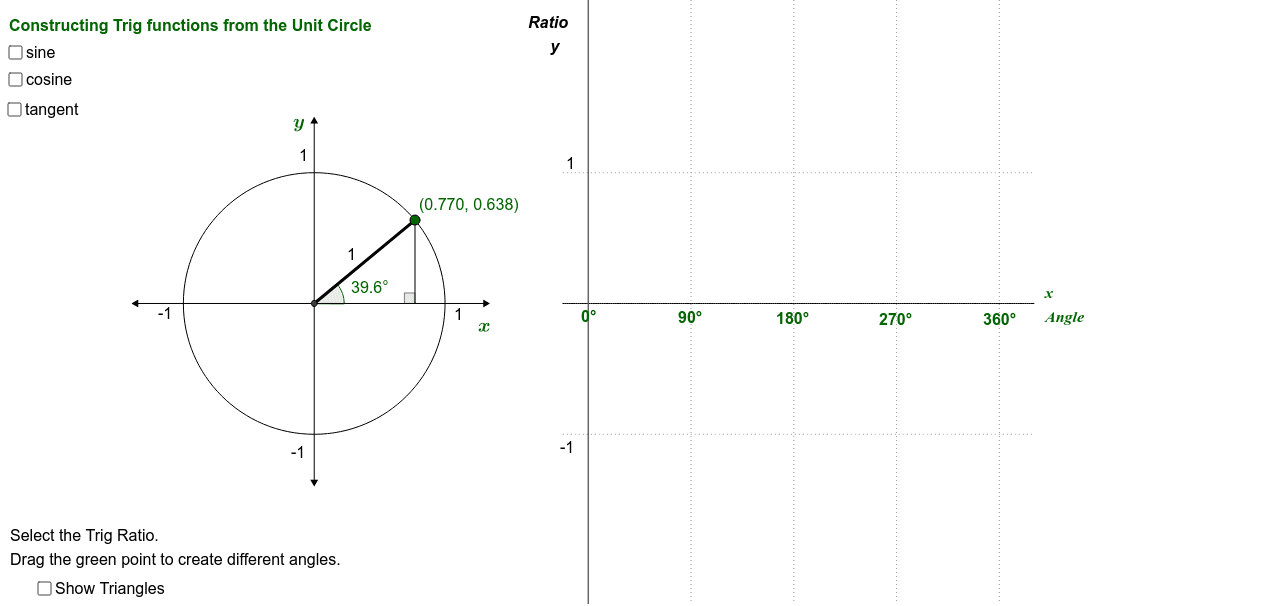
This example demonstrates the geometric interpretation of basic trigonometric functions (sine, cosine, tangent) using the unit circle. It covers core math concepts including the unit circle, trigonometric function definitions, angle and radian conversions, and right triangle side relationships. The construction utilizes GeoGebra commands/objects like Intersect, Function, Point, Circle, Tangent, Segment, OrthogonalLine, Angle, and Ray. Suitable for high school students learning about the relationship between trig functions and the unit circle, or for classroom demonstrations.
GeoGebra Commands & Parameters
Intersect(xAxis, yAxis) → AFunction(0, 1.9, 5.5) → gPoint(g) → QPoint(yAxis) → BCircle(A, B) → cPoint(c) → DTangent(D, c) → e,Intersect(e, yAxis) → FIntersect(xAxis, e) → ESegment(F, E) → lSegment(E, A) → mIntersect(m, l) → OIntersect(c, xAxis, 2) → CSegment(A, C) → dOrthogonalLine(D, d) → fIntersect(f, m) → HSegment(A, H) → cosαAngle(Q, A, D) → αSegment(A, D) → bSegment(D, E) → tanαSegment(D, H) → sinαOrthogonalLine(D, sinα) → iFunction(sin((2 * (x - (2 * 3.14 / 3)))), 2.09, 5.24) → sineαIntersect(sineα, h, (2.439250960476847, 0.6379515420040821)) → IFunction(tan((2 * (x - (2 * 3.14 / 3)))), 2.09, 5.24) → tangentαIntersect(tangentα, h, (2.439250960476847, 0.8284261815090247)) → JFunction(cos((2 * (x - (2 * 3.14 / 3)))), 2.09, 5.24) → cosineαIntersect(cosineα, h, (2.439250960476847, 0.770076509221398)) → KSegment(H, D) → jSegment(A, F) → kIntersect(j, m) → NIntersect(k, l) → PFunction(1, 1.9, 5.5) → pFunction(-1, 1.9, 5.5) → qPoint(c) → RSegment(C, R) → aSegment(A, H) → g_1Segment(D, H) → h_1Segment(A, E) → j_1Angle(A, D, E) → βRay(D, F) → i_1Ray(D, E) → l_1Intersect(c, a) → G, LOrthogonalLine(I, xAxis) → d_1Intersect(g, xAxis, 1) → MIntersect(g, xAxis, 1) → SIntersect(g, xAxis, 1) → TIntersect(g, d_1) → USegment(I, U) → e_1OrthogonalLine(K, xAxis) → k_1Intersect(k_1, xAxis) → VSegment(K, V) → m_1OrthogonalLine(J, xAxis) → n_1Intersect(n_1, xAxis) → WSegment(J, W) → p_1Point(yAxis) → ZPoint(yAxis) → A_1Segment(Z, A_1) → q_1Point(xAxis) → B_1Point(xAxis) → C_1Segment(B_1, C_1) → r_1OrthogonalLine(D, r_1) → c_1Intersect(g, r_1, 1) → D_1Intersect(c_1, r_1) → E_1Segment(D, E_1) → s_1Angle(D, E_1, A) → γ
AI Drawing Prompt Reference
Draw a unit circle with center A and point B. Mark the intersection points C and D of the circle with the x-axis. Draw the tangent line e at point D, intersecting the y-axis at F and the x-axis at E. Connect F and E to form line l, and connect E and A to form line m; their intersection is point O. Draw a perpendicular line f from D to line d, intersecting m at point H. Define angle alpha as the angle QAD, where Q is on function g. Draw segments for sin alpha, tan alpha, and cos alpha connecting D to H, E, and H respectively. Draw a perpendicular line i from H to sin alpha. Draw sine alpha, cosine alpha, and tangent alpha curves, marking their intersections with a line at points I, J, and K. Connect various points such as H, D, A, F to form intersections G, L, and P. Overall, this illustrates the geometric relationship between trigonometric functions and the unit circle, including tangents, perpendiculars, intersections, angles, and function curves.
The prompt above was compiled from the original drawing commands and is for reference only.