
Area of Any Triangle by GreenMaths
Loading the math board and drawing, please wait…
In collections
Area - Rectangles, Triangles and Parallelograms
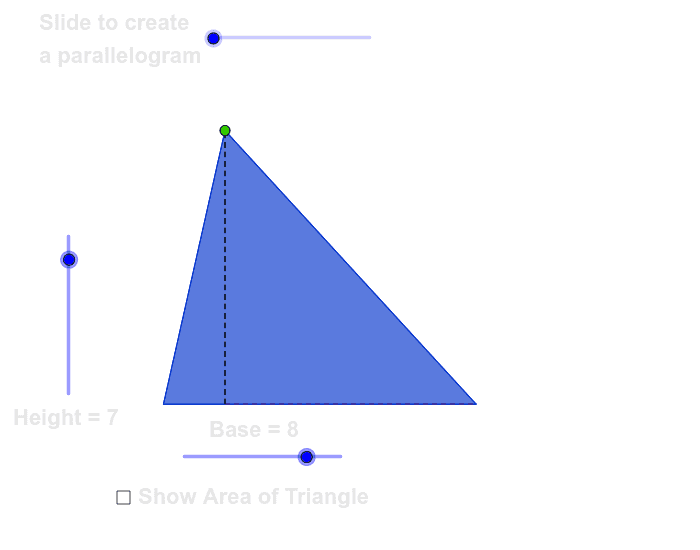
This example demonstrates the relationship between the area of a triangle and a parallelogram. Key concepts include the formula for the area of a triangle and geometric transformations. By constructing a triangle, height, and parallel lines, it illustrates how to calculate the area of a triangle using the area of a parallelogram. Suitable for middle school and above students to learn geometric transformations and area calculations.
GeoGebra Commands & Parameters
Point(xAxis) → A_1OrthogonalLine(A_1, xAxis) → g_1Point(xAxis) → ZOrthogonalLine(Z, xAxis) → f_1Circle(A, Base) → dPoint(d) → BLine(A, B) → fOrthogonalLine(A, f) → gCircle(A, Height) → cIntersect(c, g, 1) → CTangent(C, c) → h, aIntersect(h, g_1) → C_1Intersect(h, f_1) → B_1Segment(B_1, C_1) → h_1Point(h_1) → DSegment(A, B) → ePolygon(A, B, D) → P, d_1, a_1, b_1OrthogonalLine(D, f) → iIntersect(f, i) → ESegment(E, D) → jSegment(E, B) → kMidpoint(D, B) → FMidpoint(D, A) → GPoint(a_1) → HCircle(B, H) → pIntersect(p, d_1, 1) → IOrthogonalLine(H, a_1) → lOrthogonalLine(I, d_1) → mIntersect(l, m) → JIf(x(D) ≟ x(B), G) → KIf(x(D) ≟ x(B), J) → LSegment(L, H) → nSegment(L, I) → qRotate(A, α, K) → A'Rotate(B, α, K) → B'Rotate(D, α, K) → D'Polygon(A', B', D') → P', d', a', b'If(x(D) ≟ x(A), F) → MPoint(b_1) → NCircle(A, N) → rIntersect(r, d_1, 1) → OOrthogonalLine(N, b_1) → sOrthogonalLine(O, d_1) → tIntersect(s, t) → QIf(x(D) ≟ x(A), Q) → RSegment(N, R) → c_1Segment(R, O) → e_1Rotate(A, -α, M) → A'_1Rotate(B, -α, M) → B'_1Rotate(D, -α, M) → D'_1Polygon(A'_1, B'_1, D'_1) → P'_1, d'_1, a'_1, b'_1If(x(D) > x(B), G) → SRotate(A, α, S) → A'_2Rotate(B, α, S) → B'_2Rotate(D, α, S) → D'_2Polygon(A'_2, B'_2, D'_2) → P'_2, d'_2, a'_2, b'_2If(x(D) < x(A), F) → TRotate(A, -α, T) → A'_3Rotate(B, -α, T) → B'_3Rotate(D, -α, T) → D'_3Polygon(A'_3, B'_3, D'_3) → P'_3, d'_3, a'_3, b'_3If((x(D) > x(A)) ∧ (x(D) < x(B)), F) → URotate(A, -α, U) → A'_4Rotate(B, -α, U) → B'_4Rotate(D, -α, U) → D'_4Polygon(A'_4, B'_4, D'_4) → P'_4, d'_4, a'_4, b'_4Midpoint(D, E) → VMidpoint(A, B) → W
AI Drawing Prompt Reference
Draw a triangle and calculate its area by constructing parallel lines and heights. Start by taking points A and Z on the x-axis and drawing their perpendicular lines g1 and f1. Construct a circle d with A as the center and B as the radius, and let B be one vertex of the triangle. Connect AB to form the base, draw a perpendicular line g to AB, intersecting g1 at C, draw a tangent h to C, intersecting f1 at B1 and g1 at C1, connect C1B1 to form the height h1, and take point D on h1. Then, construct a parallelogram by rotating points A, B, and D, forming a new triangle P'. Finally, construct another triangle by rotating points A and D, completing the construction.
The prompt above was compiled from the original drawing commands and is for reference only.