
Area of a Parallelogram and Related Rectangle
Loading the math board and drawing, please wait…
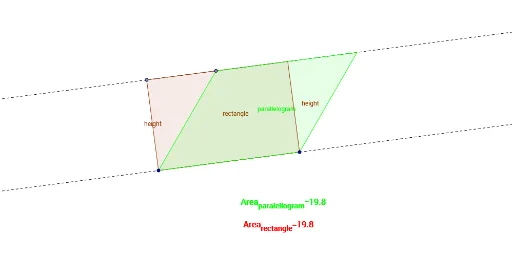
This example demonstrates how to calculate the area of a parallelogram by constructing it and related rectangles. Core math concepts include area calculation, sine theorem, circumcircle, combinatorics, subtraction, and power functions. GeoGebra commands and objects used in construction are Line, OrthogonalLine, Point, Intersect, and Polygon. Suitable for high school mathematics education to understand the parallelogram area formula and its relation to rectangles.
GeoGebra Commands & Parameters
Line(A, B) → aOrthogonalLine(A, a) → bPoint(b) → COrthogonalLine(C, b) → cOrthogonalLine(B, a) → dPoint(c) → DLine(D, A) → eLine(B, e) → fIntersect(c, d) → EPolygon(C, A, B, E) → rectangle, c_1, a_1, b_1, e_1Intersect(c, f) → FPolygon(D, A, B, F) → parallelogram, d_1, a_2, b_2, f_1
AI Drawing Prompt Reference
Draw a parallelogram and a related rectangle. First, draw line segment AB, then draw a perpendicular line to AB to determine point C, next draw a perpendicular line to BC to determine point D, then draw perpendicular lines to AB and BD to determine points E and F, finally connect points C, A, B, E and D, A, B, F to form a rectangle and a parallelogram.
The prompt above was compiled from the original drawing commands and is for reference only.