
Archimedes' Twin Circles
Loading the math board and drawing, please wait…
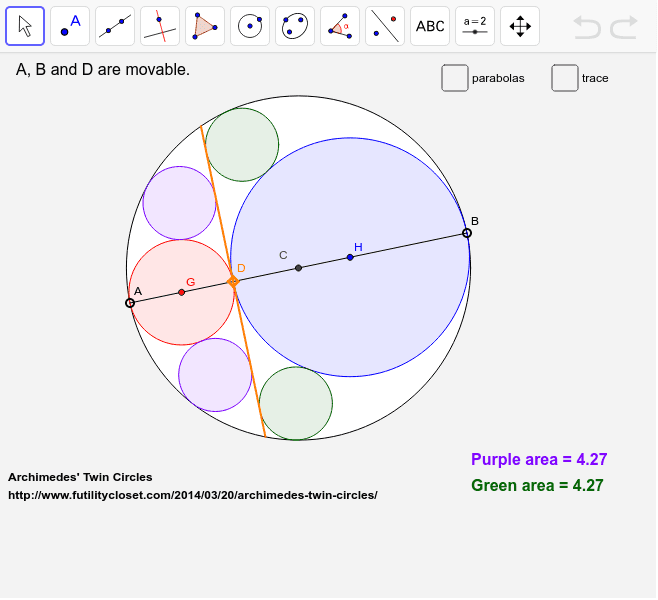
This example demonstrates Archimedes' proof of the twin circles theorem, where the purple circle is tangent to the enclosing circle, the red circle, and the perpendicular dividing line, and is congruent to them. Key concepts include circle properties, geometric construction, and similarity. It uses commands like Midpoint, Circle, Point, OrthogonalLine, etc. Suitable for high school geometry.
GeoGebra Commands & Parameters
Midpoint(A, B) → CSegment(C, A) → gCircle(C, B) → cSegment(A, B) → aPoint(g) → DMidpoint(D, A) → GMidpoint(D, B) → HCircle(G, D) → dCircle(H, D) → eOrthogonalLine(D, a) → bIntersect(c, b, 2) → EIntersect(c, b, 1) → FSegment(E, F) → fDistance(G, A) → rDistance(H, B) → RSegment(I, G) → jOrthogonalLine(I, f) → kIntersect(b, k) → JSegment(I, J) → lIntersect(d, j) → K,Segment(I, K) → mCircle(D, G) → pIntersect(p, a, 2) → LOrthogonalLine(L, a) → iParabola(G, i) → qCircle(D, H) → sLine(A, B) → nIntersect(s, n, 1) → MOrthogonalLine(M, n) → tParabola(H, t) → c_1Ray(C, I) → a_1Intersect(c, a_1, 1) → NSegment(I, N) → b_1Circle(G, C) → d_1Intersect(d_1, n, 1) → OOrthogonalLine(O, n) → e_1Parabola(C, e_1) → f_1Circle(H, C) → g_1Intersect(g_1, n, 2) → POrthogonalLine(P, n) → h_1Parabola(C, h_1) → k_1Intersect(c_1, k_1, 2) → QIntersect(c_1, k_1, 1) → SIntersect(q, f_1, 1) → TIntersect(q, f_1, 2) → UOrthogonalLine(Q, f) → i_1OrthogonalLine(S, f) → j_1OrthogonalLine(U, f) → l_1OrthogonalLine(T, f) → m_1Intersect(i_1, f) → VIntersect(m_1, f) → WIntersect(l_1, f) → ZIntersect(j_1, f) → A_1Circle(Q, V) → p_1Circle(T, W) → q_1Circle(U, Z) → r_1Circle(S, A_1) → s_1Area(p_1) → oPointIn(p_1) → Pointp1Area(q_1) → uPointIn(q_1) → Pointq1
AI Drawing Prompt Reference
Draw a geometric diagram featuring an outer circle and an inner tangent purple circle, which is congruent to and tangent to both the outer circle and the perpendicular bisector. Start by sketching the outer circle and the bisector, then create the inner tangent purple circle centered at the intersection of the bisector with the outer circle. Construct two auxiliary circles and use them to find key points, forming the complete diagram that highlights circle properties, similarity, and geometric construction.
The prompt above was compiled from the original drawing commands and is for reference only.