
Approximating Pi by timaway
Loading the math board and drawing, please wait…
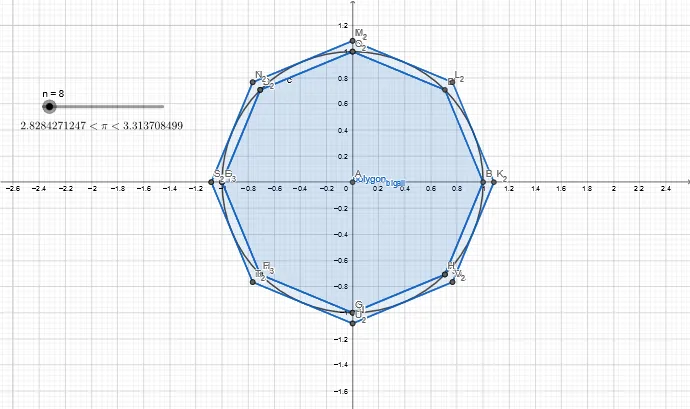
This example demonstrates how to approximate the value of pi (π) using geometric methods. Key mathematical concepts include circle properties, angle measurement, and limits. Through steps involving rotation, angle measurement, and polygon construction, the value of π is progressively approximated. GeoGebra commands used include Intersect, Circle, Rotate, Angle, and Polygon. Suitable for high school mathematics education and learning.
GeoGebra Commands & Parameters
Intersect(xAxis, yAxis) → ACircle(A, 1) → cIntersect(c, xAxis, 2) → BRotate(B, (360°) / n, A) → B'Angle(B, A, B') → αPolygon(B, B', n) → polygon_{small}, f, q, l_{22}, C, D, E, F, G, H, I, J, K, r, L, M, N, O, P, Q, R, S, T, U, s, V, W, Z, A_1, B_1, C_1, D_1, E_1, F_1, D_5, t, F_6, G_6, H_6, I_6, J_6, K_6, L_6, M_6, N_6, O_6, a, P_6, Q_6, R_8, S_8, T_8, U_8, V_8, W_8, Z_8, A_9, b, B_9, C_9, D_9, E_9, F_9, G_9, H_9, I_9, J_9, K_9, d, L_9, M_9, N_9, O_9, P_9, Q_9, R_9, S_9, T_9, U_9, e, V_9, W_9, Z_9, A_{10}, B_{10}, C_{10}, D_{10}, E_{10}, F_{10}, K_{16}, f_1, L_{16}, M_{16}, N_{16}, O_{16}, P_{16}, Q_{16}, R_{16}, S_{16}, T_{16}, U_{16}, g_1, V_{16}, W_{16}, Z_{16}, A_{17}, B_{17}, C_{17}, D_{17}, E_{17}, F_{17}, g, h_1, i_1, j_1, k_1, l_1, m_1, n_1, p_1, q_1, r_1, h, s_1, g_7, n_8, p_8, q_8, r_8, s_8, t_8, a_8, b_8, i, c_8, d_8, e_8, f_9, r_{11}, s_{11}, t_{11}, a_{11}, b_{11}, c_{11}, j, d_{11}, e_{11}, f_{12}, g_{12}, h_{12}, i_{12}, j_{12}, k_{12}, l_{12}, m_{12}, k, n_{12}, p_{12}, q_{12}, r_{12}, s_{12}, t_{12}, a_{12}, b_{12}, c_{12}, d_{12}, l, e_{12}, f_{13}, g_{13}, h_{13}, i_{13}, j_{13}, k_{13}, l_{13}, m_{13}, n_{13}, m, p_{13}, l_{21}, m_{21}, n_{21}, p_{21}, q_{21}, r_{21}, s_{21}, t_{21}, a_{21}, p, b_{21}, c_{21}, d_{21}, e_{21}, f_{22}, g_{22}, h_{22}, i_{22}, j_{22}, k_{22}Rotate(B, (360°) / ((n * 2)), A) → B'_{1}Angle(B, A, B'_{1}) → βLine(A, B'_{1}) → k_3OrthogonalLine(B'_{1}, k_3) → l_3Intersect(l_3, xAxis) → K_2Line(A, B') → m_3Intersect(l_3, m_3) → L_2Polygon(K_2, L_2, n) → polygon_{big}, n_3, l_4, n_{24}, M_2, N_2, S_2, T_2, U_2, V_2, W_2, Z_2, M_3, f_5, N_3, O_3, P_3, Q_3, R_3, G_4, H_4, I_4, J_4, K_4, g_5, L_4, M_4, F_5, G_5, H_5, I_5, J_5, K_5, L_5, M_5, h_5, F_7, G_7, H_7, I_7, J_7, K_7, L_7, M_7, N_7, O_7, i_5, P_7, Q_7, T_{11}, U_{11}, V_{11}, W_{11}, Z_{11}, A_{12}, B_{12}, C_{12}, j_5, D_{12}, E_{12}, F_{12}, G_{12}, H_{12}, I_{12}, J_{12}, K_{12}, L_{12}, M_{12}, k_5, N_{12}, O_{12}, P_{12}, Q_{12}, R_{12}, S_{12}, T_{12}, U_{12}, V_{12}, W_{12}, e_5, Z_{12}, A_{13}, B_{13}, C_{13}, D_{13}, E_{13}, F_{13}, G_{13}, H_{13}, C_{18}, f_6, D_{18}, E_{18}, F_{18}, G_{18}, H_{18}, I_{18}, J_{18}, K_{18}, L_{18}, M_{18}, g_6, N_{18}, O_{18}, P_{18}, Q_{18}, R_{18}, S_{18}, T_{18}, U_{18}, V_{18}, p_3, h_6, i_6, j_6, k_6, i_7, j_7, k_7, l_7, m_7, n_7, q_3, p_7, q_7, t_9, a_9, b_9, c_9, d_9, e_9, f_{10}, g_{10}, r_3, h_{10}, i_{10}, j_{10}, k_{10}, p_{15}, q_{15}, r_{15}, s_{15}, t_{15}, a_{15}, g_4, b_{15}, c_{15}, d_{15}, e_{15}, f_{16}, g_{16}, h_{16}, i_{16}, j_{16}, k_{16}, h_4, l_{16}, m_{16}, n_{16}, p_{16}, q_{16}, r_{16}, s_{16}, t_{16}, a_{16}, b_{16}, i_4, c_{16}, d_{16}, e_{16}, f_{17}, g_{17}, h_{17}, i_{17}, j_{17}, k_{17}, l_{17}, j_4, m_{17}, n_{23}, p_{23}, q_{23}, r_{23}, s_{23}, t_{23}, a_{23}, b_{23}, c_{23}, k_4, d_{23}, e_{23}, f_{24}, g_{24}, h_{24}, i_{24}, j_{24}, k_{24}, l_{24}, m_{24}
AI Drawing Prompt Reference
Draw a unit circle centered at the origin. Point B lies on the x-axis. Construct point B' by rotating B around the origin by 360°/n. Calculate angle α. Construct a polygon with n vertices using B and B' as starting points (approximating a circle). Rotate B by 360°/(2n) to get B'1. Calculate angle β. Draw line from origin A to B'1 and construct a perpendicular from B'1 to this line. This perpendicular intersects the x-axis at K2. Draw line from A to B' and find intersection with the perpendicular, labeled L2. Construct another polygon with n vertices using K2 and L2 as starting points (approximating a circle). These two polygons can be used to approximate π.
The prompt above was compiled from the original drawing commands and is for reference only.