
Application of Vectors in Physics by Humberto Ortez
Loading the math board and drawing, please wait…
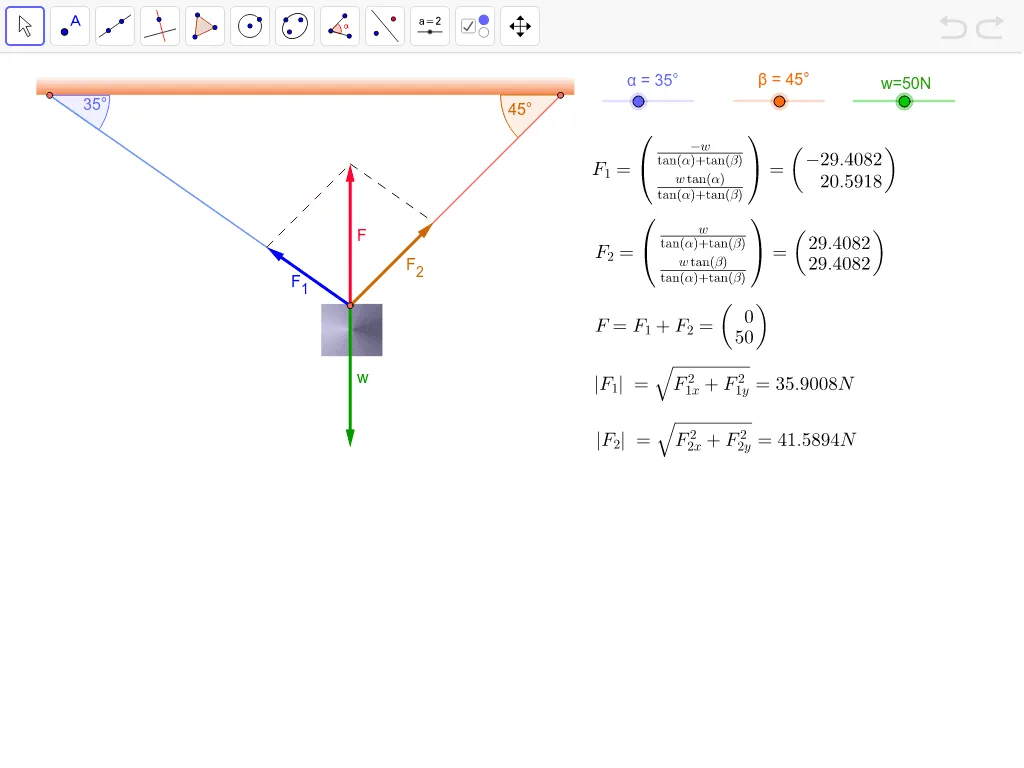
This example demonstrates the practical application of vectors in physics, visualizing vector addition and resolution through graphical methods. Core math concepts include vector operations, geometric constructions, trigonometry, and coordinate systems. Key GeoGebra commands/objects used are Rotate, Line, Intersect, Segment, OrthogonalLine, Angle, Vector, and Length. Suitable for high school physics students or math enthusiasts for learning vector concepts, teaching demonstrations, or homework assistance.
GeoGebra Commands & Parameters
Rotate(A, β, B) → A'Rotate(B, -α, A) → B'Line(B, A') → aLine(A, B') → bIntersect(a, b) → CSegment(A, B) → cOrthogonalLine(C, c) → c'Intersect(Circle[C, e / 100], c', 2) → DIntersect(Circle[C, e / 100], c', 1) → EAngle(A, B, A') → δAngle(B', A, B) → γSegment(A, C) → dSegment(B, C) → fVector(C, D) → wVector(C, E) → FLine(E, f) → iLine(E, d) → jIntersect(i, d) → GIntersect(j, f) → HVector(C, G) → F_1Vector(C, H) → F_2Segment(G, E) → kSegment(E, H) → lLength(F1) → f1Length(F2) → f2
AI Drawing Prompt Reference
Draw a vector addition demonstration showing two vectors, their rotated versions, and the resulting parallelogram. Connect the rotated vectors to form a parallelogram and mark the diagonal as the resultant vector. Then, draw perpendicular lines from the vertices of the parallelogram to the extensions of the original vectors, finding their intersections to determine the components of the resultant vector.
The prompt above was compiled from the original drawing commands and is for reference only.