
Ambiguous Case of the Sine Law (SSA Triangle) Dynamic Demo
Loading the math board and drawing, please wait…
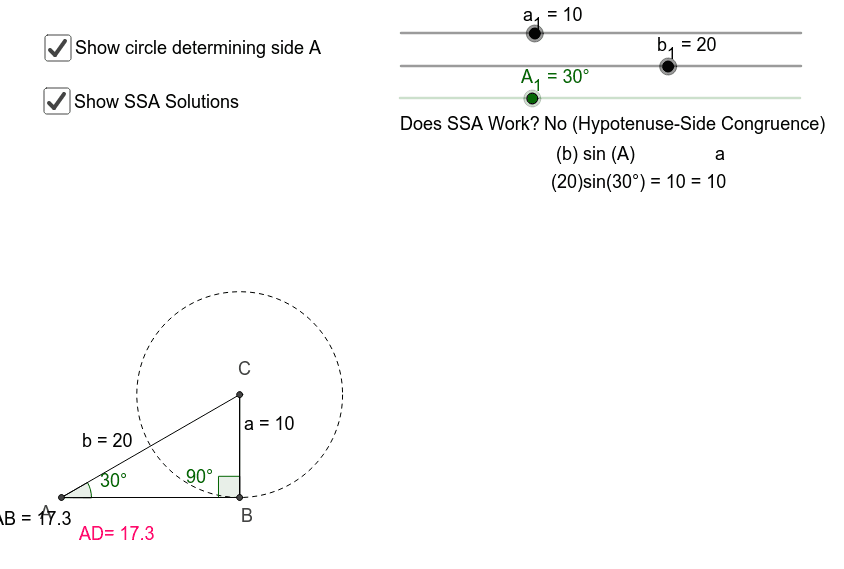
This GeoGebra example dynamically demonstrates the ambiguous case of the sine law for SSA (side-side-angle) triangles, where given two sides and a non-included angle, there can be zero, one, or two possible triangles. The core mathematical concepts include the sine law, triangle congruence criteria, and the analysis of multiple solutions when solving triangles. Construction highlights: sliders control angle A and sides a and b; the intersection of a circle and a ray (Intersect) determines possible positions of vertex C; commands such as Rotate, Angle, OrthogonalLine, and If are used to build the triangle and display the number of solutions via text objects. Suitable for high school or early college students learning trigonometry and geometric construction, this interactive tool helps visualize why the SSA condition is ambiguous and how the geometry leads to different solution counts.
GeoGebra Commands & Parameters
Intersect(xAxis, yAxis) → APoint(xAxis) → FRay(A, F) → c_1Rotate(F, A_1, A) → F'Angle(F, A, F') → βRay(A, F') → d_1Circle(A, b_1) → eIntersect(e, d_1, 1.0) → CSegment(A, C) → bCircle(C, a_1) → cIntersect(c, c_1) → D, BSegment(C, B) → aSegment(C, D) → gSegment(A, D) → iPoint(i) → ESegment(A, B) → jPoint(j) → GOrthogonalLine(C, c_1) → kIntersect(c, k) → H, ISegment(H, C) → a_2Angle(C, D, A) → γAngle(C, B, A) → δOrthogonalLine(C, c_1) → dIntersect(d, c_1) → JSegment(C, J) → lSegment(C, B) → pIf(a_1 < b_1, If[l ≟ a_2, "(" + b + ")sin(" + β + ") = " + l + " = " + a_2, If[l > a_2, "(" + b + ")sin(" + β + ") = " + l + " > " + a_2, "(" + b + ")sin(" + β + ") = " + l + " < " + a_2]]) → text3If(a_1 ≥ b_1, "Yes!", If[b_1 * sin(A_1) > a_1, "No! (We don't even have a triangle!)", If[δ ≟ 90.0°, "No (Hypotenuse-Side Congruence)", "No (Two Possible Triangles)"]]) → text6
AI Drawing Prompt Reference
Draw a dynamic geometric diagram illustrating the ambiguous case of the sine law for SSA triangles. Start with a horizontal ray from a fixed point, and another ray rotated from the first by a given angle. Draw a circle centered at the fixed point with a given radius, intersecting the rotated ray at a point, and connect these to form one side. Then draw a second circle centered at that intersection point with another given radius, intersecting the horizontal ray at two possible points, and connect them to form two candidate triangles. Show a dashed perpendicular from the intersection point to the horizontal ray, marking the foot. Include text annotations comparing the perpendicular length with the given side length, indicating whether zero, one, or two triangles exist, and display the corresponding conclusion.
The prompt above was compiled from the original drawing commands and is for reference only.