
Addition of Fractions with Unlike Denominators
Loading the math board and drawing, please wait…
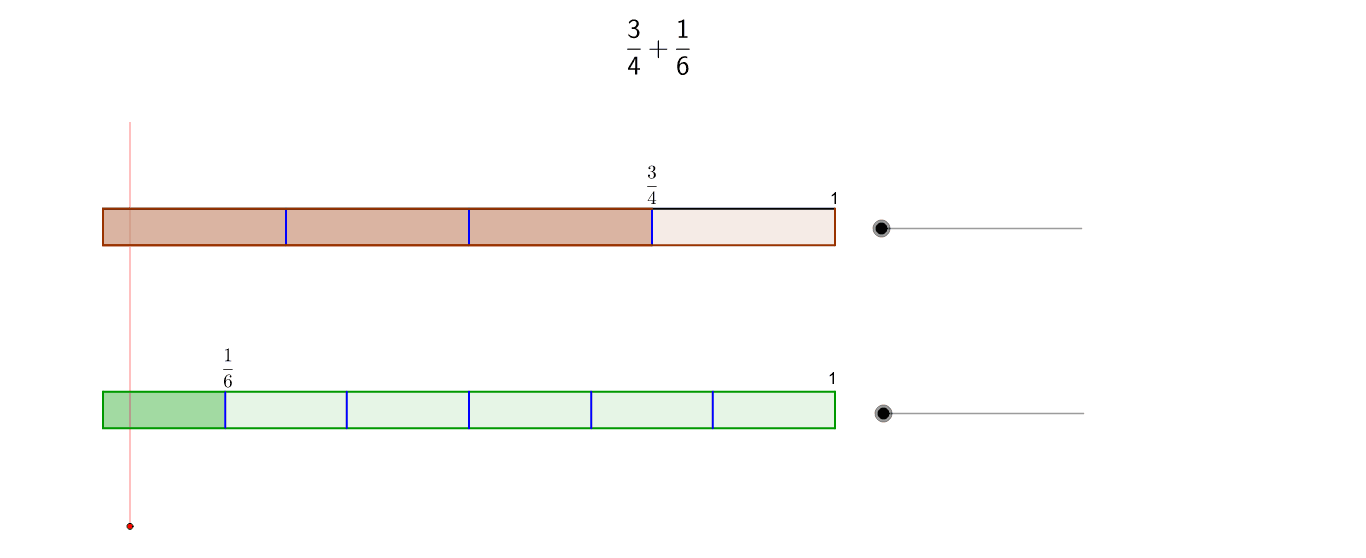
This example demonstrates the process of adding fractions with unlike denominators, visually illustrating the importance of finding a common denominator. It involves core math concepts such as fraction addition, finding a common unit, and the concept of equivalent fractions. The construction uses GeoGebra commands like Polygon, Segment, Point, and OrthogonalLine. Suitable for middle school mathematics education.
GeoGebra Commands & Parameters
Polygon(A, B, C, D) → poly1, a, b, c, dSegment(E, F) → eSegment(G, H) → gSegment(I, J) → hSegment(K, L) → iSegment(M, N) → jSegment(O, P) → kSegment(Q, R) → lPolygon(A_2, B_2, C_2, D_2) → poly2, a_2, b_2, c_2, d_2Segment(E_2, F_2) → f_1Segment(G_2, H_2) → g_1Segment(J_2, K_2) → h_1Segment(L_2, M_2) → i_1Segment(N_2, O_2) → j_1Segment(P_2, Q_2) → k_1Segment(R_2, S_2) → l_1Segment(T_2, U_2) → m_1Segment(V_2, W_2) → n_1Segment(Z_2, A_3) → r_1Segment(B_3, C_3) → s_1Segment(D_3, E_3) → t_1Segment(F_3, G_3) → e_2Segment(H_3, I_3) → f_2Segment(J_3, K_3) → g_2Segment(L_3, M_3) → h_2Segment(N_3, O_3) → i_2Segment(K_5, L_5) → mSegment(M_5, N_5) → nSegment(O_5, P_5) → pPoint(yAxis) → S_1OrthogonalLine(S_1, yAxis) → qPoint(q) → T_1OrthogonalLine(T_1, q) → rPoint(r) → U_1Segment(U_1, T_1) → sSegment(Q_5, R_5) → tSegment(S_5, T_5) → a_1Segment(U_5, V_5) → b_1Segment(W_5, Z_5) → c_1Segment(A_6, B_6) → d_1Polygon(A_2, J_2, K_2, D_2) → poly3, a_3, j_2, k_2, d_3Polygon(A, I, J, D) → poly4, a_4, i_3, j_3, d_4Segment(C_6, D_6) → e_1Segment(E_6, F_6) → l_2Segment(G_6, H_6) → m_2Segment(I_6, J_6) → n_2Segment(K_6, L_6) → r_2Segment(M_6, N_6) → s_2Segment(O_6, P_6) → t_2Segment(Q_6, R_6) → b_3Segment(S_6, T_6) → c_3Segment(U_6, V_6) → e_3Segment(W_6, Z_6) → f_3Segment(A_7, B_7) → g_3Segment(C_7, D_7) → h_3Segment(E_7, F_7) → k_3Segment(G_7, H_7) → l_3Segment(I_7, J_7) → m_3Segment(K_7, L_7) → n_3Segment(M_7, N_7) → q_3Segment(O_7, P_7) → r_3Segment(Q_7, R_7) → s_3Segment(S_7, T_7) → t_3Segment(U_7, V_7) → b_4Segment(W_7, Z_7) → c_4Segment(A_8, B_8) → e_4Segment(C_8, D_8) → f_4Segment(E_8, F_8) → g_4Segment(G_8, H_8) → h_4Segment(I_8, J_8) → i_4Segment(K_8, L_8) → j_4Segment(M_8, N_8) → k_4Segment(O_8, P_8) → l_4Segment(Q_8, R_8) → m_4Segment(S_8, T_8) → n_4Segment(U_8, V_8) → p_4Segment(W_8, Z_8) → q_4Segment(A_9, B_9) → r_4Segment(C_9, D_9) → s_4Segment(E_9, F_9) → t_4Segment(G_9, H_9) → a_5Segment(I_9, J_9) → b_5Segment(K_9, L_9) → c_5Segment(M_9, N_9) → d_5Segment(O_9, P_9) → e_5Segment(Q_9, R_9) → f_5Segment(S_9, T_9) → g_5Segment(U_9, V_9) → h_5Segment(W_9, Z_9) → i_5Segment(A_10, A_11) → j_5Segment(C_11, D_11) → k_5Segment(E_11, F_11) → l_5