
3D Vector and Line Construction
Loading the math board and drawing, please wait…
In collections
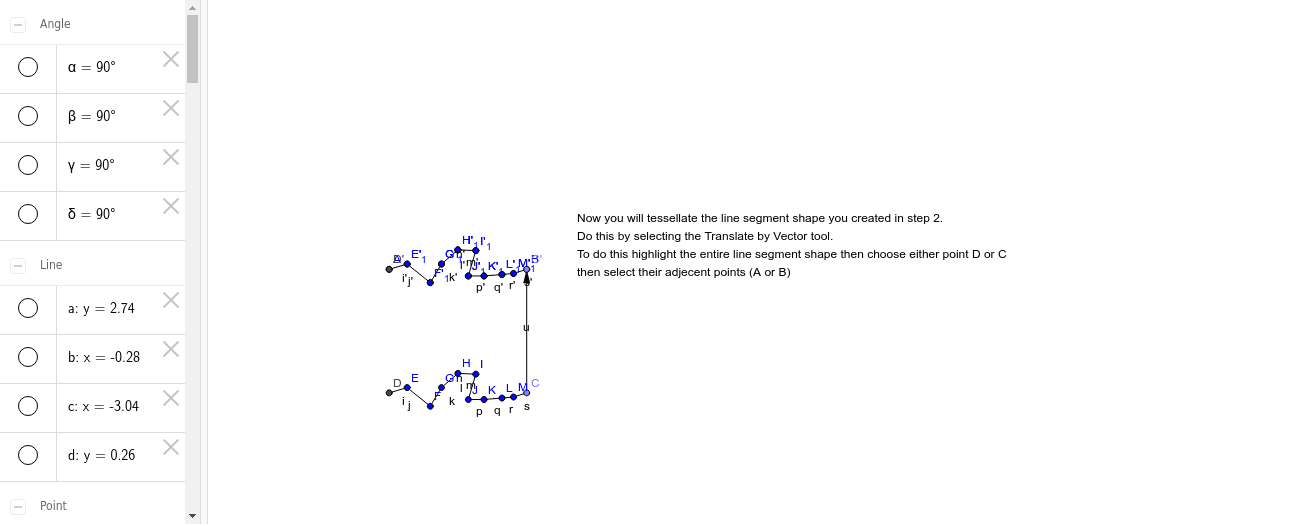
Phebe Tanner Translation Tessallation
This example demonstrates the construction of lines and vectors in 3D space. Key mathematical concepts include vectors and coordinate geometry. Using GeoGebra commands such as Line, OrthogonalLine, Point, Intersect, etc., one can construct lines and vectors in 3D space. Suitable for high school math education and learning 3D geometry.
GeoGebra Commands & Parameters
Line(A, B) → aOrthogonalLine(B, a) → bOrthogonalLine(A, a) → cPoint(b) → COrthogonalLine(C, c) → dIntersect(c, d) → DSegment(D, C) → eSegment(C, B) → fSegment(B, A) → gSegment(A, D) → hAngle(A, B, C) → αAngle(C, D, A) → βAngle(D, A, B) → γAngle(B, C, D) → δSegment(D, E) → iSegment(E, F) → jSegment(F, G) → kSegment(G, H) → lSegment(H, I) → mSegment(I, J) → nSegment(J, K) → pSegment(K, L) → qSegment(L, M) → rSegment(M, C) → sVector(C, B) → uTranslate(D, u) → D'Translate(E, u) → E'Segment(D', E') → i'Translate(E, u) → E'_1Translate(F, u) → F'Segment(E'_1, F') → j'Translate(F, u) → F'_1Translate(G, u) → G'Segment(F'_1, G') → k'Translate(G, u) → G'_1Translate(H, u) → H'Segment(G'_1, H') → l'Translate(H, u) → H'_1Translate(I, u) → I'Segment(H'_1, I') → m'Translate(I, u) → I'_1Translate(J, u) → J'Segment(I'_1, J') → n'Translate(J, u) → J'_1Translate(K, u) → K'Segment(J'_1, K') → p'Translate(K, u) → K'_1Translate(L, u) → L'Segment(K'_1, L') → q'Translate(L, u) → L'_1Translate(M, u) → M'Segment(L'_1, M') → r'Translate(M, u) → M'_1Translate(C, u) → C'Segment(M'_1, C') → s'
AI Drawing Prompt Reference
Construct a 3D vector and line in space. Start by creating points A and B, then create line a through A and B. Next, construct two orthogonal lines b and c to a, and create point C on b. Then, create line d through C and c, and find the intersection D of c and d. After that, create segments e from D to C, f from C to B, g from B to A, and h from A to D. Calculate angles α, β, γ, and δ. Continue by creating segments from D to E, E to F, F to G, G to H, H to I, I to J, J to K, K to L, L to M, and M to C. Finally, create vector u from C to B, and use u to translate D, E, F, G, H, I, J, K, L, M, and C to generate a series of new segments.
The prompt above was compiled from the original drawing commands and is for reference only.