
解线性不等式(进阶)
几何画板及绘图内容加载中,请稍等……
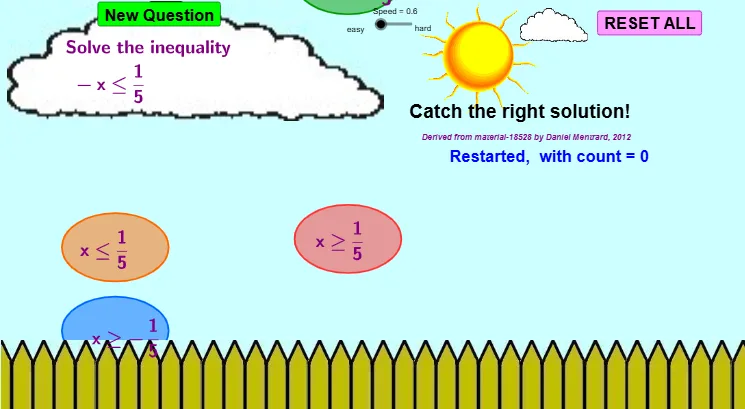
这是一个解线性不等式的进阶练习,不等式两边都有线性表达式。通过游戏形式进行,帮助学生掌握解线性不等式的技巧。使用了RandomElement, Random, If, Simplify等GeoGebra命令,适合初中高年级学生或数学爱好者。
GeoGebra 命令及参数
RandomElement(listcoeffA1C1) → linel3coeffxRandomElement({1, 2, 1, 3, 1, 5, 1}) → ansvaldenomRandom(-5, 7) → ansvalnumRandomElement({-3, -2, -1, 2, 3, 4, 5}) → factoraIf(abs((answervalue * factora)) - floor(abs((answervalue * factora))) ≟ 0, RandomElement[listcoeffB1] - (answervalue * factora), RandomElement[listcoeffB1]) → linel3constIf(Length[Coefficients[A12]] ≟ 1, {0, Element[Coefficients[A12], 1]}, Coefficients[A12]) → listcoeffA10If(Element[listcoeffA10, 1] ≟ 0 ∨ Element[listcoeffA10, 2] ≟ 0, 1, GCD[{Element[listcoeffA10, 1], Element[listcoeffA10, 2]}]) → A10coeffHCFSimplify(x - x + ((answervalue * factora) * ansvaldenom)) → C16Coefficients(C12) → listcoeffC10RandomElement(Join[{Remove[{-1, 1}, {If[Element[listcoeffC10, 1] < 0 ∧ Element[listcoeffC10, 2] < 0 ∨ Element[listcoeffC10, 1] < 0, -1, 1]}], {If[Element[listcoeffC10, 1] < 0 ∧ Element[listcoeffC10, 2] < 0 ∨ Element[listcoeffC10, 1] < 0, -1, 1]}}]) → C9coeffouterIf(Element[listcoeffC10, 1] ≟ 0 ∨ Element[listcoeffC10, 2] ≟ 0, 1, (GCD[Element[listcoeffC10, 1], Element[listcoeffC10, 2]] * C9coeffouter)) → C10coeffHCFRandom(1, 4) → SelectedIneqListIndexNumRandom(1, 4) → rrRandom(1, 10) → bbRandom(1, 10) → ccIf(texte1 ≟ "" + dd, 1, 0) → vraiIf(t > -4.9, Random[1, 4] + 0, Random[1, 4]) → iIf(rr ≟ 1, A, If[rr ≟ 2, B, If[rr ≟ 3, C, D]]) → MIf(rr ≟ 1, B, If[rr ≟ 2, C, If[rr ≟ 3, D, A]]) → NIf(rr ≟ 1, C, If[rr ≟ 2, D, If[rr ≟ 3, A, B]]) → PIf(rr ≟ 1, D, If[rr ≟ 2, A, If[rr ≟ 3, B, C]]) → QIf(factora < 0, If[SelectedIneqListIndexNum < 2, 2, If[SelectedIneqListIndexNum > 3, 3, If[SelectedIneqListIndexNum < 3, 1, 4]]], SelectedIneqListIndexNum) → DisplayIneqListIndexNumIf(SelectedIneqListIndexNum > 2, If[SelectedIneqListIndexNum > 3, 3, 4], If[SelectedIneqListIndexNum < 2, 2, 1]) → distractor1symbolIndexSimplify(g(x) / factora) → g_0RandomElement({1, 1, -1, 1, 2, 1, 2, 1, 3, 1, 3, 1, 4, 1, 5, 1, -2}) → K1RandomElement({1, RandomElement[{2, 3, -2, -3}]}) → M1RandomElement(listcoeffB1) → B1Random(-15, 15) → D1RandomElement({0, 1, 2, 3, RandomElement[Remove[listcoeffA1C1, {Element[listcoeffB1, IndexOf[B1, listcoeffB1]]}]]}) → A1RandomElement(Remove[listcoeffA1C1, {A1, Element[listcoeffB1, IndexOf[B1, listcoeffB1]]}]) → C1Coefficients(A4) → line2leftcoeffCoefficients(C4) → line2rightcoeffSimplify(A4) → A5Simplify(C4) → C5Simplify(A6) → A7If(C5(3) ≟ C5(0), C5(0) - A5(0), C5(0) - A5(0) - C5(0) - A5(0)) → C5(0)Simplify(C6) → C7Text(Element[ListIneqSymGenerated, SelectedIneqListIndexNum]) → B20FractionText(factora) → D20Simplify(x - x + answervalue) → C20RandomElement(listcoeffB1) → linel2const2If(factora < 0, Element[ListIneqSymGeneratedNegative, SelectedIneqListIndexNum], Element[ListIneqSymGenerated, SelectedIneqListIndexNum]) → B16FractionText(answervalue) → E20Ellipse(A - (circleradius, 0), A + (circleradius, 0), A + ((circleradius * ellipseaxisfactor), 0)) → cEllipse(B - (circleradius, 0), B + (circleradius, 0), B + ((circleradius * ellipseaxisfactor), 0)) → kEllipse(D - (circleradius, 0), D + (circleradius, 0), D + ((circleradius * ellipseaxisfactor), 0)) → qEllipse(C - (circleradius, 0), C + (circleradius, 0), C + ((circleradius * ellipseaxisfactor), 0)) → r
AI 绘图提示语参考
绘制一个坐标几何图形,展示线性不等式的解法。包含两条直线和不等式符号,通过滑块控制参数变化,并用随机生成的数值和表达式展示解题过程。先画出两条直线,再根据不等式符号填充区域,最后用椭圆和文本标注关键点和参数值。
以上提示语为根据原始绘图命令整理而来,仅供参考。