
混合数字与十进制数字转换的GeoGebra教学范例
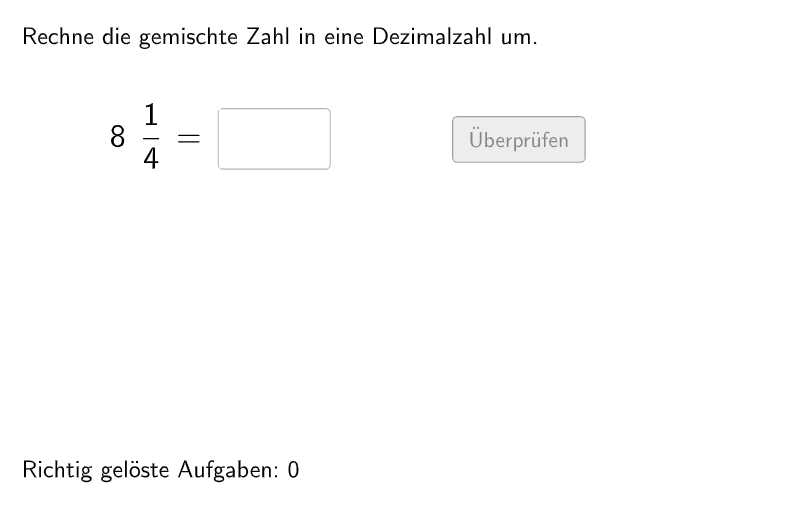
几何画板及绘图内容加载中,请稍等……
所属专题
Wiederholung II: Erweitern & Kürzen, Darstellungsarten
Bruchzahlen in endliche Dezimalzahlen umrechnen
该范例演示了如何将分数转换为十进制数字,并展示其转换过程。核心数学概念包括有理数的表示与转换,涉及分数、十进制、循环小数等。作图要点包括使用GeoGebra命令如Sequence、Element、Zip、Shuffle等来生成随机数字和输入框。适合小学五年级至六年级学生,用于数学教学和练习。
GeoGebra 命令及参数
Sequence(Random[1, 9], m, 1, 110) → randomNosForNK1, {2, 6, 2, 6, 3, 9, 6, 7, 6, 1, 4, 2, 9, 2, 3, 7, 2, 4, 5, 3, 7, 1, 8, 6, 7, 3, 9, 2, 4, 5, 5, 5, 6, 9, 3, 8, 8, 2, 5, 7, 1, 7, 9, 8, 9, 3, 1, 9, 7, 5, 5, 4, 7, 5, 5, 2, 1, 8, 1, 1, 7, 3, 5, 1, 3, 2, 1, 7, 6, 9, 5, 5, 7, 6, 1, 2, 9, 7, 2, 9, 6, 6, 6, 9, 6, 7, 9, 2, 7, 7, 9, 8, 1, 3, 2, 1, 7, 4, 5, 3, 9, 5, 4, 5, 2, 9, 1, 8, 6, 6}Element(randomNosForNK1, Mod[questionCount, 100] + 1) → numK1Element(randomNosForNK1, Mod[questionCount, 100] + 1) → d1Sequence(Random[1, 3], m, 1, 110) → listNKstellen, {1, 1, 2, 3, 3, 1, 2, 1, 3, 1, 3, 2, 1, 3, 1, 2, 2, 1, 3, 1, 1, 3, 3, 1, 1, 3, 1, 2, 3, 2, 2, 2, 1, 1, 1, 1, 2, 3, 1, 2, 2, 1, 1, 1, 1, 2, 1, 1, 2, 3, 1, 1, 1, 3, 1, 3, 2, 3, 3, 2, 2, 3, 2, 1, 3, 1, 3, 1, 2, 1, 1, 2, 3, 2, 1, 1, 1, 1, 1, 1, 2, 2, 2, 2, 1, 2, 2, 2, 2, 3, 1, 3, 2, 3, 2, 2, 3, 2, 1, 3, 1, 3, 1, 3, 2, 3, 1, 3, 3, 2}Zip(Random[If[m ∈ {1, 2}, 0, 1], If[m ∈ {1, 2}, 0, 9]], m, listNKstellen) → randomNosForNK3Element(randomNosForNK3, Mod[questionCount, 100] + 1) → numK3Element(randomNosForNK3, Mod[questionCount, 100] + 1) → d3Zip(Random[If[m ∈ {1, 3}, 0, 1], If[m ≟ 1, 0, 9]], m, listNKstellen) → randomNosForNK2Element(randomNosForNK2, Mod[questionCount, 100] + 1) → numK2Element(randomNosForNK2, Mod[questionCount, 100] + 1) → d2Shuffle(Sequence[Random[1, 9], i, 1, 100]) → randomNosForX1, {8, 4, 7, 8, 6, 2, 1, 8, 7, 6, 7, 7, 1, 8, 6, 8, 1, 7, 2, 8, 6, 2, 1, 2, 4, 5, 8, 5, 3, 7, 4, 6, 3, 9, 3, 4, 9, 3, 2, 3, 1, 4, 2, 1, 8, 6, 8, 9, 4, 7, 6, 5, 3, 4, 1, 3, 9, 4, 3, 6, 2, 6, 2, 3, 8, 5, 8, 3, 5, 8, 1, 7, 1, 9, 3, 6, 6, 5, 6, 4, 8, 9, 1, 5, 2, 3, 5, 3, 8, 9, 8, 5, 7, 3, 7, 4, 3, 6, 1, 2}Element(randomNosForX1, Mod[questionCount, 100] + 1) → numX1Element(randomNosForX1, Mod[questionCount, 100] + 1) → d0Textfield(input0) → InputBox0Textfield(input1) → InputBox1Textfield(input2) → InputBox2Textfield(input3) → InputBox3Sequence(RandomElement[{2, 4, 5, 8, 10, 20, 25, 100}], m, 1, 100) → randomNosForB, {4, 100, 10, 5, 10, 20, 100, 4, 4, 25, 25, 5, 5, 10, 25, 20, 8, 4, 8, 5, 2, 5, 4, 25, 10, 25, 4, 100, 100, 25, 2, 20, 100, 8, 2, 4, 4, 5, 10, 8, 2, 8, 10, 100, 10, 4, 2, 20, 5, 100, 100, 25, 20, 4, 2, 10, 25, 8, 10, 4, 4, 2, 100, 2, 10, 10, 8, 25, 2, 100, 4, 5, 2, 10, 10, 10, 4, 4, 100, 100, 2, 8, 20, 20, 20, 8, 10, 10, 8, 8, 25, 100, 2, 4, 100, 20, 100, 100, 5, 25}Sequence(1, 99, 1) → poss100Zip(RandomElement[listPossiblesA(IndexOf[m, listPossiblesB])], m, randomNosForB) → randomNosForAElement(randomNosForB, Mod[questionCount, 100] + 1) → numBElement(randomNosForA, Mod[questionCount, 100] + 1) → numAShuffle(Sequence[Random[1, 99], i, 1, 100]) → randomNosForX, {94, 83, 9, 80, 73, 8, 69, 87, 92, 17, 31, 17, 82, 27, 64, 18, 65, 53, 11, 74, 91, 4, 27, 10, 63, 66, 85, 65, 73, 86, 49, 12, 73, 81, 55, 48, 56, 2, 60, 74, 79, 63, 68, 48, 70, 82, 46, 76, 11, 63, 6, 31, 37, 19, 83, 19, 76, 99, 6, 6, 38, 23, 47, 8, 96, 81, 25, 52, 2, 33, 91, 86, 29, 96, 97, 68, 91, 64, 43, 21, 99, 91, 13, 49, 11, 33, 18, 82, 64, 79, 77, 83, 88, 47, 31, 63, 21, 92, 1, 76}Corner(zahlText, 3) → CornerIf(format ≟ 1, correct1 ∧ correctg, correct2) → correctPolygon(PtopLeftCornerFeedback, PtopRightCornerFeedback, PbottomRightCornerFeedback, PbottomLeftCornerFeedback) → rectangleCorrect, ptopleftcornerfeedback, ptoprightcornerfeedback, pbottomrightcornerfeedback, pbottomleftcornerfeedbackDenominator(dez) → nennerSegment(Corner + (0.82, -0.3), Corner + (1.75, -0.3)) → bruchstrichNumberSeparationComma(10^(nkstellen)) → Text8