
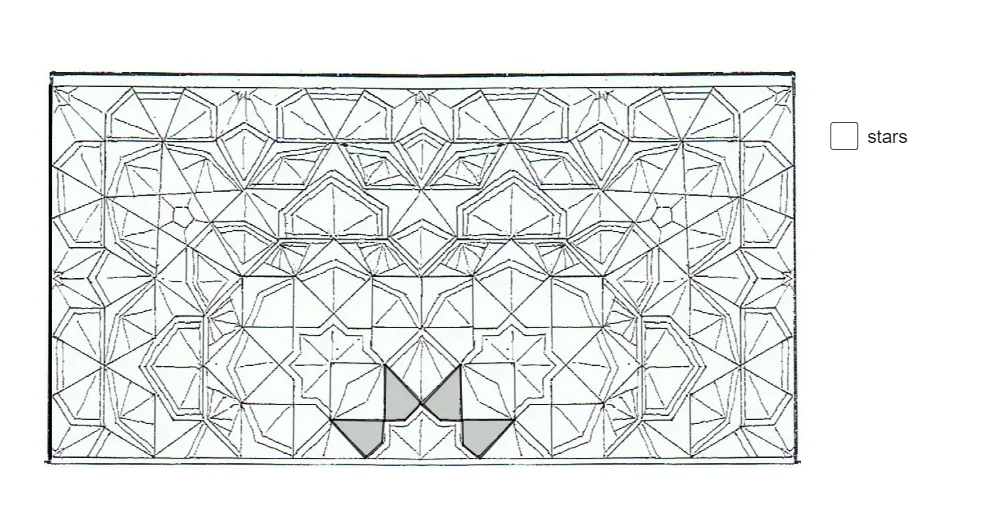
Kayseri-Sahibiye清真寺几何构造 by chris cambré
几何画板及绘图内容加载中,请稍等……
①本范例演示了Kayseri-Sahibiye清真寺的几何构造过程;②涉及的核心数学概念包括多边形、向量、变换和几何作图;③作图要点:使用Point, ConstructionStep, Polygon, Segment, Intersect, Mirror, Vector, Translate等GeoGebra命令和对象进行构造;④适合高中阶段学生学习和理解几何作图方法。
GeoGebra 命令及参数
Point(xAxis) → AConstructionStep() → stapPoint(xAxis) → BPolygon(A, B, C, D) → vierhoek1, a, b, c, dPoint(yAxis) → ESegment(E, F) → fIntersect(a, f) → GPoint(c) → H_1Segment(H_1, G) → sSegment(D, G) → gIntersect(c, f) → HSegment(A, H) → hPoint(d) → ISegment(I, J) → iPoint(c) → KPoint(a) → LSegment(K, L) → jMirror(G, g) → G'Intersect(g, h) → NPoint(d) → PPoint(b) → MSegment(J, M) → kPoint(c) → OPoint(a) → RSegment(O, R) → lSegment(I, K) → mSegment(K, J) → pSegment(I, L) → qSegment(L, J) → nSegment(L, J) → rMirror(afbeelding5, yAxis) → afbeelding5'Point(a) → I_1Point(s) → M_1Polygon(I_1, J_1, R_1, S_1, T_1, U_1, V_1, W_1, K_1, L_1, M_1, N_1, O_1, P_1, Q_1, E_1) → veelhoek1, t, m_1, n_1, p_1, q_1, r_1, s_1, t_1, e, f_1, g_1, h_1, i_1, j_1, k_1, l_1Polygon(A_2, B_2, C_2, D_2, E_2, F_2, G_2, H_2, I_2, J_2) → veelhoek2, a_2, j_2, b_2, c_2, d_2, e_2, f_2, g_2, h_2, i_2Mirror(A_2, yAxis) → K_2Mirror(B_2, yAxis) → L_2Mirror(C_2, yAxis) → M_2Mirror(D_2, yAxis) → N_2Mirror(E_2, yAxis) → O_2Mirror(F_2, yAxis) → P_2Mirror(G_2, yAxis) → Q_2Mirror(H_2, yAxis) → R_2Mirror(I_2, yAxis) → S_2Mirror(J_2, yAxis) → T_2Polygon(K_2, L_2, M_2, N_2, O_2, P_2, Q_2, R_2, S_2, T_2) → veelhoek2', k_2, t_2, l_2, m_2, n_2, o_2, p_2, q_2, r_2, s_2Polygon(U_2, V_2, W_2, Z_2, A_3, B_3, C_3) → veelhoek3, u_2, v_2, w_2, z_2, a_3, b_3, c_3Vector(D_3, E_3) → uTranslate(U_2, u) → F_3Translate(V_2, u) → G_3Translate(W_2, u) → H_3Translate(Z_2, u) → I_3Translate(A_3, u) → J_3Translate(B_3, u) → K_3Translate(C_3, u) → L_3Polygon(F_3, G_3, H_3, I_3, J_3, K_3, L_3) → veelhoek3', f_3, g_3, h_3, i_3, j_3, k_3, l_3Translate(U_2, Vector[(-u)]) → M_3Translate(V_2, Vector[(-u)]) → N_3Translate(W_2, Vector[(-u)]) → O_3Translate(Z_2, Vector[(-u)]) → P_3Translate(A_3, Vector[(-u)]) → Q_3Translate(B_3, Vector[(-u)]) → R_3Translate(C_3, Vector[(-u)]) → S_3Polygon(M_3, N_3, O_3, P_3, Q_3, R_3, S_3) → veelhoek3'_1, m_3, n_3, o_3, p_3, q_3, r_3, s_3