
交点30
几何画板及绘图内容加载中,请稍等……
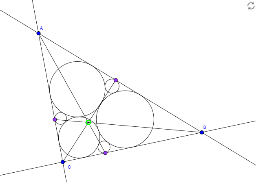
该范例展示了如何通过几何作图方法找到两条直线的交点。涉及的核心数学概念包括直线方程和向量。通过使用GeoGebra命令如Line, Intersect, Mirror等,可以直观地理解交点的几何意义。适合高中数学教学和学习。
GeoGebra 命令及参数
Line(A, B) → aAngularBisector(B, C, A) → fAngularBisector(C, A, B) → dAngularBisector(A, B, C) → eIntersect(d, e) → DAngularBisector(C, A, D) → gAngularBisector(D, C, A) → hIntersect(g, h) → EAngularBisector(D, A, B) → jAngularBisector(D, B, A) → lIntersect(j, l) → GSegment(E, G) → tMirror(d, t) → d'AngularBisector(B, C, D) → nAngularBisector(D, B, C) → qIntersect(n, q) → ISegment(I, G) → b_1Mirror(e, b_1) → e'Intersect(d', e') → OLine(B, C) → bOrthogonalLine(I, b) → rIntersect(b, r) → JAngularBisector(O, J, C) → i_1Intersect(i_1, f) → TOrthogonalLine(T, b) → j_1Intersect(b, j_1) → UCircle(T, U) → p_1AngularBisector(O, J, B) → g_1Intersect(e, g_1) → ROrthogonalLine(R, a) → h_1Intersect(a, h_1) → SCircle(R, S) → k_1Intersect(p_1, k_1) → V, , ,OrthogonalLine(V, b) → l_1Intersect(b, l_1) → WMidpoint(V, W) → B_1Circle(V, W) → q_1Intersect(k_1, q_1) → Z, A_1, ,Line(A_1, Z) → m_1Line(B_1, m_1) → n_1Dilate(q_1, 0.5, W) → r_1Intersect(r_1, n_1) → C_1, D_1Mirror(r_1, D_1) → s_1Mirror(s_1, q_1) → t_1Intersect(t_1, b) → D_2,Line(C, A) → cOrthogonalLine(E, c) → iIntersect(c, i) → FAngularBisector(O, F, A) → c_1Intersect(d, c_1) → POrthogonalLine(P, a) → e_1Intersect(a, e_1) → QCircle(P, Q) → f_1Intersect(f_1, k_1, 1) → L_1OrthogonalLine(L_1, a) → h_2Intersect(a, h_2) → M_1Circle(L_1, M_1) → k_2Intersect(k_2, f_1) → O_1, P_1, ,Line(P_1, O_1) → i_2Midpoint(M_1, L_1) → N_1Line(N_1, i_2) → j_2Circle(N_1, M_1) → p_2Intersect(p_2, j_2) → Q_1, R_1Mirror(p_2, Q_1) → q_2Mirror(q_2, k_2) → r_2Intersect(r_2, a) → B_2,Circle(E, F) → kOrthogonalLine(G, a) → mIntersect(a, m) → HCircle(G, H) → pCircle(I, J) → sIntersect(k, d) → K, NIntersect(p, d) → L, MSegment(E, I) → a_1Mirror(f, a_1) → f'AngularBisector(A, H, O) → d_1Intersect(f_1, p_1, 1) → E_1OrthogonalLine(E_1, c) → a_2Intersect(c, a_2) → F_1Midpoint(F_1, E_1) → G_1Circle(G_1, F_1) → c_2Circle(E_1, F_1) → d_2Intersect(f_1, d_2) → H_1, I_1, ,Line(I_1, H_1) → b_2Line(G_1, b_2) → e_2Intersect(c_2, e_2) → J_1, K_1Mirror(c_2, J_1) → f_2Mirror(f_2, d_2) → g_2Center(f_1) → S_1Center(p_1) → T_1Center(k_1) → U_1Center(r_2) → V_1Center(g_2) → W_1Center(t_1) → Z_1Segment(C, B_2) → m_2Segment(D_2, A) → l_2Intersect(l_2, m_2) → A_2Intersect(g_2, c) → C_2,Segment(C_2, B) → n_2