
找等价分数互动练习
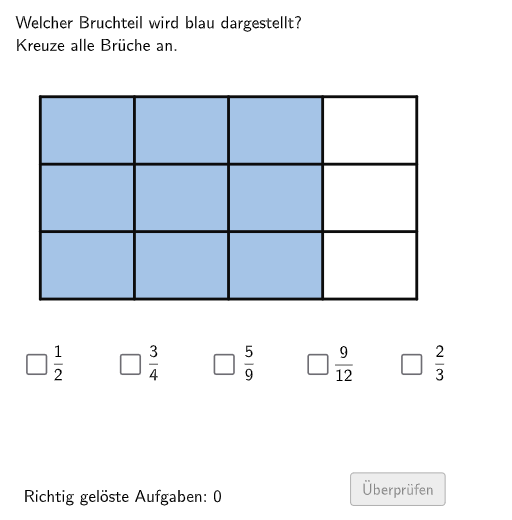
几何画板及绘图内容加载中,请稍等……
本范例通过互动方式让学生练习寻找等价分数。①演示内容:学生需要在圆形(饼图)模型中找到与给定分数等价的分数,通过旋转、分割圆面来观察分数大小的变化。②核心数学概念:分数的等价关系、分数的扩展与约分、分子分母同乘同除商不变的性质。③作图要点:使用Circle命令绘制多个圆形表示分数单位,用CircleSector命令将圆分割成不同等份展示分数,用Rotate命令实现分数图形的旋转动画,Sequence命令生成序列化的分数表示,RandomElement随机生成练习题目,Textfield与CountIf实现答案判断与反馈功能。④适合学段:五年级至六年级,可用于分数概念教学、分数等价关系探究、或作为课后巩固练习。
GeoGebra 命令及参数
Join(Sequence[Shuffle[{2, 3}], i, 1, 50]) → ListeAnzahlRichtigeElement(ListeAnzahlRichtige, questionCount) → AnzahlrichtigJoin(Sequence[Shuffle[{1, 2, 3, 4}], i, 1, 20]) → ListeBrücheElement(ListeBrüche, questionCount) → bruchteilIf(bruchteil ≟ 1, M13, If[bruchteil ≟ 2, M14, If[bruchteil ≟ 3, M23, If[bruchteil ≟ 4, M34]]]) → MElement(ListeNennerGross, If[Anzahlrichtig ≟ 3, 1, 2]) → nennergrossIf(M13 ≟ M ∨ M ≟ M23, 3, 4) → rechteckyCircle(A, 2) → cElement(ListeZählerGross, If[Anzahlrichtig ≟ 3, 1, 2]) → zählergrossRotate(A1, ((-2 * pi / 360) * bruchwinkel), A) → A2Rotate(A2, ((-2 * pi / 360) * bruchwinkel), A) → A3Rotate(A3, ((-2 * pi / 360) * bruchwinkel), A) → A4Rotate(A4, ((-2 * pi / 360) * bruchwinkel), A) → A5Rotate(A5, ((-2 * pi / 360) * bruchwinkel), A) → A6Rotate(A6, ((-2 * pi / 360) * bruchwinkel), A) → A7Rotate(A7, ((-2 * pi / 360) * bruchwinkel), A) → A8Rotate(A8, ((-2 * pi / 360) * bruchwinkel), A) → A9Rotate(A9, ((-2 * pi / 360) * bruchwinkel), A) → A10Rotate(A10, ((-2 * pi / 360) * bruchwinkel), A) → A11Rotate(A11, ((-2 * pi / 360) * bruchwinkel), A) → A12Rotate(A12, ((-2 * pi / 360) * bruchwinkel), A) → A13Rotate(A13, ((-2 * pi / 360) * bruchwinkel), A) → A14Rotate(A14, ((-2 * pi / 360) * bruchwinkel), A) → A15Rotate(A15, ((-2 * pi / 360) * bruchwinkel), A) → A16Join(Sequence[Shuffle[{1, 2}], i, 1, 1]) → ListeLayout1Join(Sequence[Shuffle[{1, 2, 3}], i, 1, 33]) → ListeLayout2Join({ListeLayout1, {3}, ListeLayout2}) → ListeLayoutJoin(Sequence[Shuffle[{1, 2, 3, 4, 5}], i, 1, 20]) → ListePositionSequence(1, Anzahlrichtig, 1) → ListeRichtigSequence(Anzahlrichtig + 1, 5, 1) → ListeFalschElement(ListePosition, questionCount) → pos1RandomElement({1, 2, 3, 4, 5} \ {pos1}) → pos2RandomElement({1, 2, 3, 4, 5} \ {pos1, pos2}) → pos3RandomElement({1, 2, 3, 4, 5} \ {pos1, pos2, pos3}) → pos4RandomElement({1, 2, 3, 4, 5} \ {pos4, pos3, pos2, pos1}) → pos5CountIf(x ≟ true, ListeCorrect) → AnzahlEingabeIf(Anzahlrichtig ≟ 3, 2, 4) → bruchnennerIf(Anzahlrichtig ≟ 3, 1, 3) → bruchzählerElement(M, 5, bruchzähler) → zeElement(M, 4, bruchzähler) → zdElement(M, 3, bruchzähler) → zcElement(M, 2, bruchzähler) → zbElement(M, 1, bruchzähler) → zaTextfield(aInput) → InputBox1Textfield(bInput) → InputBox2Polygon(PF13, PF14, PF11, PF12) → rectangleCorrect1, ptopleftcornerfeedback, ptoprightcornerfeedback, pbottomrightcornerfeedback, pbottomleftcornerfeedbackElement(ListeLayout, questionCount) → layoutRandomElement(ListeRichtig) → UnterteilungElement(M, Unterteilung, bruchnenner) → nennerSegment(A, A1) → a1Segment(A, A2) → a2Segment(A, A3) → a3Segment(A, A4) → a4Segment(A, A5) → a5Segment(A, A6) → a6Segment(A, A7) → a7Segment(A, A8) → a8Segment(A, A9) → a9Segment(A, A10) → a10Segment(A, A11) → a11Segment(A, A12) → a12Segment(A, A13) → a13Segment(A, A14) → a14Segment(A, A15) → a15Segment(A, A16) → a16Element(M, Unterteilung, bruchzähler) → zählerElement(KreisPunkte, zählergross + 1) → APCircleSector(A, AP, A1) → dPolygon(B1, B2, B3, B4) → Streifen, b1, b2, b3, b4Polygon(B1, BP1, BP2, B4) → StreifenP, bp3, bp1, bp2, bp4Polygon(C1, C2, C3, C4) → Rechteck, c1, c2, c3, c4Polygon(C1, CP1, CP2, CP3) → ReckteckP, cp4, cp1, cp2, cp3Element(M, 1, bruchnenner) → naElement(M, 2, bruchnenner) → nbElement(M, 3, bruchnenner) → ncElement(M, 4, bruchnenner) → aElement(M, 4, bruchnenner) → ndElement(M, 5, bruchnenner) → neElement(ListeZähler, pos1) → z1Element(ListeZähler, pos2) → z2Element(ListeZähler, pos3) → z3Element(ListeZähler, pos4) → z4Element(ListeZähler, pos5) → z5Element(ListeNenner, pos1) → n1Element(ListeNenner, pos2) → n2Element(ListeNenner, pos3) → n3Element(ListeNenner, pos4) → n4Element(ListeNenner, pos5) → n5Polygon(PF23, PF24, PF21, PF22) → rectangleCorrect2, pf23, pf24, pf21, pf22Polygon(PF43, PF44, PF41, PF42) → rectangleCorrect4, pf43, pf44, pf41, pf42Polygon(PF53, PF54, PF51, PF52) → rectangleCorrect5, pf53, pf54, pf51, pf52Polygon(PF33, PF34, PF31, PF32) → rectangleCorrect3, pf33, pf34, pf31, pf32Polygon(E1, E2, E3, E4) → v1, e1, e2, e3, e4Sequence(Segment[B1 + ((i / nennergross * länge), 0), B4 + ((i / nennergross * länge), 0)], i, 1, nennergross - 1) → BalkenStreifenySequence(Segment[C1 + ((i / rechtecky * länge), 0), C4 + ((i / rechtecky * länge), 0)], i, 1, rechtecky - 1) → RechteckStreifenySequence(Segment[C1 - (0, (i / rechteckx * breite3)), C2 - (0, (i / rechteckx * breite3))], i, 1, rechteckx - 1) → ReckteckStreifenxIf(M ≟ M13 ∨ M ≟ M23, 3, 4) → bIf(pos3 ∈ ListeRichtig ∧ tick3 ∧ pos4 ∈ ListeRichtig ∧ tick4 ∧ pos5 ∈ ListeRichtig ∧ tick5, pos1 ∈ ListeRichtig ∧ (tick1 * pos2) ∈ ListeRichtig ∧ tick2) → e