
探索缩放面积计算:几何图形面积与缩放比例的关系
几何画板及绘图内容加载中,请稍等……
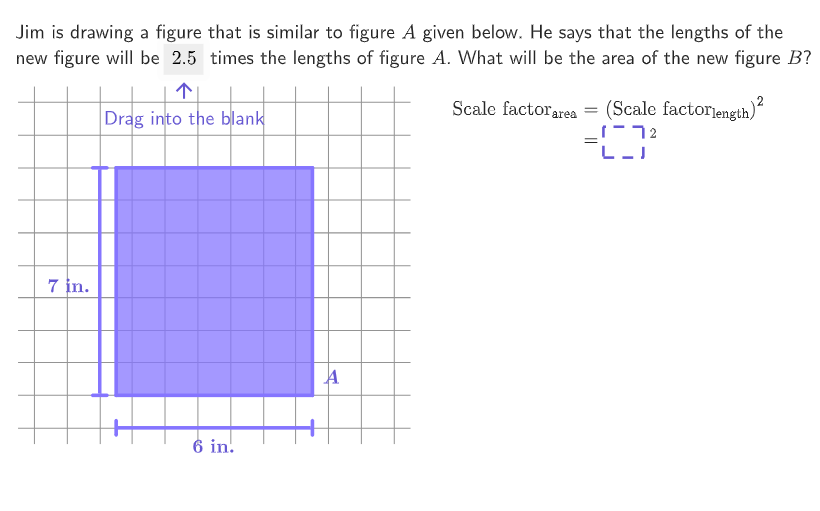
这个范例演示了如何通过缩放比例来计算相似几何图形的面积变化。核心数学概念是面积与长度比例的平方关系。作图要点包括使用GeoGebra命令如Dilate、Scale、Polygon等来构造图形并观察面积变化。适合6-8年级学生用于理解面积缩放规律和解决相关数学问题。
GeoGebra 命令及参数
Shuffle(Sequence[1.5, 4, 0.5]) → l3, {2, 1.5, 3.5, 4, 2.5, 3}RandomUniform(0, 0.99, 200) → allRandomSeeds, {0.4685917812681518, 0.2012505003582646, 0.6861007067706905, 0.7399771036234561, 0.5591575070748879, 0.967307700310622, 0.3344672936141103, 0.8943741054129235, 0.12411893941661649, 0.7283439071931139, 0.7134459892295615, 0.7864478715997133, 0.9203324373289585, 0.1595312876003502, 0.43681860632545055, 0.6994790703703223, 0.35134653522982107, 0.5499721830362213, 0.9103485558805878, 0.5510033577989492, 0.6048676903862722, 0.5921390587985159, 0.7575876936910675, 0.05148036983408587, 0.793971967693963, 0.5540596716554305, 0.891436020368879, 0.3535190718641712, 0.44072196148771203, 0.3514492629118613, 0.82436585781155, 0.9429187897321395, 0.3386509145000225, 0.7112784119856784, 0.8153699003646058, 0.4781662692300122, 0.3705666897088904, 0.3422407906584341, 0.9440256570602621, 0.6450974429490559, 0.8703053441786598, 0.06124564842870794, 0.2415903308836257, 0.6281885189314631, 0.7414298021768069, 0.9384110406963908, 0.06574970893159936, 0.06938401378860264, 0.2924214477922616, 0.8760696682306596, 0.03954061461394963, 0.3995009827943604, 0.2166533170231289, 0.16002467049332267, 0.4960506552064089, 0.25606597099571166, 0.7263603252086491, 0.6237043253953077, 0.4087702786910239, 0.5449482089518884, 0.012938305789364737, 0.3879643307453672, 0.2729316245682983, 0.25134493768203625, 0.6312054005845202, 0.1510736469292123, 0.1958145734453649, 0.09855642334518795, 0.6527504098920882, 0.1848942204047093, 0.7838347169781993, 0.9705559381185194, 0.22316963074146184, 0.32442712428701687, 0.9612493849845878, 0.516616291802054, 0.43985969953039983, 0.5087474800879143, 0.03952670479549401, 0.09319762860231386, 0.321086163891386, 0.20188696041989657, 0.687819593022338, 0.5199320847192918, 0.16328797375481313, 0.4024483863169672, 0.6735698216285801, 0.9028593577547502, 0.7320058148132909, 0.16064779415856115, 0.8780396171578498, 0.21907307679728905, 0.9624372384472262, 0.06108004719424442, 0.6045265019798202, 0.8126309790558239, 0.5784247115191367, 0.7787902977270894, 0.5471642789076123, 0.6819632982542471, 0.35367240929864446, 0.7152089086388086, 0.8755461713260696, 0.8040814306216163, 0.24616569341690553, 0.39916919124722483, 0.3649287300689395, 0.20064543308825267, 0.5761322789533799, 0.9165767201527276, 0.09348280955430642, 0.03539195339759896, 0.9194368823933075, 0.49033690037968636, 0.8469557001102006, 0.6415548849256614, 0.10204144873087889, 0.9398709520735944, 0.5771914685303815, 0.5117299849024585, 0.8870906011400892, 0.44696360011614766, 0.5242284959962898, 0.8811398281521996, 0.7842973452307263, 0.5317847484703585, 0.09215238558358689, 0.42844941529352387, 0.9216066723606151, 0.3497146717144147, 0.2665282653067051, 0.11616331649777815, 0.0016052508902960616, 0.23607713472388178, 0.7160710728390852, 0.585203545307498, 0.5898226462143195, 0.7520464854401782, 0.38323387491799965, 0.4255234659254453, 0.7689350926207821, 0.930844704094749, 0.29760263324892866, 0.006556263197856094, 0.271935439576263, 0.6888815287317953, 0.14238311526199024, 0.18792723078986093, 0.7585733085230425, 0.4217152294049767, 0.5278491479464251, 0.7121776990857893, 0.15279685333256798, 0.29962359329745786, 0.6863930882344745, 0.8972542548084345, 0.6245432196377763, 0.04217482982026742, 0.5517781128598126, 0.24721010250437642, 0.5670270898613022, 0.8454743136759684, 0.6903388944499601, 0.664946396947328, 0.0006673668768865537, 0.7997389544575821, 0.7342106880731758, 0.3308899433902417, 0.40696933438164323, 0.09851157161646086, 0.09618863281472143, 0.4162588900641588, 0.2800452917230724, 0.5341786431549556, 0.852528114050382, 0.8290122699693009, 0.4500090428760303, 0.13749111044081402, 0.7738932011473344, 0.5247092266066127, 0.8612201397076797, 0.8315125842909481, 0.005744564012955949, 0.9733229918674869, 0.8892812731829061, 0.28283196963306345, 0.13772941976816616, 0.5265595595590833, 0.5438075726299297, 0.014976216084488231, 0.8270951775196388, 0.2984253948078233, 0.41928939954568645, 0.6207469436741405, 0.7237949889151893, 0.944668602295427, 0.16386022838213452, 0.2616786936815658, 0.04478740439312818, 0.9242865035922172}Corner(5) → AppSizePolygon({(-1.5, -0.5), (10.5, -0.5), (10.5, 10.5), (-1.5, 10.5)}) → graphWinTake(allRandomSeeds, randIndex, randIndex + numRandoms - 1) → currentRandomSeedsIf(2 + floor((currentRandomSeeds(4) * 7)) ≟ base, If[base ≟ 2, 3, base - 1], 2 + floor((currentRandomSeeds(4) * 7))) → heiPolygon(A, B, 4) → poly1, f, g, h, i, C, DDilate(B, scaleFactor, A) → B'Translate(Polygon[A, B', 4], (3, 0)) → poly2Translate(A, (0, -1)) → A'Translate(B, (0, -1)) → B'_{1}Segment(A', B'_{1}) → f'Translate(A, (0, -1)) → A'_{1}Translate(B', (0, -1)) → B''Segment(Translate[A'_{1}, (3, 0)], Translate[B'', (3, 0)]) → j'Text((Length[f] * "\text{ in.}"), Midpoint[f'], true, true, 0, -1) → labelOrigSqText((Length[j'] * "\;in."), Midpoint[j'], true, true, 0, -1) → labelDilatedSqTranslate(hGuideline, Vector[(Vector[Corner[1], Corner[4]] / 500 * 16)]) → hGuideline'Zip((("$\textsf{" * tt) * " }$"), tt, l1) → l2If(currentRandomSeeds(2) ≤ 0.5, 2, 3) → CasePolygon(A, B, (x(B), y(C1)), C1) → q1, n, p, q, rTranslate(I, Vector[(Vector[E, F] * scaleFactor)]) → I'Translate(I', Vector[(Vector[F, G] * scaleFactor)]) → I''Element({4, 3, 3, 2.5}, Case) → maxSLPolygon(I, I', I'', J) → q2, i_1, i', i'', jPolygon({A, B, C1}) → t1Polygon({I, I', I''}) → t2Translate(A, Vector[(-0.5, 0)]) → H'Translate(A, Vector[(-0.5, 0)]) → E'Segment(E', (x(E'), y(C1))) → kTranslate(I', Vector[(0.5, 0)]) → I''_{1}Translate(I'', Vector[(0.5, 0)]) → I'''Segment(I''_{1}, I''') → i''_{1}Text((k * "\text{ in.}"), Midpoint[k], true, true, -1, 0) → text1Text((i''_{1} * "\textsf{ in.}"), Midpoint[i''_{1}], true, true, 1, 0) → text2Circle(K, L) → cCircle(M, (Distance[K, L] * scaleFactor)) → dSegment(K, L) → lText(legendOF, Centroid[Element[{poly1, q1, t1, Polygon[K + (-1, -1.5), K + (1, -1.5), 4]}, Case]], true, true, 0, 0) → textAreaOFText(legendDF, Centroid[Element[{poly2, q2, t2, Polygon[M + (-1, -1.5), M + (1, -1.5), 4]}, Case]], true, true, 0, 0) → textAreaSFSegment(M, M + (Radius[d], 0)) → mText((l * "\textsf{ in.}"), Midpoint[l], true, true, 0, 1) → text3Text((m * "\textsf{ in.}"), Midpoint[m], true, true, 0, 1) → text4Polygon(D1, D1 + (boxWidth, 0), D1 + (boxWidth, boxHeight), D1 + (0, boxHeight)) → box1, s, t, a, c_2Polygon(T2, T2 + (1.22, 0), T2 + (1.22, 0.95), T2 + (0, 0.95)) → blank2, h_1, j_1, k_1, l_1Translate(blank2, (1.9, 0)) → blank3Polygon(D3, D3 + (boxWidth, 0), D3 + (boxWidth, boxHeight), D3 + (0, boxHeight)) → box3, d3, c_1, d_1, e_1Polygon(D2, D2 + (boxWidth, 0), D2 + (boxWidth, boxHeight), D2 + (0, boxHeight)) → box2, d2, f_2, g_2, h_2Vertex(blank3, 1) → T3Polygon(D4, D4 + ((2 * boxWidth), 0), D4 + ((2 * boxWidth), boxHeight), D4 + (0, boxHeight)) → box4, i_2, j_2, k_2, d_2Polygon(D5, D5 + ((2 * boxWidth), 0), D5 + ((2 * boxWidth), boxHeight), D5 + (0, boxHeight)) → box5, s_2, t_2, a_2, b_2Text("A", B, true, true, 1, 1) → text5Polygon(T1, T1 + (1.22, 0), T1 + (1.22, 0.95), T1 + (0, 0.95)) → blank1, b, e, f_1, g_1Translate(vGuideline, Vector[(Vector[Corner[1], Corner[2]] / 800 * 24)]) → vGuideline'Polygon(Home2_{1}, Home2_{1} + (1.22, 0), Home2_{1} + (1.22, 0.95), Home2_{1} + (0, 0.95)) → q3, home2, m_1, n_1, p_1Polygon(Home2, Home2 + (1.22, 0), Home2 + (1.22, 0.95), Home2 + (0, 0.95)) → q4, home3, q_1, r_1, s_1Polygon(Home3, Home3 + (1.22, 0), Home3 + (1.22, 0.95), Home3 + (0, 0.95)) → q5, home4, t_1, a_1, b_1Translate(blank1, (2.5, 0)) → blank1'Vertex(blank1', 1) → Home4Polygon(T4, T4 + (boxWidth, 0), T4 + (boxWidth, boxHeight), T4 + (0, boxHeight)) → q6, t4, l_2, m_2, n_2Polygon(T5, T5 + ((2 * boxWidth), 0), T5 + ((2 * boxWidth), boxHeight), T5 + (0, boxHeight)) → q7, t5, p_2, q_2, r_2Text(scaleFactor, Centroid[box1] + (0, 0.15), true, true, 0, 0) → textBox1Text(text1, Centroid[box3] + (0, 0.15), true, true, 0, 0) → textBox3Text(labelOrigSq, Centroid[box2] + (0, 0.15), true, true, 0, 0) → textBox2Defined(IndexOf[true, Zip[IsInRegion[PP, blank1], PP, {Vertex[box1]}]]) → box1InRegDefined(IndexOf[true, Zip[IsInRegion[PP, blank2], PP, {Vertex[box2]}]]) → box2InRegDefined(IndexOf[true, Zip[IsInRegion[PP, blank3], PP, {Vertex[box3]}]]) → box3InRegPolygon({T4, T4 + ((2 * boxWidth), 0), T4 + ((2 * boxWidth), boxHeight), T4 + (0, boxHeight)}) → blank4Polygon({T5, T5 + ((2 * boxWidth), 0), T5 + ((2 * boxWidth), boxHeight), T5 + (0, boxHeight)}) → blank5Defined(IndexOf[true, Zip[IsInRegion[PP, blank4], PP, {Vertex[box4]}]]) → box4InRegDefined(IndexOf[true, Zip[IsInRegion[PP, blank5], PP, {Vertex[box5]}]]) → box5InRegText(scaleFactor^(2), Centroid[box4] + (0, 0.1), true, true, 0, 0) → textBox4Polygon(D1 + (0.1, 0), D1 - (0.2, 0) + (boxWidth, 0), D1 - (0.2, 0) + (boxWidth, boxHeight), D1 + (0.1, 0) + (0, boxHeight)) → box1Vis, e_2, f_3, g_3, h_3IndexOf(true, {box1InReg ∧ box1InMove, box2InReg ∧ box2InMove, box3InReg ∧ box3InMove, box4InReg ∧ box4InMove, box5InReg ∧ box5InMove}) → indexHLElement({blank1, blank2, blank3, blank4, blank5}, indexHL) → q8onboardingTextOffset(Corner[onboardingText_{1}, 1], Corner[onboardingText_{1}, 3], onboardingCase_{1}, Corner[1], Corner[3], Corner[5]) → OnboardingTextOffset_{1}expandQuad(Vertex[box1, 1], Vertex[box1, 2], Vertex[box1, 3], Vertex[box1, 4], (7 * pulsing), Cor1, Cor3, (800, 500)) → pulsingObject1expandQuad(Vertex[box2, 1], Vertex[box2, 2], Vertex[box2, 3], Vertex[box2, 4], (7 * pulsing), Cor1, Cor3, (800, 500)) → pulsingObject2expandQuad(Vertex[box3, 1], Vertex[box3, 2], Vertex[box3, 3], Vertex[box3, 4], (7 * pulsing), Cor1, Cor3, (800, 500)) → pulsingObject3expandQuad(Vertex[box4, 1], Vertex[box4, 2], Vertex[box4, 3], Vertex[box4, 4], (7 * pulsing), Cor1, Cor3, (800, 500)) → pulsingObject4expandQuad(Vertex[box5, 1], Vertex[box5, 2], Vertex[box5, 3], Vertex[box5, 4], (7 * pulsing), Cor1, Cor3, (800, 500)) → pulsingObject5Text((((base * hei) * If[Case ≟ 3, 1 / 2, 1]) * "\text{ in^2}"), Centroid[box5] + (0, 0.15), true, true, 0, 0) → textBox5
AI 绘图提示语参考
绘制一个几何图形探索演示,包含两个相似的多边形和一个圆形,展示比例因子如何影响面积。首先画一个矩形作为背景,然后在矩形内随机生成一个四边形,并计算其面积。接着,使用相同的比例因子放大四边形,并计算放大后四边形的面积。在图形旁边标注原始和放大后四边形的面积,并用不同颜色区分。最后,画一个圆形,并展示其半径与面积的关系,以强调比例因子与面积平方的关系。
以上提示语为根据原始绘图命令整理而来,仅供参考。