
十进制与分数的转换
几何画板及绘图内容加载中,请稍等……
所属专题
Wiederholung II: Erweitern & Kürzen, Darstellungsarten
Bruchzahlen in endliche Dezimalzahlen umrechnen
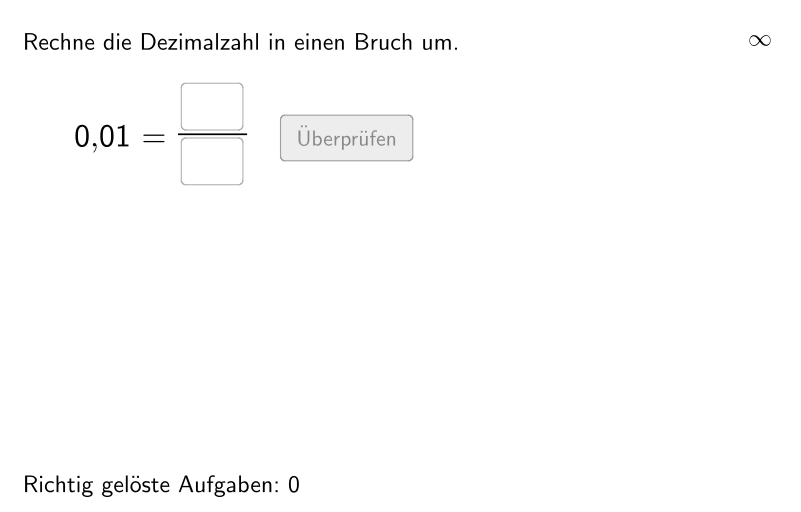
本范例演示了如何将十进制数转换为分数。它涉及的核心数学概念是分数的表示形式和十进制与分数之间的转换。作图要点包括使用 GeoGebra 的 Shuffle、Append、Remove 等命令来生成随机的分数和十进制数。适合的学段或用途是中小学数学教育,特别是对于学习分数和十进制表示形式的学生。
GeoGebra 命令及参数
Shuffle(Sequence[Random[1, 99], i, 1, 100]) → randomNosForX, {60, 50, 46, 34, 33, 98, 86, 7, 63, 76, 75, 68, 5, 27, 69, 93, 97, 45, 55, 12, 8, 10, 7, 46, 94, 33, 33, 57, 57, 9, 88, 25, 58, 93, 35, 27, 92, 10, 30, 20, 87, 93, 56, 91, 49, 14, 35, 56, 60, 30, 31, 79, 21, 32, 3, 98, 18, 64, 24, 82, 27, 44, 62, 82, 16, 72, 55, 72, 14, 46, 69, 3, 32, 55, 12, 99, 17, 66, 88, 89, 74, 53, 3, 36, 65, 16, 61, 86, 27, 89, 70, 43, 18, 7, 36, 22, 12, 92, 38, 5}Shuffle(Sequence[Random[1, 9], i, 1, 100]) → randomNosForY, {2, 1, 3, 8, 6, 9, 9, 9, 8, 6, 7, 8, 9, 3, 6, 8, 8, 3, 7, 4, 8, 8, 3, 7, 8, 7, 8, 1, 7, 9, 3, 3, 1, 4, 5, 2, 2, 7, 3, 8, 8, 1, 6, 1, 3, 6, 3, 1, 4, 6, 2, 2, 5, 7, 9, 9, 1, 2, 8, 7, 1, 6, 9, 2, 8, 1, 9, 5, 4, 7, 7, 5, 2, 8, 7, 6, 7, 4, 3, 3, 9, 3, 5, 4, 6, 5, 7, 8, 1, 3, 2, 3, 4, 3, 8, 7, 9, 7, 3, 7}Shuffle(Sequence[Random[1, 3], i, 1, 100]) → randomNosForZ, {1, 2, 2, 1, 1, 1, 1, 2, 2, 1, 3, 1, 3, 3, 2, 2, 1, 2, 2, 2, 3, 1, 1, 1, 1, 3, 2, 3, 2, 2, 3, 3, 2, 1, 3, 3, 1, 2, 1, 2, 1, 2, 3, 3, 1, 3, 3, 2, 3, 1, 1, 3, 2, 2, 2, 1, 3, 3, 1, 2, 3, 1, 3, 1, 3, 1, 1, 1, 3, 1, 3, 2, 2, 2, 3, 2, 2, 1, 3, 2, 1, 3, 2, 3, 2, 2, 1, 1, 1, 3, 2, 1, 3, 2, 2, 2, 2, 2, 2, 1}Append(true, Sequence[If[randomNosForZ(i) ≟ randomNosForZ(i - 1), false, true], i, 2, 100]) → stayZRemove(Sequence[If[stayZ(i), randomNosForZ(i), 0], i, 1, 100], Sequence[0, i, 1, 100]) → randomNosForZwithoutRepeatElement(randomNosForZwithoutRepeat, Mod[questionCount, 100] + 1) → numZAppend(true, Sequence[If[randomNosForY(i) ≟ randomNosForY(i - 1), false, true], i, 2, 100]) → stayYRemove(Sequence[If[stayY(i), randomNosForY(i), 0], i, 1, 100], Sequence[0, i, 1, 100]) → randomNosForYwithoutRepeatAppend(true, Sequence[If[randomNosForX(i) ≟ randomNosForX(i - 1), false, true], i, 2, 100]) → stayXRemove(Sequence[If[stayX(i), randomNosForX(i), 0], i, 1, 100], Sequence[0, i, 1, 100]) → randomNosForXwithoutRepeatIf(numZ ≟ 1, Element[randomNosForXwithoutRepeat, Mod[questionCount, 100] + 1], If[numZ ≟ 2, Element[randomNosForYwithoutRepeat, Mod[questionCount, 100] + 1], (Element[randomNosForYwithoutRepeat, Mod[questionCount, 100] + 1] * 10)]) → numXTextfield(input2) → AInputBox1Textfield(input1) → AInputBox2Corner(zahlText, 3) → CornerPolygon(PtopLeftCornerFeedback, PtopRightCornerFeedback, PbottomRightCornerFeedback, PbottomLeftCornerFeedback) → rectangleCorrect, ptopleftcornerfeedback, ptoprightcornerfeedback, pbottomrightcornerfeedback, pbottomleftcornerfeedbackDefined((input1 * input2)) → fixedSegment(Corner + (0.03, -0.275), Corner + (1, -0.275)) → bruchstrichDenominator(dez) → nennerNumerator(dez) → zaehlerIf(Mod[numX, 10] ≟ 0, numX / 10 ≟ saveZaehler, numX ≟ saveZaehler) → correct1If(numX < 10, 1000, If[numX ≥ 10 ∧ numX < 100, 100, If[numX ≥ 100, 10]]) → gesuchterNenner