
计算多边形面积
几何画板及绘图内容加载中,请稍等……
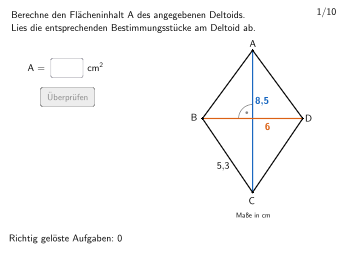
本范例演示如何计算特殊四边形(平行四边形、梯形、菱形、正方形)的面积。通过使用GeoGebra命令如Join、Sequence、Zip等,学生可以理解并验证这些四边形面积公式的应用。适合5-6年级学生学习。
GeoGebra 命令及参数
Join(Sequence[Shuffle[Sequence[1, maxexnum]], m, 1, 15]) → randomNosSequence(2, 15) → listPoolSequence(RandomElement[listPool], m, 1, 110) → randomNosForX, {9, 8, 7, 15, 8, 14, 13, 4, 4, 11, 2, 2, 8, 14, 6, 14, 10, 2, 8, 9, 7, 3, 11, 7, 12, 9, 4, 10, 10, 2, 11, 10, 2, 12, 6, 6, 11, 14, 13, 9, 8, 3, 11, 11, 4, 4, 7, 9, 14, 7, 3, 6, 14, 6, 8, 4, 12, 2, 9, 10, 4, 7, 12, 5, 14, 12, 12, 4, 11, 11, 15, 5, 13, 3, 5, 7, 7, 3, 14, 8, 9, 14, 3, 9, 10, 4, 5, 12, 2, 6, 11, 9, 2, 8, 14, 3, 4, 8, 3, 4, 8, 3, 6, 6, 5, 13, 13, 11, 14, 14}Zip(RandomElement[listPool \ Join[{{m}, Sequence[1, (floor(m) * (1 - percentage))], Sequence[(ceil(m) * (1 + percentage)), 50]}]], m, randomNosForX) → randomNosForYIf(numX ≥ numY, P1, P5) → AIf(numX ≥ numY, P3, P7) → CSegment(A, C) → e1Sequence(RandomElement[Sequence[0.3, 0.5, 0.01]], m, 1, 110) → randomNosForProp, {0.48000000000000015, 0.4000000000000001, 0.4400000000000001, 0.4200000000000001, 0.37000000000000005, 0.4100000000000001, 0.4500000000000001, 0.37000000000000005, 0.48000000000000015, 0.4200000000000001, 0.47000000000000014, 0.39000000000000007, 0.4200000000000001, 0.49000000000000016, 0.46000000000000013, 0.32, 0.3, 0.47000000000000014, 0.4400000000000001, 0.4400000000000001, 0.4000000000000001, 0.34, 0.37000000000000005, 0.34, 0.33, 0.37000000000000005, 0.36000000000000004, 0.3, 0.4400000000000001, 0.31, 0.33, 0.35000000000000003, 0.4000000000000001, 0.4200000000000001, 0.47000000000000014, 0.31, 0.37000000000000005, 0.33, 0.39000000000000007, 0.49000000000000016, 0.4400000000000001, 0.36000000000000004, 0.38000000000000006, 0.4000000000000001, 0.5000000000000001, 0.4100000000000001, 0.48000000000000015, 0.3, 0.31, 0.35000000000000003, 0.34, 0.32, 0.47000000000000014, 0.36000000000000004, 0.36000000000000004, 0.37000000000000005, 0.39000000000000007, 0.4000000000000001, 0.38000000000000006, 0.46000000000000013, 0.34, 0.4400000000000001, 0.4300000000000001, 0.34, 0.4100000000000001, 0.37000000000000005, 0.4400000000000001, 0.4100000000000001, 0.34, 0.31, 0.3, 0.5000000000000001, 0.4300000000000001, 0.5000000000000001, 0.3, 0.48000000000000015, 0.31, 0.4000000000000001, 0.4400000000000001, 0.39000000000000007, 0.34, 0.34, 0.38000000000000006, 0.4500000000000001, 0.5000000000000001, 0.4500000000000001, 0.4300000000000001, 0.4400000000000001, 0.38000000000000006, 0.4200000000000001, 0.39000000000000007, 0.4000000000000001, 0.4200000000000001, 0.3, 0.4100000000000001, 0.4000000000000001, 0.32, 0.35000000000000003, 0.35000000000000003, 0.3, 0.4000000000000001, 0.3, 0.46000000000000013, 0.4400000000000001, 0.49000000000000016, 0.47000000000000014, 0.4300000000000001, 0.34, 0.4500000000000001, 0.4100000000000001}If(numX ≥ numY, P4, P8) → DIf(numX ≥ numY, P2, P6) → BSegment(B, D) → f1Textfield(input1) → InputBox1Textfield(input2) → InputBox2Polygon(PtopLeftCornerFeedback, PtopRightCornerFeedback, PbottomRightCornerFeedback, PbottomLeftCornerFeedback) → rectangleCorrect, rectangleCorrectS3, rectangleCorrectS4, rectangleCorrectS2, rectangleCorrectS1Append(true, Sequence[If[randomNosForX(i) ≟ randomNosForX(i - 1), false, true], i, 2, 100]) → stayXAppend(true, Sequence[If[randomNosForY(i) ≟ randomNosForY(i - 1), false, true], i, 2, 100]) → stayYRemove(Sequence[If[stayX(i), randomNosForX(i), 0], i, 1, 100], Sequence[0, i, 1, 100]) → randomNosForXwithoutRepeatRemove(Sequence[If[stayY(i), randomNosForY(i), 0], i, 1, 100], Sequence[0, i, 1, 100]) → randomNosForYwithoutRepeatElement(randomNosForXwithoutRepeat, Mod[questionCount, Length[randomNosForXwithoutRepeat]] + 1) → numXwithoutRepeatElement(randomNosForYwithoutRepeat, Mod[questionCount, Length[randomNosForYwithoutRepeat]] + 1) → numYwithoutRepeatDefined(input1) → fixedIntersect(e1, f1) → EAngle(A, E, D) → αNumberSeparationComma((numX * numY)) → numberSeparationZaehlerIf((10 * numA) - floor((10 * numA)) < 0.5, (floor((10 * numA)) * 0.1), (floor((10 * numA)) * 0.1) + 0.1) → numAroundIf((10 * numB) - floor((10 * numB)) < 0.5, (floor((10 * numB)) * 0.1), (floor((10 * numB)) * 0.1) + 0.1) → numBroundMidpoint(A, B) → MaMidpoint(B, C) → MbMidpoint(C, D) → McMidpoint(D, A) → MdSequence(Random[1, 4], m, 1, 130) → randomBate, {4, 1, 2, 3, 3, 3, 1, 3, 4, 1, 4, 4, 1, 4, 1, 1, 2, 1, 4, 3, 1, 2, 3, 4, 2, 3, 1, 4, 3, 1, 3, 2, 3, 4, 4, 2, 3, 4, 3, 3, 4, 3, 4, 2, 3, 1, 4, 3, 2, 1, 4, 1, 2, 2, 3, 3, 1, 3, 1, 1, 2, 4, 1, 1, 2, 2, 4, 1, 1, 4, 3, 3, 2, 1, 1, 1, 4, 1, 2, 4, 4, 1, 3, 4, 2, 2, 3, 4, 4, 4, 4, 1, 3, 1, 4, 1, 3, 2, 4, 4, 1, 2, 3, 3, 3, 1, 1, 3, 1, 4, 3, 3, 1, 1, 2, 1, 3, 4, 1, 3, 2, 2, 3, 2, 2, 4, 4, 2, 2, 1}
AI 绘图提示语参考
画一个包含平行四边形、梯形、菱形和正方形的几何图形集合,展示它们的面积计算方法。首先绘制随机的点对形成四边形,然后连接这些点构成不同的四边形。标注对角线,并计算对角线交点。在图形旁边显示面积计算公式和结果,并用不同颜色区分不同的四边形。
以上提示语为根据原始绘图命令整理而来,仅供参考。