
Volume of Solid Figures using Dissection and Completion Method
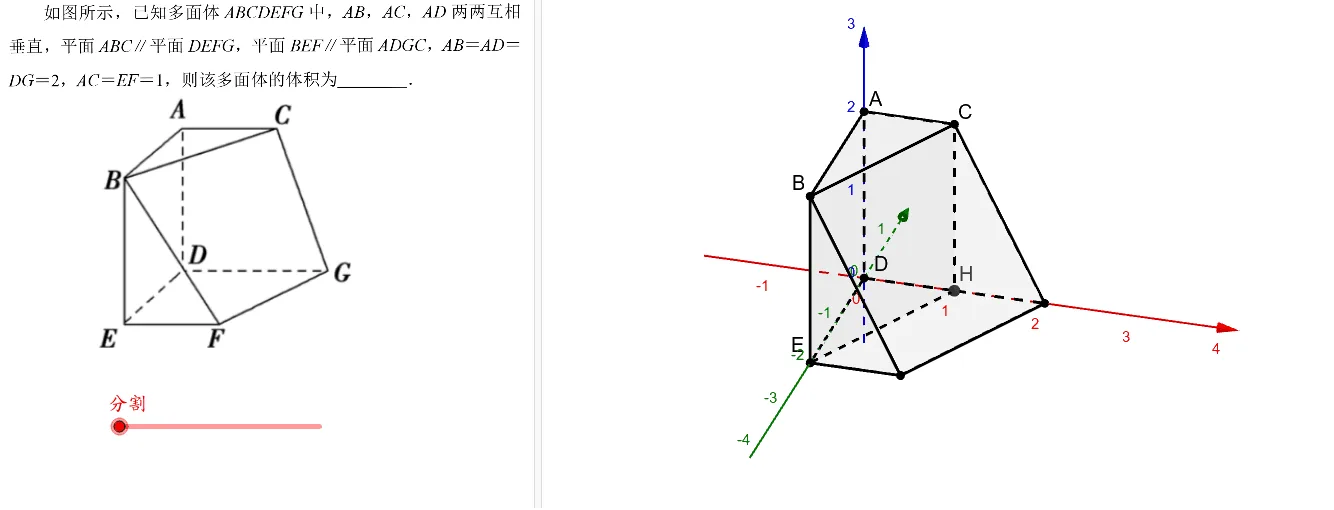
This GeoGebra applet demonstrates how to calculate the volume of complex solid figures using the dissection and completion method, also known as the cut-and-paste method. Through interactive geometric transformations such as translation, rotation, and midpoint construction, irregular or non-standard three-dimensional shapes are systematically decomposed or completed into regular geometric solids like cylinders, prisms, and other polygonal figures whose volume formulas are well established. Students can manipulate the constructions dynamically, watching as pieces of a complex solid are moved, reoriented, and reassembled into simpler forms that preserve volume. This visual and hands-on approach makes abstract spatial reasoning accessible and tangible. The applet is particularly useful in solid geometry courses where students need to compute volumes of prisms, pyramids, cylinders, and composite solids that do not directly fit standard volume formulas. By engaging with the dissection and completion process interactively, learners develop a deeper conceptual understanding of why volume remains invariant under rigid transformations such as translation and rotation. The tool supports intuitive teaching and exploratory learning, allowing educators to guide students through step-by-step reconstructions while reinforcing key principles of conservation of volume and geometric equivalence. It is suitable for secondary school mathematics classrooms, geometry units on three-dimensional figures, and self-directed study where students benefit from visual, dynamic representations of abstract mathematical ideas.
Loading the math board and drawing, please wait…