
Visual Proof of the British Flag Theorem
Loading the math board and drawing, please wait…
In collections
Proofs Without Words
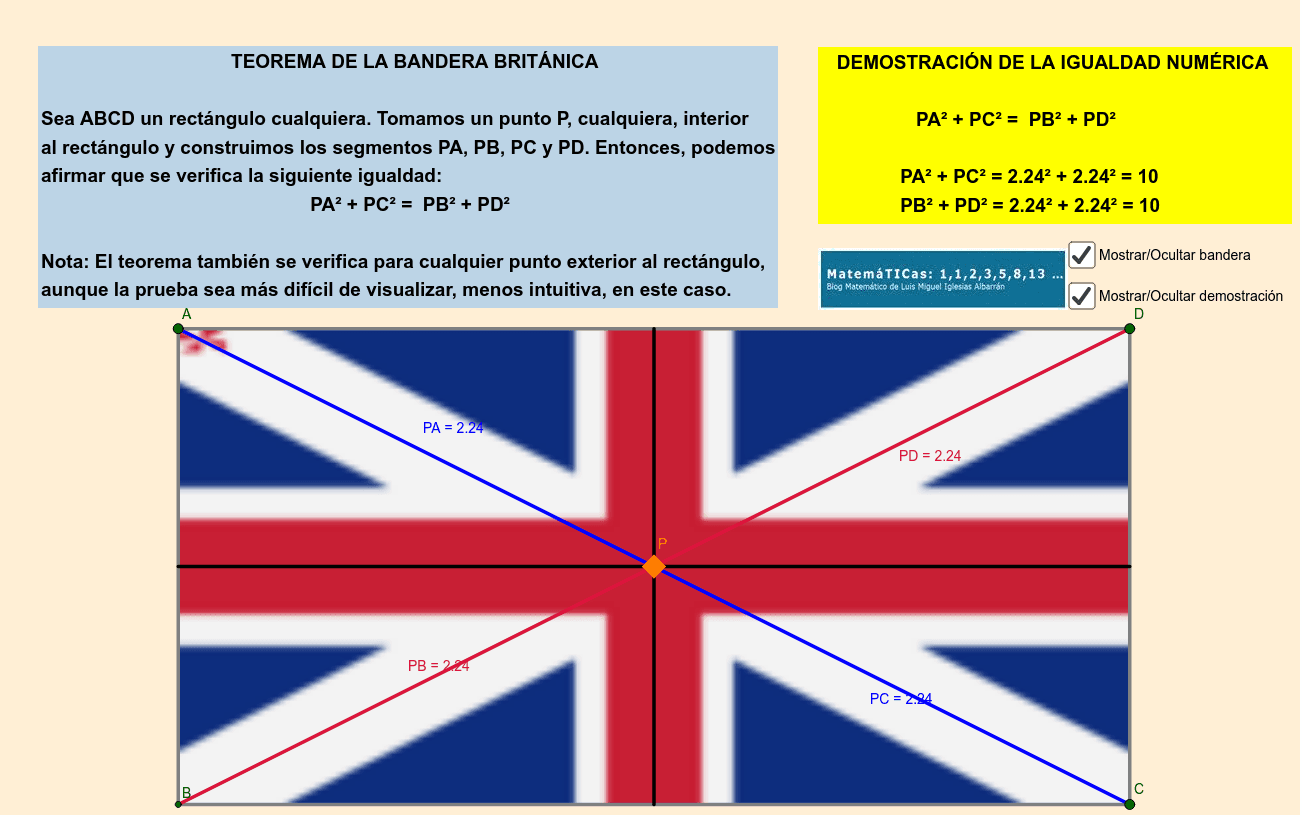
This example visually demonstrates the British Flag Theorem, which describes the relationships between segments in a specific geometric configuration. The core math concepts involved include quadrilaterals, rectangles, congruence, slope difference, and hypothesis testing. The construction utilizes GeoGebra commands such as Intersect, Point, Polygon, Line, and Segment. It is suitable for high school and above students to understand the intuitive proof of geometric theorems.
GeoGebra Commands & Parameters
Intersect(xAxis, yAxis) → BPoint(yAxis) → APolygon(B, C, D, A) → polígono1, a, b, c, dLine(P, c) → fLine(P, b) → gIntersect(g, c) → FIntersect(g, a) → HIntersect(b, f) → IIntersect(f, d) → JSegment(F, H) → hSegment(I, J) → iSegment(P, A) → PASegment(P, C) → PCSegment(P, B) → PBSegment(P, D) → PD
AI Drawing Prompt Reference
Draw a quadrilateral and inscribe two diagonals intersecting at point P. Connect P to each vertex of the quadrilateral to form four smaller rectangles. Draw perpendicular lines from P to each side of the quadrilateral, marking the feet as A, B, C, D. Connect these feet to form two intersecting line segments inside the rectangles, visually demonstrating the relationship between the rectangles and the perpendicular lines to prove a geometric theorem.
The prompt above was compiled from the original drawing commands and is for reference only.