
Vector Translation by M. Johnson
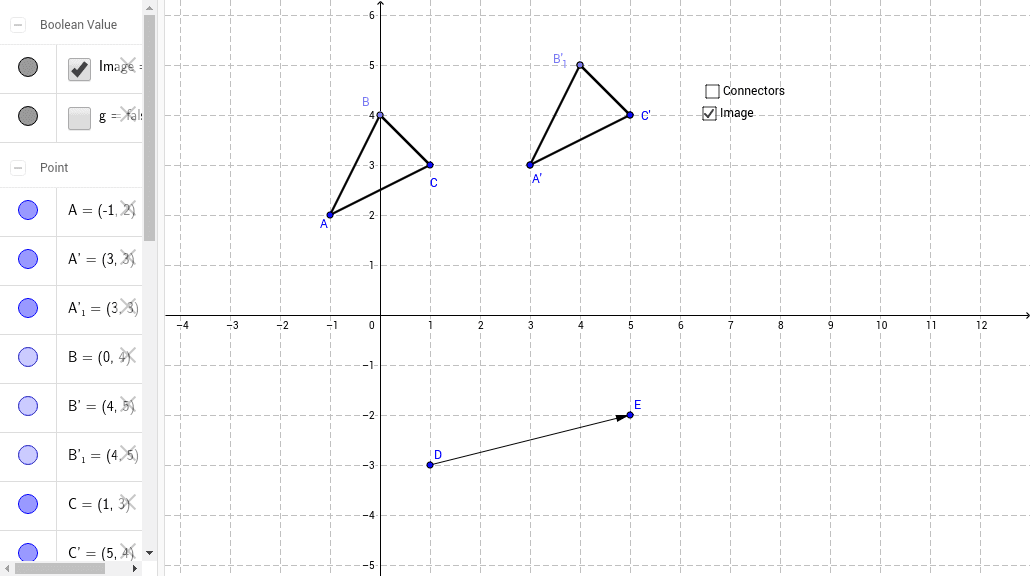
Loading the math board and drawing, please wait…
In collections
Grade 8 Congruence and Transformations
This example demonstrates the application of vector translation in geometric figures, showing how points, segments, and other shapes can be translated using vectors; Core math concepts include vectors, translation transformations, and coordinate transformations; Construction highlights involve GeoGebra commands/objects like Point, Segment, Vector, and Translate; Suitable for high school mathematics teaching to understand the relationship between vectors and geometric transformations, as well as coordinate transformations in analytical geometry.
GeoGebra Commands & Parameters
Point(yAxis) → BSegment(A, B) → aSegment(A, C) → bSegment(C, B) → cVector(D, E) → uTranslate(A, u) → A'Translate(B, u) → B'Segment(A', B') → a'Translate(C, u) → C'Translate(B, u) → B'_1Segment(C', B'_1) → c'Translate(A, u) → A'_1Translate(C, u) → C'_1Segment(A'_1, C'_1) → b'Segment(C, C') → dSegment(A, A') → eSegment(B, B') → f
AI Drawing Prompt Reference
Draw a geometric figure including points, segments, and a vector to demonstrate vector translation. Start by plotting a point on the y-axis and connecting it to form two segments. Then, draw a vector. Use this vector to translate the original segments and points, obtaining translated segments and points. Finally, draw lines connecting the original and translated points, and the original and translated segments, to observe the translation effect.
The prompt above was compiled from the original drawing commands and is for reference only.