
Two Tangent Lines to a Parabola and Their Geometric Properties
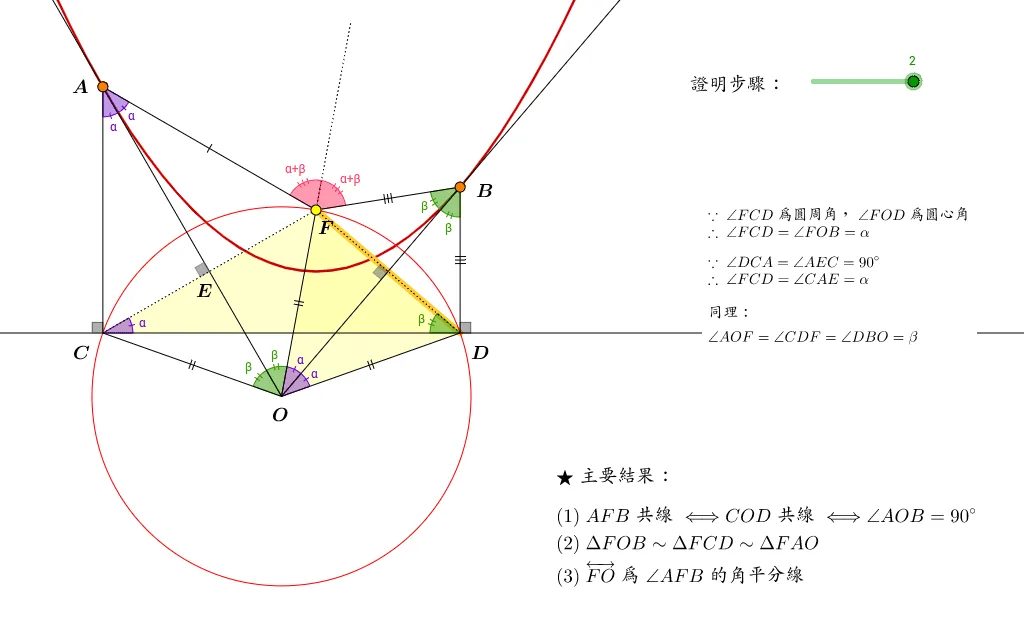
This GeoGebra applet explores the geometric properties of two tangent lines drawn to a parabola. It begins by constructing a parabola along with its focus, then builds two tangent lines at arbitrary points on the curve. The applet further constructs the intersection point of these two tangents, the perpendicular feet from the focus onto each tangent line, circles, and polygonal figures to reveal deeper relationships among these elements.
The demonstration highlights several classical results in parabolic geometry. First, it shows that the feet of the perpendiculars dropped from the focus onto any tangent line of a parabola all lie on the tangent at the vertex—a well-known locus theorem. Second, it illustrates that the line segment joining the focus to the intersection point of the two tangents bisects the angle formed by the lines connecting the focus to the respective points of tangency. This property is intimately connected to the reflective or optical property of parabolas, which states that rays emanating from the focus reflect off the parabola parallel to its axis of symmetry.
Through interactive manipulation, students can drag the points of tangency along the curve and observe how the configuration dynamically adjusts while preserving the underlying geometric invariants. The angles, distances, and circle constructions provide visual confirmation of the relevant theorems, allowing learners to discover and verify properties such as equal angle measurements and proportional segment lengths.
The applet is designed for use in coordinate geometry and conic sections instruction, particularly at the high school or early undergraduate level. By combining dynamic visualization with rigorous construction, it helps students move beyond static textbook diagrams toward an intuitive, exploratory understanding of parabolic tangent theorems. Teachers can employ it as a demonstration tool during lectures or as an investigative activity where students formulate conjectures and test them through manipulation of the interactive elements.
In collections
Conic Sections
Loading the math board and drawing, please wait…