
Triangle Parts: Perpendicular Bisectors, Altitudes, etc.
Loading the math board and drawing, please wait…
In collections
Parts of a Triangle
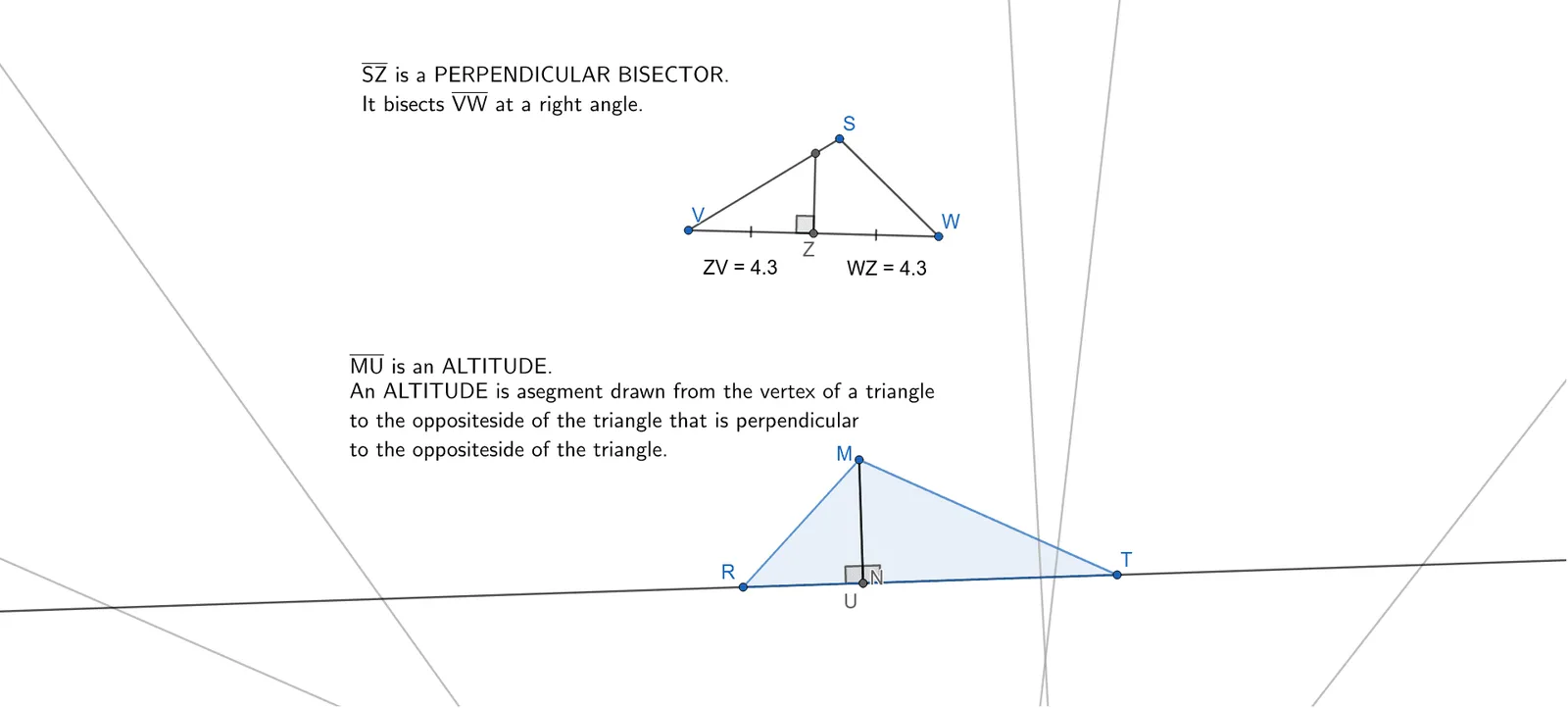
This example demonstrates the geometric properties and relationships of triangle components such as perpendicular bisectors, altitudes, and angle bisectors. Key math concepts include perpendicular lines, altitudes, angle bisectors, midpoints, distances, and circles. Construction highlights GeoGebra commands like Polygon, OrthogonalLine, Intersect, Segment, Angle, Midpoint, Distance, LineBisector, Circle, and Line. Suitable for high school and above mathematics learners to explore triangle geometry and constructions.
GeoGebra Commands & Parameters
Polygon(R, M, T) → t4, t_1, r_1, s_1OrthogonalLine(M, s_1) → dIntersect(d, s_1) → USegment(M, U) → eAngle(T, U, M) → αSegment(V, W) → f_1Midpoint(V, W) → ZOrthogonalLine(Z, f_1) → i_1Distance(Z, V) → distanceZVDistance(W, Z) → distanceWZSegment(V, S) → m_1Segment(S, W) → q_1OrthogonalLine(Z, f_1) → j_1Intersect(j_1, q_1) → H_1Segment(Z, H_1) → k_1Angle(W, Z, H_1) → βLineBisector(f_1) → fIntersect(f, m_1) → ASegment(Z, A) → gAngle(A, Z, V) → γSegment(Z, V) → hSegment(Z, W) → iPolygon(B, C, D) → t1, d_1, b, cLineBisector(c) → jLineBisector(d_1) → kLineBisector(b) → lIntersect(j, d_1) → EIntersect(j, c) → FIntersect(k, d_1) → GIntersect(k, c) → HIntersect(l, b) → IIntersect(l, c) → JIntersect(j, b) → KIntersect(k, b) → LIntersect(l, d_1) → M_1Intersect(j, k) → CircumcenterAngle(C, I, J) → δAngle(D, F, K) → εAngle(L, G, C) → ζAngle(H, G, C) → ηAngle(D, F, E) → θAngle(M_1, I, D) → ιCircle(Circumcenter, C) → pPolygon(S_1, O, P) → t2, p_1, n, oOrthogonalLine(P, p_1) → mIntersect(m, p_1) → QOrthogonalLine(O, o) → qIntersect(q, o) → A_1OrthogonalLine(S_1, n) → rIntersect(r, n) → B_1Intersect(m, q) → OrthocenterAngle(P, Q, O) → κAngle(S_1, B_1, P) → λAngle(P, A_1, O) → μSegment(Q, Orthocenter) → sSegment(B_1, Orthocenter) → tSegment(A_1, Orthocenter) → aLine(R, T) → g_1OrthogonalLine(M, g_1) → h_1Intersect(g_1, h_1) → NAngle(M, N, R) → νSegment(M, N) → l_1