
Triangle on Three Lines: Rotation and Scaling Transformation
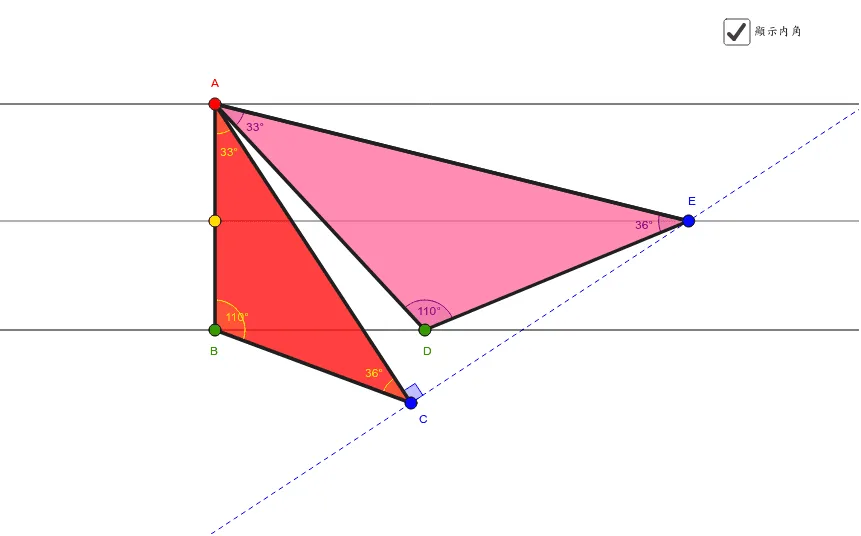
This GeoGebra applet demonstrates how the three vertices of a triangle can be mapped onto three given lines through a combined rotation and scaling transformation. The construction utilizes a range of geometric tools, including points, polygons, perpendicular lines, intersection points, segments, angle measurements, rotations, and arbitrary lines, to explore the transformational geometry relationship between a triangle and three fixed lines in the plane.
The core idea is that a single rotation-scaling (spiral similarity) transformation can be found or constructed so that the images of the triangle's vertices lie precisely on three specified lines. This involves determining the appropriate center of rotation, the rotation angle, and the scaling factor that satisfy all three constraints simultaneously. The construction proceeds by building auxiliary geometric elements such as perpendiculars from key points to the given lines, locating intersection points, and measuring relevant angles to verify the correctness of the transformation.
Multiple angle parameters — denoted by α, β, γ, δ, ε, ζ, η, and θ — appear throughout the construction. These angles capture the rotational relationships between corresponding segments and help illustrate how the spiral similarity preserves angular relationships while scaling distances proportionally. By interactively adjusting the positions of the triangle vertices or the orientations of the three lines, users can observe how the transformation adapts and how the angular constraints remain satisfied.
The applet serves as an interactive teaching tool for students studying transformational geometry in the plane. It makes visible the abstract concept that a rotation combined with a uniform scaling is equivalent to a single spiral similarity, and that such a transformation is fully determined by its center, angle, and scale factor. Students can visually verify geometric properties such as the preservation of oriented angles between corresponding segments and the proportional relationship between lengths of corresponding sides. The interactive nature of the construction encourages exploration and experimentation, allowing learners to develop intuition about how rotational and scaling operations interact and how they can be used to solve classical construction problems involving constraints on vertex positions. Overall, this applet provides a rich, visual environment for understanding the elegant interplay between rotation, scaling, and collinearity in plane geometry.
Loading the math board and drawing, please wait…