
Triangle Midsegment Demo
Loading the math board and drawing, please wait…
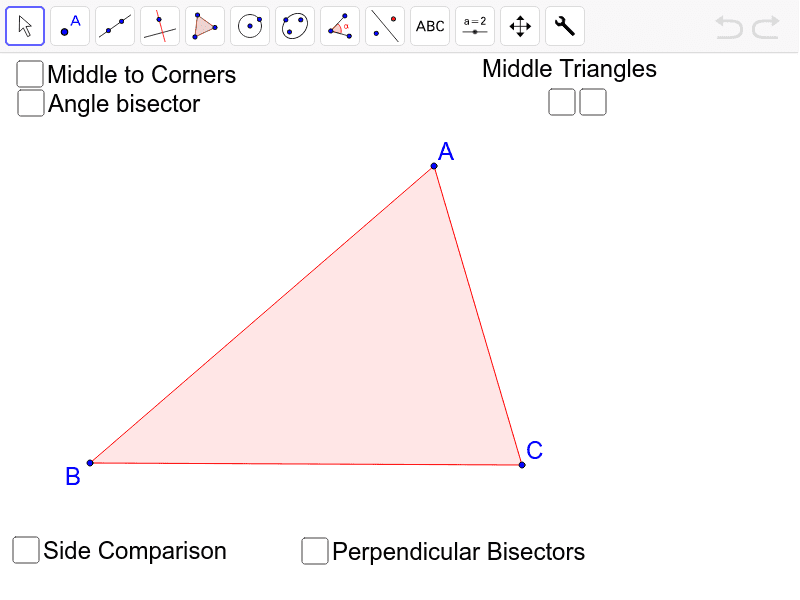
This example demonstrates the properties and construction of midsegments in a triangle. It involves core mathematical concepts like midsegment, centroid, angle bisector, and perpendicular line. The construction uses commands such as Polygon, midtri, Line, Angle, Intersect, Distance, OrthogonalLine, Segment, Midpoint, Circle, and AngularBisector from GeoGebra. Suitable for high school mathematics teaching or for geometry enthusiasts.
GeoGebra Commands & Parameters
Polygon(A, B, C) → poly1, c, a, bPolygon(D, E, F) → poly2, f, d, emidtri(F, D, E) → G, H, I, poly3midtri(I, G, H) → J, K, L, poly4midtri(K, L, J) → M, N, O, poly5midtri(N, O, M) → P, Q, R, poly6Line(A, H) → iLine(B, I) → jLine(C, G) → kAngle(F, A, E) → αAngle(C, B, A) → βAngle(A, C, B) → γAngle(E, D, F) → δAngle(F, E, D) → εAngle(D, F, E) → ζAngle(C, D, E) → ηAngle(D, E, C) → θAngle(E, F, A) → ιAngle(A, E, F) → κAngle(B, F, D) → λAngle(F, D, B) → μLine(S, A) → mLine(S, C) → nLine(S, B) → pIntersect(p, b) → TDistance(A, T) → distanceATDistance(T, C) → distanceTCIntersect(m, a) → UIntersect(n, c) → VDistance(A, V) → distanceAVDistance(V, B) → distanceVBDistance(B, U) → distanceBUDistance(U, C) → distanceUCOrthogonalLine(S, b) → qOrthogonalLine(S, c) → rOrthogonalLine(S, a) → sIntersect(s, a) → WIntersect(q, b) → ZIntersect(r, c) → A_1Segment(A_1, S) → tSegment(W, S) → a_1Segment(Z, S) → b_1Angle(S, A_1, A) → νAngle(C, W, S) → ξAngle(A, Z, S) → οMidpoint(a) → B_1Midpoint(c) → C_1Midpoint(b) → D_1OrthogonalLine(C_1, c) → c_1OrthogonalLine(D_1, b) → d_1OrthogonalLine(B_1, a) → e_1Intersect(c_1, d_1) → E_1Segment(E_1, B) → f_1Segment(E_1, A) → g_1Segment(E_1, C) → h_1Circle(E_1, B) → k_1AngularBisector(C, B, A) → i_1AngularBisector(B, A, C) → j_1AngularBisector(A, C, B) → l_1Intersect(i_1, j_1) → F_1Angle(F_1, C, B) → ρAngle(A, C, F_1) → σ
AI Drawing Prompt Reference
Draw a triangle and display its three midsegments. Find the midpoints on the midsegments and connect them to form a new triangle. Label the vertices of the original triangle and the midpoints of the midsegments. Draw lines from the vertices to the midpoints and measure the lengths of these segments, showing the relationship between the new triangle and the original one.
The prompt above was compiled from the original drawing commands and is for reference only.