
Triangle Area Bisectors
Loading the math board and drawing, please wait…
In collections
Besondere Punkte/Special Points
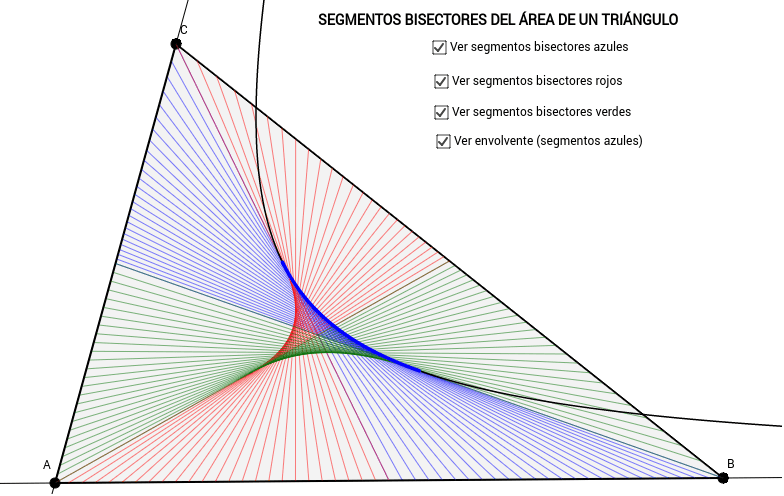
This example demonstrates finding all lines that divide a triangle into two equal-area parts. It involves core math concepts like triangle area, coordinate geometry, and geometric construction. Construction highlights include using Polygon for the triangle, Sequence for points, CurveCartesian for curves, and Line for drawing bisectors. Suitable for high school mathematics teaching or geometric exploration activities to help students understand the properties of area bisectors.
GeoGebra Commands & Parameters
Polygon(A, B, C) → polígono1, c, a, bSequence(Segment[(x(A) + t * (x(B) - x(A)), y(A) + t * (y(B) - y(A))), (x(A) + 1 / (2 * t) * (x(C) - x(A)), y(A) + 1 / (2 * t) * (y(C) - y(A)))], t, 0.5, 1, 0.02) → lista1Sequence(Segment[(x(B) + t * (x(A) - x(B)), y(B) + t * (y(A) - y(B))), (x(B) + 1 / (2 * t) * (x(C) - x(B)), y(B) + 1 / (2 * t) * (y(C) - y(B)))], t, 0.5, 1, 0.02) → lista2Sequence(Segment[(x(C) + t * (x(A) - x(C)), y(C) + t * (y(A) - y(C))), (x(C) + 1 / (2 * t) * (x(B) - x(C)), y(C) + 1 / (2 * t) * (y(B) - y(C)))], t, 0.5, 1, 0.02) → lista3CurveCartesian(1 / (4 * p) * (x(C) - x(A)) + 1 / 2 * p * (x(B) - x(A)) + x(A), 1 / (4 * p) * (y(C) - y(A)) + 1 / 2 * p * (y(B) - y(A)) + y(A), p, -100, 100) → gLine(A, C) → hLine(A, B) → iCurveCartesian(1 / (4 * p) * (x(C) - x(A)) + 1 / 2 * p * (x(B) - x(A)) + x(A), 1 / (4 * p) * (y(C) - y(A)) + 1 / 2 * p * (y(B) - y(A)) + y(A), p, 0.5, 1) → j
AI Drawing Prompt Reference
Draw a triangle ABC and find all lines that divide its area into two equal parts. First, draw triangle ABC. Then, construct three line segments, each with endpoints as one vertex of the triangle and the midpoint of the opposite side. Next, draw a curve passing through the vertices, representing the area bisectors. Finally, draw the two sides of the triangle.
The prompt above was compiled from the original drawing commands and is for reference only.