
Tetrahedral Stacking of Four Spheres
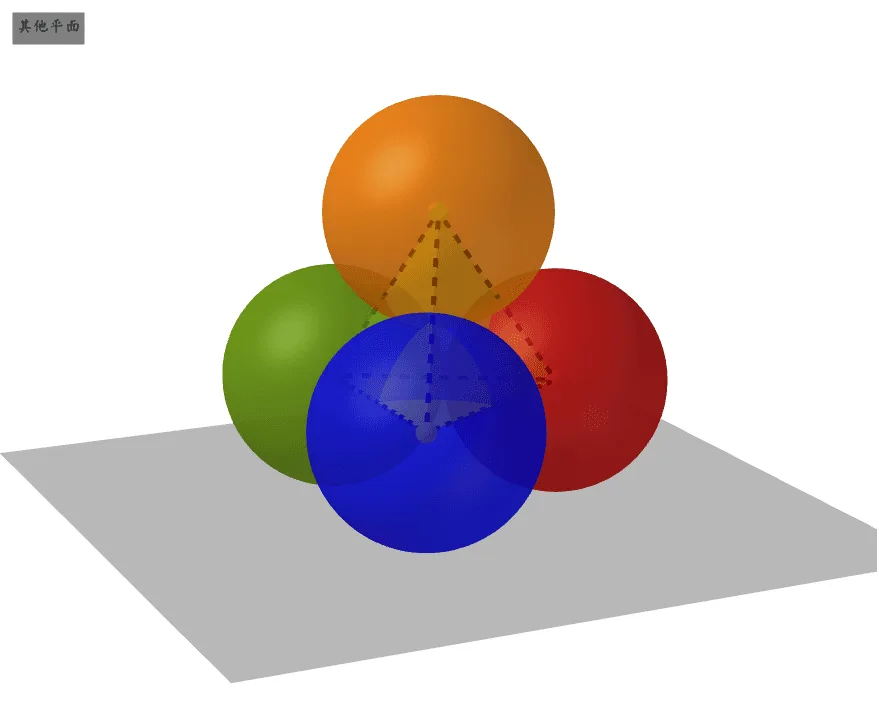
This GeoGebra applet provides an interactive and highly visual exploration of the geometric structure formed by stacking four identical spheres in a regular tetrahedral arrangement within three-dimensional space. By leveraging core GeoGebra 3D commands such as Sphere and Tetrahedron, the application meticulously constructs both the spheres and the regular tetrahedron that connects their centers. This setup allows users to deeply investigate the spatial relationships between the sphere centers, the precise construction of the tetrahedron faces and edges, and the exact points of tangency where the spheres physically touch one another.
In this interactive 3D environment, students and educators can freely rotate, pan, and zoom the model to examine the structure from any angle. The applet clearly highlights the enclosing tetrahedron, labeling its specific geometric components to bridge the gap between abstract algebraic coordinates and tangible spatial forms. By observing the tangency contacts between the spheres, learners can visually grasp the concept of sphere packing, seeing firsthand how four spheres naturally nestle together to form a highly symmetric and stable configuration.
From a mathematical perspective, this tool is invaluable for teaching solid geometry, spatial symmetry, and three-dimensional coordinate relationships. It serves as an excellent visual aid for deriving the height of a regular tetrahedron, calculating the distance between sphere centers, and understanding the dihedral angles between the tetrahedral faces. Students can use the model to verify theoretical calculations regarding the volume of the tetrahedron compared to the combined volume of the spheres, fostering a deeper understanding of spatial efficiency and packing density.
Ultimately, this applet transforms complex stereometric concepts into an accessible, hands-on learning experience. It encourages inquiry-based learning by allowing students to manipulate the 3D view and observe how the invariant properties of the regular tetrahedron govern the spatial arrangement of the spheres. Whether used for introductory high school geometry or more advanced university-level discrete mathematics, this visualization tool effectively demystifies three-dimensional spatial reasoning and structural symmetry.
Loading the math board and drawing, please wait…