
Surface on Sphere
Loading the math board and drawing, please wait…
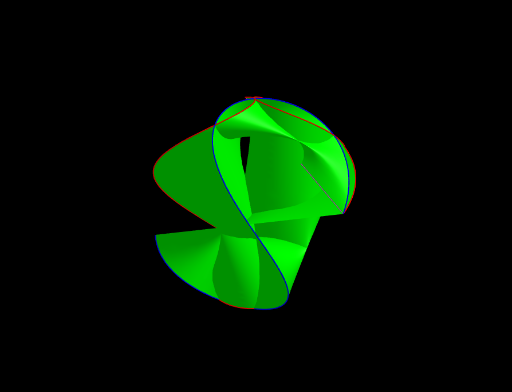
This example demonstrates a surface on a sphere. It involves spherical geometry and surface construction. By using commands like CurveCartesian, Sequence, and Surface, you can dynamically adjust the surface parameters and observe how the surface changes on the sphere. Suitable for high school mathematics education and students learning solid geometry.
GeoGebra Commands & Parameters
CurveCartesian((cos((a * t)) * cos((b * t))), (sin((a * t)) * cos((b * t))), sin((b * t)), t, 0, ((tm * 2) * π)) → c_1CurveCartesian((cos((c * t)) * cos((d * t))), (sin((c * t)) * cos((d * t))), sin((d * t)), t, 0, ((tm * 2) * π)) → c_2Sequence(Segment[((cos((a * t)) * cos((b * t))), (sin((a * t)) * cos((b * t))), sin((b * t))), ((cos((c * t)) * cos((d * t))), (sin((c * t)) * cos((d * t))), sin((d * t)))], t, (2 * π / n), ((tm * 2) * π), (2 * π / n)) → liste1Sequence(Segment[Point[c_1, i], Point[c_2, 1 - i]], i, 1 / n, 1, 1 / ((tm * n))) → liste2Surface(((v * cos((a * u))) * cos((b * u))) + (((1 - v) * cos((c * u))) * cos((d * u))), ((v * sin((a * u))) * cos((b * u))) + (((1 - v) * sin((c * u))) * cos((d * u))), (v * sin((b * u))) + ((1 - v) * sin((d * u))), u, 0, ((tm * 2) * π), v, 0, 1) → fSurface(((v * cos((a * u))) * cos((b * u))) + (((1 - v) * cos((c * (((tm * 2) * π) - u)))) * cos((d * (((tm * 2) * π) - u)))), ((v * sin((a * u))) * cos((b * u))) + (((1 - v) * sin((c * (((tm * 2) * π) - u)))) * cos((d * (((tm * 2) * π) - u)))), (v * sin((b * u))) + ((1 - v) * sin((d * (((tm * 2) * π) - u)))), u, 0, ((tm * 2) * π), v, 0, 1) → e