
Steiner Chain
Loading the math board and drawing, please wait…
In collections
Teselaciones regulares
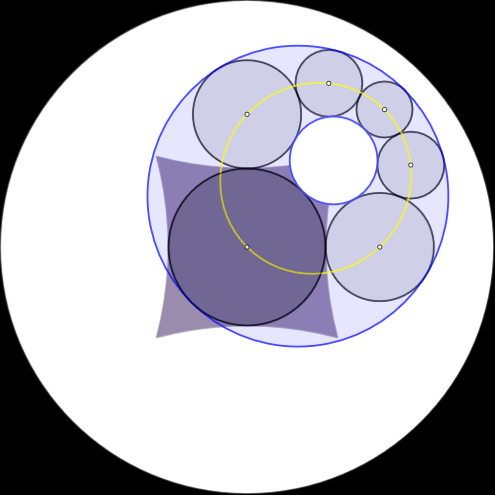
A Steiner chain is a special type of geometric figure used to demonstrate the Steiner construction of polygons. This example shows how to construct a Steiner chain using GeoGebra, illustrating the basic principles of the Steiner construction of polygons. Key mathematical concepts include geometric construction, polygons, and Steiner construction. Construction points include using Circle, Intersect
GeoGebra Commands & Parameters
Circle((0, 0), 1) → cIntersect(Circle[((1 - (sin(pi / p) / cos(pi / q))^(2))^(-1 / 2), 0), ((cos(pi / q) / sin(pi / p))^(2) - 1)^(-1 / 2)], Ray[(0, 0), Rotate[(1, 0), pi / p]], 1) → P0Sequence(Rotate[P0, ((k * 2) * pi / p)], k, 0, p - 1) → VCircle(Mirror[V(p), c], V(p), V(1)) → hc1Polygon(pV) → actualpFlatten(Join[{{Vac(p)}, {Vac \ {Vac(p)}}}]) → VacpFlatten(Join[{{Vac \ {Vac(1)}}, {Vac(1)}}]) → Vac2Zip(Center[a], a, s) → SCircle(((-0.22475, -0.22475) + (0.63683, 0.63683)) / 2, (-0.22475, -0.22475)) → cExtCircle(((0.22475, 0.22475) + (0.47618, 0.47618)) / 2, (0.22475, 0.22475)) → cIntConic(S(1), S(2), S(3), S(4), S(5)) → e1Intersect(hc1, Ray[(V(1) + V(p)) / 2, (0, 0)]) → V0,CircumcircleArc(V(p), V0, V(1)) → arcoCeldaJoin(Sequence[Rotate[Sequence[Point[arcoCelda, s], s, 0, 0.9, 0.1], ((2 * k) * pi / p)], k, 0, p - 1]) → celda0Polygon(celda0) → polSequence({Vac(k), q - 1, ncActual}, k, 3, p - 1) → VplusIf(floor(p / 2) ≠ p / 2 ∧ q ≟ 3, 4, floor(q / 2) ≟ q / 2, 2, 3) → ncSequence({V(k), q - 1, 0}, k, 1, p) → vert0Flatten(Join[{{Vac \ {Vac(1), Vac(2)}}, {Vac(1), Vac(2)}}]) → Vac2'Flatten(Join[{{Vac(p - 1), Vac(p)}, {Vac \ {Vac(p - 1), Vac(p)}}}]) → Vacp'