
SS Test for Similar Triangles
Loading the math board and drawing, please wait…
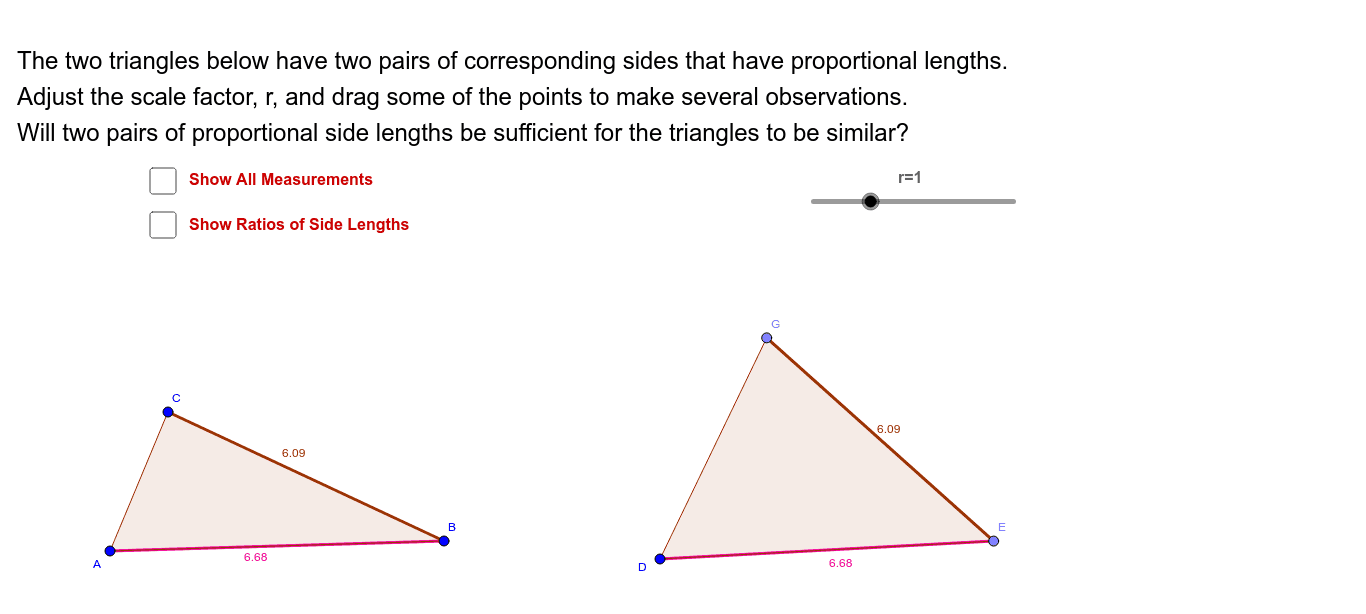
This example demonstrates the SSS (Side-Side-Side) similarity criterion for triangles, illustrating how corresponding sides of triangles can be proportional to determine similarity. Key math concepts include triangle similarity, side ratios, and geometric constructions. It uses GeoGebra commands like Segment, Point, Circle, Polygon, and Angle to construct the example, making it suitable for high school students learning geometric proofs and constructions.
GeoGebra Commands & Parameters
Segment(A, B) → aSegment(A, C) → bSegment(C, B) → cPoint(Circle[D, (r * a)]) → ESegment(D, E) → dCircle(E, Ra) → ePoint(e) → GSegment(E, G) → fSegment(D, G) → gPolygon(C, B, A) → poly1, a_1, c_1, b_1Polygon(G, E, D) → poly2, d_1, g_1, e_1Angle(B, A, C) → αAngle(C, B, A) → βAngle(A, C, B) → γAngle(D, G, E) → δAngle(E, D, G) → εAngle(G, E, D) → ζ
AI Drawing Prompt Reference
Draw a triangle ABC, then draw a similar triangle DEG outside of it, with each side of triangle DEG proportional to the corresponding side of triangle ABC. First, draw the three sides of triangle ABC, then draw a circle and use a point E on the circle to construct triangle DEG, ensuring that DE, EG, and GD are proportional to AB, BC, and CA respectively.
The prompt above was compiled from the original drawing commands and is for reference only.