
Similar Triangles Area Check: Dynamic Geometry Exploration
Loading the math board and drawing, please wait…
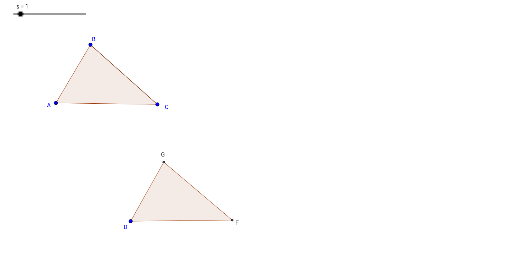
This GeoGebra example dynamically demonstrates the relationship between the area ratio of similar triangles and the square of their side-length ratio, while incorporating hyperbola and optimization contexts. Core mathematical concepts include similarity criteria, area ratio theorem, proportions with integers, and the hyperbola as the locus of area ratios. Construction highlights: using Segment, Polygon, Angle, Ray, Rotate, Circle, and Intersect commands to build base triangles and their similar counterparts, rotating rays to generate corresponding vertices, using circles and intersections to fix proportional points, and creating multiple polygons (poly1, poly2) with auxiliary lines (g, h, i, j) for area measurement. Suitable for middle/high school geometry, math competitions, or introductory college geometry, this interactive tool helps verify area scaling rules and explore extremal cases in optimization problems.
GeoGebra Commands & Parameters
Segment(A, B) → fSegment(B, C) → gSegment(C, A) → hPolygon(A, B, C) → poly1, c, a, bAngle(C, A, B) → αRay(D, E) → iRotate(E, α, D) → E'Angle(E, D, E') → βRay(D, E') → jCircle(D, (s * h)) → dIntersect(d, i, 1) → FCircle(D, (s * f)) → eIntersect(e, j, 1) → GSegment(F, G) → kPolygon(D, F, G) → poly2, g_1, d_1, f_1
AI Drawing Prompt Reference
Draw a triangle and construct a similar triangle sharing one vertex. Start with the original triangle, noting one of its angles. From the shared vertex, draw two rays. Along each ray, mark points at distances proportional to two sides of the original triangle, using the same scale factor. Connect these two new points to form the second triangle. Ensure the corresponding sides are parallel or proportional. Fill the two triangles with different colors or patterns to distinguish them, and label the side lengths or area ratio to show that the area ratio equals the square of the side-length ratio.
The prompt above was compiled from the original drawing commands and is for reference only.