
Sierpinski Triangle by Luis Miguel López Herranz
Loading the math board and drawing, please wait…
In collections
Regularity
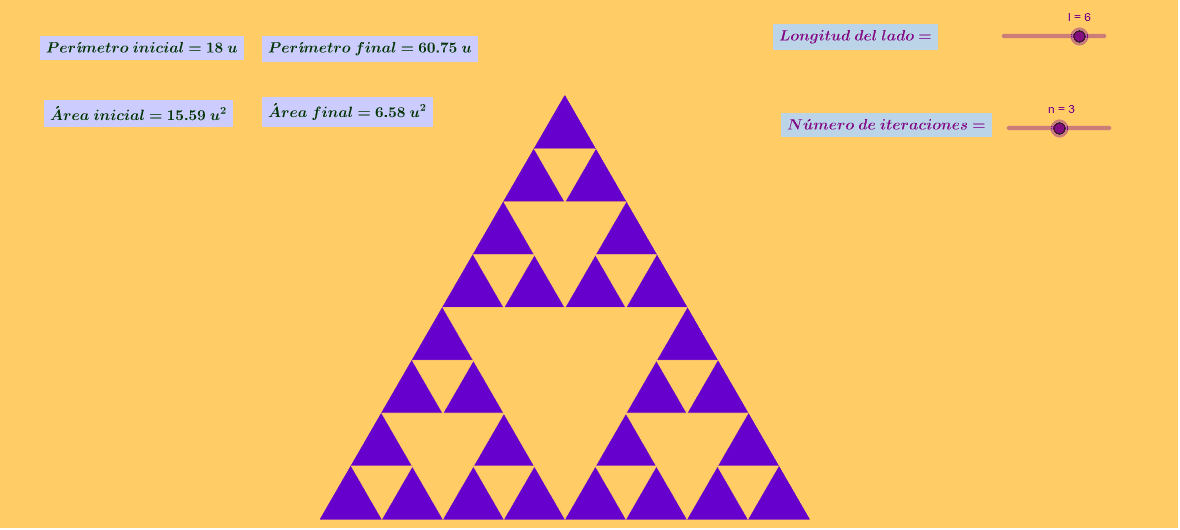
This example demonstrates the generation process of the Sierpinski triangle. It involves core concepts of fractal geometry, showing how self-similar geometric shapes are generated through iterative processes. It uses GeoGebra commands such as Ray, Circle, Intersect, Polygon, Vector, Sequence, and Join to construct a dynamic Sierpinski triangle. Suitable for high school and above students to learn fractal geometry and geometric construction.
GeoGebra Commands & Parameters
Ray(A, B_1) → aCircle(A, l) → cIntersect(c, a, 1) → BPolygon(A, B, 3) → polígono1, b, d, e, CVector(A, B) → uSequence(Sequence[Polygon[A + (If[i ≤ 2^(j), i] * u / 2^(j)), A + (If[i ≤ 2^(j), i] * u / 2^(j)) + (l / 2^(j); 60°), A + (If[i ≤ 2^(j), i] * u / 2^(j)) + (l / 2^(j); 120°), A + (If[i ≤ 2^(j), i] * u / 2^(j))], i, 1, 2^(n), 2], j, 1, n) → lista1Vector(C, A) → vVector(B, C) → wJoin(lista1) → lista2RemoveUndefined(lista2) → lista3Sequence(Sequence[Translate[Take[lista3, 2^(i - 1), 2^(i) - 2 - j], Vector[((j + 1) * ((-v)) / 2^(i - 1))]], i, 2, n], j, 0, 2^(n)) → lista4