
Rotation Transformation in Cartesian Coordinates
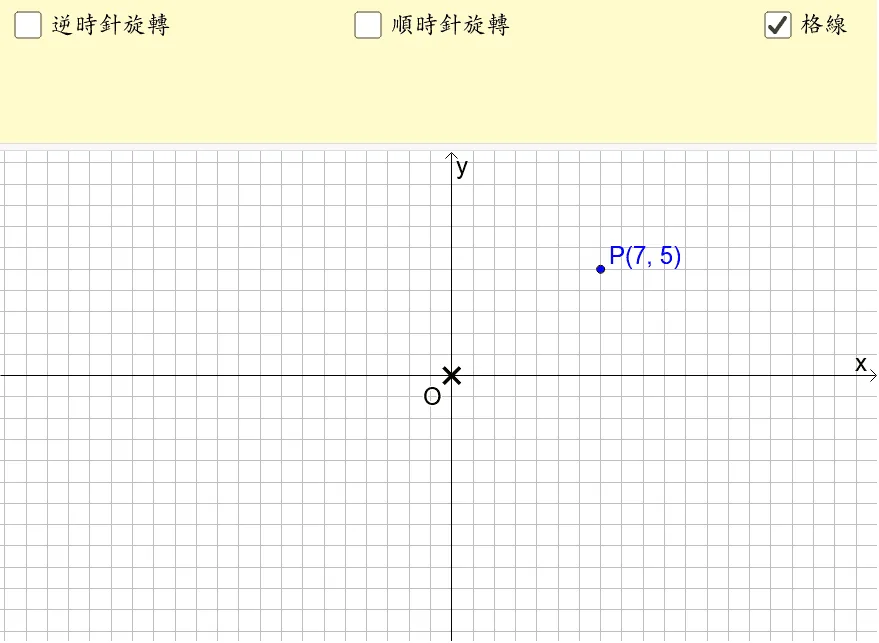
This GeoGebra applet demonstrates rotation transformations of points and polygons in the Cartesian coordinate system. Using the Rotate command, point P is rotated about the origin O by a specified angle α to produce its image P', while DynamicCoordinates displays the real-time numerical relationship between original and rotated coordinates. The construction includes concentric circle arcs, polygon figures, and angle annotations that visually present the geometric properties of rotation transformations, namely the preservation of distances and angles.
The applet features interactive sliders that allow users to adjust the rotation angle dynamically. As the angle changes, students can observe how the coordinates of point P and its image P' vary across different quadrants, revealing the signs of coordinate values and their connection to trigonometric functions. Multiple sets of concentric circular arcs are drawn to illustrate that all points at the same distance from the origin trace out the same rotational path. The polygon elements further demonstrate that rotation preserves both the shape and size of figures, providing concrete visual evidence of this fundamental isometry.
The mathematical concepts covered include the definition of rotation as a rigid transformation, the formula for rotating a point (x, y) about the origin by angle α to obtain (x cos α − y sin α, x sin α + y cos α), and the relationship between rotations and trigonometric identities. Students can explore how coordinate signs change depending on the quadrant into which the rotated point lands, reinforcing their understanding of the unit circle and the periodic nature of sine and cosine functions.
This applet is suitable for teaching analytical geometry and transformational geometry in secondary and introductory college mathematics courses. It enables learners to develop an intuitive grasp of rotation before encountering formal proofs, supports the exploration of symmetry and periodicity, and serves as an effective visual aid for instructors demonstrating how algebraic coordinate formulas correspond to geometric motion. By allowing real-time manipulation of the rotation parameter, the tool encourages active discovery and helps bridge the gap between abstract trigonometric formulas and their geometric interpretations.
Loading the math board and drawing, please wait…