
Pythagorean Theorem Rearrangement Proof
Loading the math board and drawing, please wait…
In collections
Pythagorean Theorem
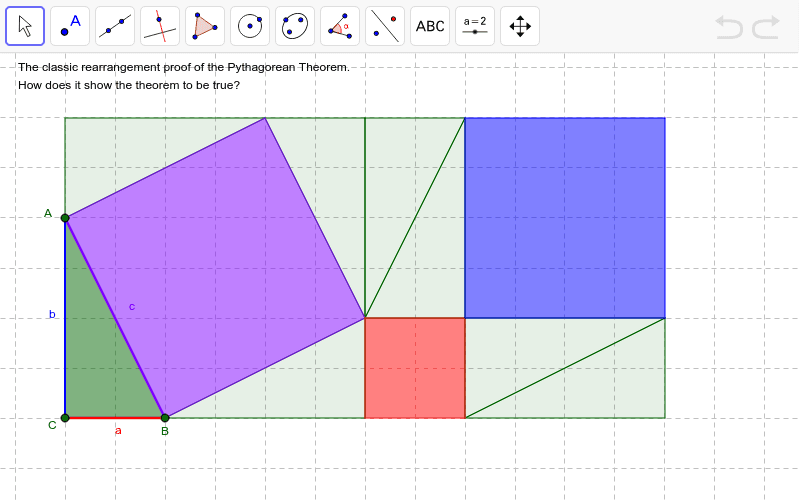
This example demonstrates the Pythagorean Theorem through geometric rearrangement. It uses the area relationship of triangles and rotation and reflection operations to intuitively prove that the square of the hypotenuse of a right triangle is equal to the sum of the squares of the other two sides. The construction process involves commands such as point, polygon, line, rotate, and mirror. Suitable for middle school and above students to learn geometric proofs.
GeoGebra Commands & Parameters
Point(x = x(A)) → CPoint(Ray[C, C + (1, 0)]) → BPolygon(A, C, B) → poly1, b, a, cPolygon(B, E, D) → poly2, d, c_1, eLineBisector(d) → a_3LineBisector(c) → b_2Intersect(a_3, b_2) → FRotate(A, -90*°, F) → A'Rotate(C, -90*°, F) → B'Rotate(B, -90*°, F) → C'Polygon(A', B', C') → poly1', c', a', b'Rotate(B, 90*°, F) → C'_1Rotate(E, 90*°, F) → E'Rotate(D, 90*°, F) → D'Polygon(C'_1, E', D') → poly2', d', c'_1, e'Mirror(C'_1, e') → GMirror(E', e') → E''Mirror(D', e') → D''Polygon(G, E'', D'') → poly2'', d'', g, e''Midpoint(E, E'') → HRotate(G, 180*°, H) → G'Rotate(E'', 180*°, H) → E'''Rotate(D'', 180*°, H) → D'''Polygon(G', E''', D''') → poly2''', d''', g', e'''Line(D, D''') → fMirror(G, f) → G'_1Mirror(E'', f) → E'''_1Mirror(D'', f) → D'''_1Polygon(G'_1, E'''_1, D'''_1) → poly2'''_1, d'''_1, g'_1, e'''_1Mirror(G', f) → G''Mirror(E''', f) → IMirror(D''', f) → JPolygon(G'', I, J) → poly3, j, g'', iPolygon(A, B, E, A') → poly4, a_2, c_2, e_1, a'_1Line(D', E'') → hIntersect(f, h) → KPolygon(D, E, D''', G'_1) → poly5, d_1, e_2, d'''_2, g'_2Polygon(D''', E'', K, E'''_1) → poly6, d'''_3, e''_1, k, e'''_2
AI Drawing Prompt Reference
Draw a right triangle with one leg as the basecars. Construct a square on the hypotenuse. Rotate this square by 90 degrees, then use mirror and rotation operations to dissect and rearrange it into two smaller squares placed on the other two legs. Include auxiliary lines to show the area relationships among triangles and squares, visually proving the Pythagorean theorem. The final figure contains multiple triangles and quadrilaterals arranged through rotations, reflections, and symmetry, forming a clear geometric proof diagram.
The prompt above was compiled from the original drawing commands and is for reference only.