
Pythagorean Theorem Proof 41
Loading the math board and drawing, please wait…
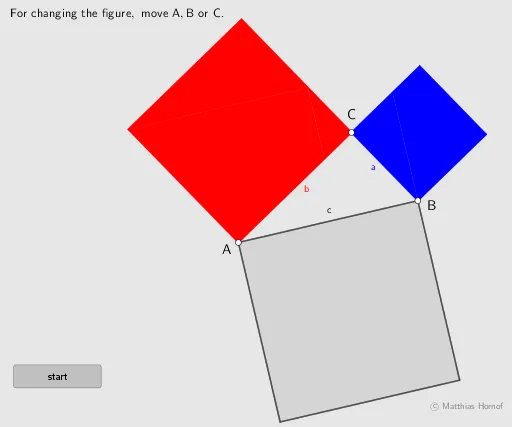
This example demonstrates a geometric proof of the Pythagorean Theorem using auxiliary circles and line segment relationships to verify the sum of the squares of the sides of a right triangle. Core mathematical concepts include the Pythagorean Theorem, circles, polygons, midpoints, perpendicular lines, intersections, angles, etc. Construction highlights involve GeoGebra commands such as CircleArc for drawing arcs, Point for defining key points, Polygon for forming polygons, Midpoint for finding midpoints, OrthogonalLine for perpendicular lines, Intersect for calculating intersections, Angle for measuring angles, If for conditional logic, and Segment for connecting segments. Suitable for high school mathematics education to deepen understanding of the Pythagorean Theorem and enhance geometric construction skills.
GeoGebra Commands & Parameters
CircleArc(Midpoint[A, B], B, A) → thPoint(th) → Th_2Point(th) → Th_1CircleArc(Midpoint[A, B], Th_1, Th_2) → th_2Polygon(B, A, 4) → QHyp, c, g, h, i, C_1, C_2Midpoint(c) → M_cPoint(th_2) → COrthogonalLine(M_c, c) → m_cIntersect(m_c, OrthogonalLine[C, m_c]) → C_MAngle(C, M_c, C_M) → wi_mIf(wi_m ≤ π / 2, 1, -1) → vzIntersect(OrthogonalLine[Fps, c], Ray[Fpv, C]) → D_1Polygon(C, B, 4) → QKA, a, k, l, m, A_1, A_2Polygon(A, C, 4) → QKB, b, p, q, r, B_1, B_2Polygon(E_{11}, E_{12}, E_{13}) → Poly1, f, j, nPolygon(E_{21}, E_{22}, E_{23}, E_{24}) → Poly2, e_{21}, e_{22}, e_{23}, e_{24}Intersect(Ray[D_2, D_2 + (vz * v_c)], Ray[Fps, Fps + w_2]) → D_3Intersect(Ray[Fpv, C], OrthogonalLine[D_3, c]) → D_5Polygon(E_{31}, E_{32}, E_{33}) → Poly3, e_{33}, e_{31}, e_{32}Polygon(E_{41}, E_{42}, E_{43}, E_{44}) → Poly4, e_{41}, e_{42}, e_{43}, e_{44}Polygon(E_{51}, E_{52}, E_{53}) → Poly5, e_{53}, e_{51}, e_{52}Segment(Fps, Fps + (Min[Max[t_6 - 0, 0], 1] * Vector[Fps, D_1])) → sn_1Segment(D_2, D_2 + (Min[Max[t_6 - 1, 0], 1] * Vector[D_2, D_3])) → sn_2Segment(D_3, D_3 + (Min[Max[t_6 - 2, 0], 1] * Vector[D_3, D_5])) → sn_3
AI Drawing Prompt Reference
Draw a right triangle with auxiliary circles and line segment relationships to prove the Pythagorean Theorem. Start by constructing the triangle and two auxiliary circles, finding midpoints and centers, and drawing perpendicular lines and intersection points. Connect key points to form multiple quadrilaterals and pentagons, and link specific points with segments to display angles and positional relationships, ultimately presenting a geometric proof of the Pythagorean Theorem.
The prompt above was compiled from the original drawing commands and is for reference only.