
Pythagoras Theorem Dynamic Geometry Demonstration by sanger_n
Loading the math board and drawing, please wait…
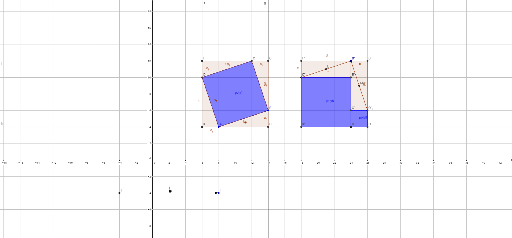
① This GeoGebra example dynamically demonstrates the Pythagorean theorem: squares are constructed on the three sides of a right triangle, visually showing that the sum of the areas of the squares on the two legs equals the area of the square on the hypotenuse. ② Core mathematical concepts include the Pythagorean theorem, area relationships, right triangles, squares, and quadratic equations (area expressions). ③ Construction highlights: using commands such as Segment, Polygon, Point, Intersect, Vector, Translate, Midpoint, and Rotate to build the triangle and squares, creating multiple polygons (poly1 to poly5) and auxiliary lines to form a complete area comparison. ④ Suitable for middle school to high school students learning the connection between geometry and algebra, and for teachers to use in classroom demonstrations or for students to explore various proofs of the Pythagorean theorem independently.
GeoGebra Commands & Parameters
Segment(A, B) → aPolygon(A, B, 4) → poly1, b, c, d, e, C, DLine(D, yAxis) → fLine(B, yAxis) → gLine(A, xAxis) → hLine(C, xAxis) → iPoint(f) → EPolygon(A, D, E) → poly2, e_1, a_1, d_1Intersect(f, i) → FPolygon(D, F, C) → poly3, c_1, d_2, f_1Intersect(g, i) → GPolygon(C, G, B) → poly4, b_1, c_2, g_1Intersect(g, h) → HPolygon(B, H, A) → poly5, a_2, b_2, h_1Segment(I, J) → jVector(J, I) → uVector(J, I) → vVector(J, I) → wTranslate(F, w) → F'Vector(J, I) → kTranslate(G, k) → G'Vector(J, I) → lVector(J, I) → mTranslate(H, m) → H'Intersect(f, h) → KVector(J, I) → nTranslate(K, n) → K'Vector(J, I) → pTranslate(C, p) → C'Vector(J, I) → qTranslate(D, q) → D'Vector(J, I) → rTranslate(B, r) → B'Midpoint(D', C') → LMidpoint(C', B') → MPolygon(F', D', C') → poly6, c', f', d'Polygon(C', G', B') → poly7, b', c'_1, g'Rotate(F', 180°, L) → F''Rotate(D', 180°, L) → D''Rotate(C', 180°, L) → C''Polygon(F'', D'', C'') → poly6', c'', f'', d''Rotate(C', 180°, M) → C''_1Rotate(G', 180°, M) → G''Rotate(B', 180°, M) → B''Polygon(C''_1, G'', B'') → poly7', b'', c''_1, g''Polygon(D', K', 4) → poly8, s, t, i_1, j_1, N, OPolygon(G'', N, 4) → poly9, k_1, l_1, m_1, n_1, P, Q