
Pythagoras Theorem Demonstration by Kim Kelly
Loading the math board and drawing, please wait…
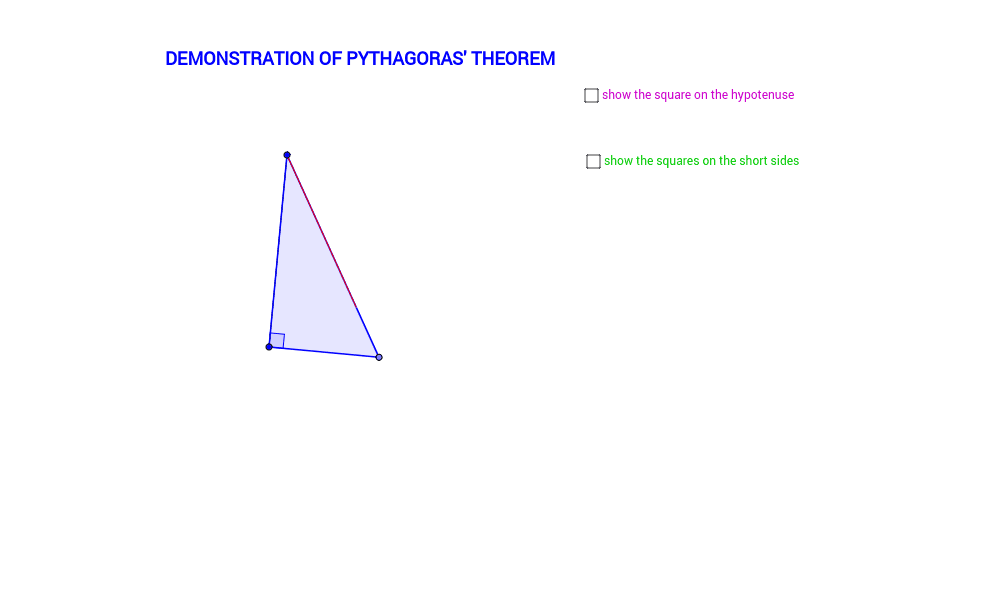
This example demonstrates the Pythagorean theorem, which states that in a right-angled triangle, the square of the hypotenuse is equal to the sum of the squares of the other two sides. Key concepts include right triangles, Pythagorean theorem, and geometric construction. Using GeoGebra commands such as Segment, OrthogonalLine, Point, etc., the construction process of the triangle can be dynamically shown. Suitable for students at the junior high school level and above to learn geometry and algebra.
GeoGebra Commands & Parameters
Segment(triPT_A, triPT_B) → aOrthogonalLine(triPT_B, a) → bPoint(b) → triPT_CRay(triPT_A, triPT_C) → cAngle(triPT_C, triPT_B, triPT_A) → αPolygon(triPT_A, triPT_C, triPT_B) → poly1, b_1, a_1, c_1OrthogonalLine(triPT_A, b_1) → dOrthogonalLine(triPT_C, b_1) → eOrthogonalLine(triPT_C, a_1) → fOrthogonalLine(triPT_B, a_1) → gOrthogonalLine(triPT_B, c_1) → hOrthogonalLine(triPT_A, c_1) → iCircle(triPT_A, triPT_C) → kCircle(triPT_C, triPT_B) → pCircle(triPT_B, triPT_A) → qIntersect(p, h) → F, GIntersect(q, h) → H, IIntersect(p, f) → L, MIntersect(k, d) → D, EOrthogonalLine(E, d) → jOrthogonalLine(I, h) → lOrthogonalLine(M, f) → mIntersect(j, e) → JIntersect(g, m) → KIntersect(l, i) → NIntersect(e, j) → OPolygon(triPT_A, triPT_C, O, E) → hypotSQUARE, a_2, c_2, o, e_1Polygon(triPT_A, N, I, triPT_B) → small_1SQUARE, a_3, n, i_1, b_2Polygon(triPT_B, K, M, triPT_C) → small_2SQUARE, b_3, k_1, m_1, c_3Angle(triPT_C, triPT_A, E) → βAngle(triPT_B, triPT_C, M) → γAngle(triPT_A, triPT_B, I) → δLine(triPT_B, b_1) → d_1Line(triPT_A, c_2) → f_1Intersect(d_1, a_3) → AIntersect(d_1, f_1) → BIntersect(f_1, n) → CIntersect(n, a_3) → PPolygon(C, B, A, P) → cut_1, c_4, b_4, a_4, p_1Intersect(i_1, n) → QPolygon(C, B, triPT_B, Q) → cut_2, c_5, b_5, tript_b, q_1Polygon(A, triPT_A, B) → cut_3, b_6, a_5, tript_aPolygon(triPT_A, triPT_B, B) → cut_4, b_7, tript_1, tript_2Vector(B, triPT_A) → uTranslate(triPT_A, u) → RTranslate(triPT_B, u) → STranslate(B, u) → B'Polygon(R, S, B') → Tcut_4, b', r_2, s_1Intersect(e_1, o) → TVector(B, T) → vTranslate(C, v) → C'Translate(B, v) → B'_1Translate(triPT_B, v) → UTranslate(Q, v) → Q'Polygon(C', B'_1, U, Q') → Tcut_2, c', b'_1, u_1, q'Intersect(o, c_2) → VVector(B, V) → wTranslate(C, w) → C'_1Translate(B, w) → B'_2Translate(A, w) → A'Translate(P, w) → P'Polygon(C'_1, B'_2, A', P') → Tcut_1, c'_1, b'_2, a', p'Vector(B, triPT_C) → zTranslate(A, z) → A'_1Translate(triPT_A, z) → WTranslate(B, z) → B'_3Polygon(A'_1, W, B'_3) → Tcut_3, b'_3, a'_1, w_1Intersect(k_1, b_3) → ZIntersect(m_1, k_1) → A_1Vector(Z, S) → v_1Translate(triPT_B, v_1) → B_1Translate(triPT_C, v_1) → C_1Translate(A_1, v_1) → D_1Translate(Z, v_1) → Z'Polygon(B_1, C_1, D_1, Z') → Tcopy, b_8, c_6, d_2, z'