
Pythagoras' Theorem Demo
Loading the math board and drawing, please wait…
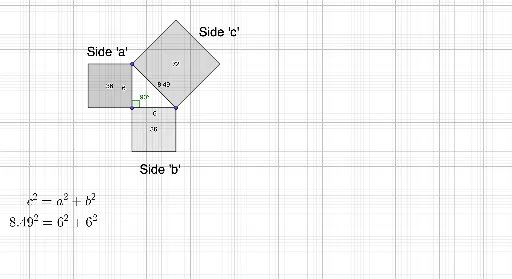
This example demonstrates the Pythagorean Theorem in a right triangle, showing that the sum of the squares of the legs equals the square of the hypotenuse. Core math concepts include Pythagorean Theorem, right triangle, and side length calculations. It is constructed using GeoGebra commands like Segment, OrthogonalLine, Circle, Intersect, Polygon, and Angle. Suitable for middle school geometry education to visually aid understanding of the theorem.
GeoGebra Commands & Parameters
Segment(A, B) → fSegment(B, C) → gSegment(C, A) → hOrthogonalLine(C, h) → iOrthogonalLine(A, h) → jCircle(C, A) → kIntersect(k, i, 2) → HCircle(A, C) → pIntersect(p, j, 2) → IPolygon(A, I, H, C) → q3, a_1, i_1, h_1, c_1Circle(B, C) → cCircle(C, B) → dCircle(B, A) → eCircle(A, B) → qOrthogonalLine(B, g) → lOrthogonalLine(C, g) → mOrthogonalLine(B, f) → nOrthogonalLine(A, f) → rIntersect(d, m, 2) → DIntersect(c, l, 2) → EIntersect(e, n, 2) → FIntersect(q, r, 2) → GPolygon(C, D, E, B) → q1, c_2, d_1, e_1, bPolygon(B, F, G, A) → q2, b_1, f_1, g_1, aAngle(A, B, C) → α
AI Drawing Prompt Reference
Draw a right triangle with one leg horizontal and the other vertical. Construct a square outward on each side of the triangle, so that the square on the hypotenuse is larger than the squares on the legs. Ensure the squares are attached to the triangle sides without overlapping. Mark the right angle inside the triangle. Show that the sum of the areas of the two smaller squares equals the area of the largest square, illustrating the Pythagorean theorem.
The prompt above was compiled from the original drawing commands and is for reference only.