
Proving Parallelograms
Loading the math board and drawing, please wait…
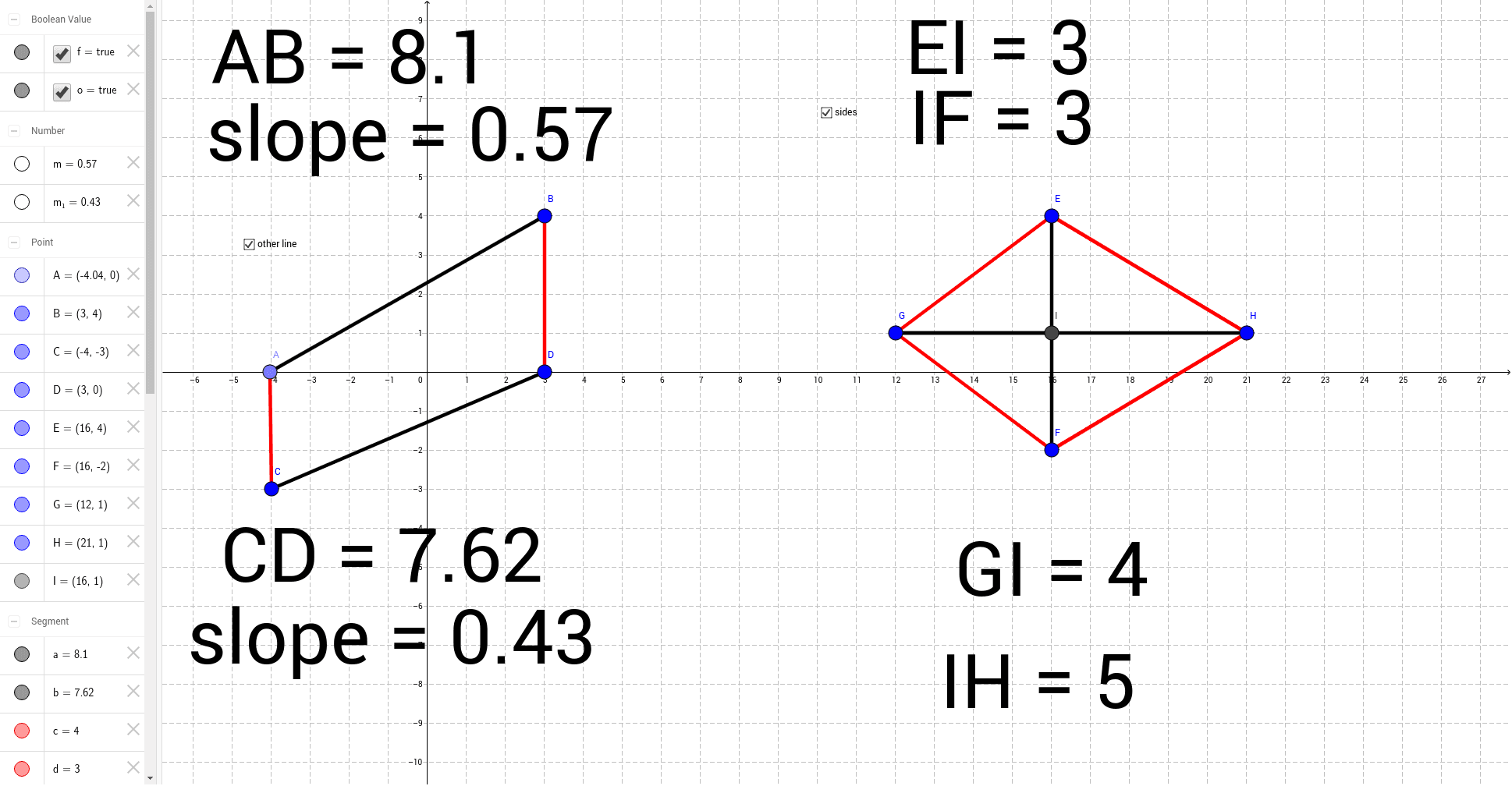
This example demonstrates how to determine if a quadrilateral is a parallelogram by exploring the relationships between opposite sides and diagonals. Core math concepts include parallel lines, equal segments, and bisecting diagonals. Construction highlights the use of GeoGebra commands like Point, Segment, Slope, and Intersect to dynamically visualize and verify the conditions for a parallelogram. Suitable for middle school and above students for geometry learning and exploration.
GeoGebra Commands & Parameters
Point(xAxis) → ASegment(A, B) → aSegment(C, D) → bSegment(B, D) → cSegment(A, C) → dSlope(a) → mSlope(b) → m_1Segment(E, F) → eSegment(G, H) → gSegment(G, E) → hSegment(E, H) → iSegment(H, F) → jSegment(F, G) → kIntersect(g, e) → ISegment(G, I) → lSegment(I, H) → nSegment(I, F) → pSegment(E, I) → q
AI Drawing Prompt Reference
Draw a quadrilateral with labeled opposite sides and diagonals, showing that opposite sides are parallel and equal, and diagonals bisect each other. Start by drawing two parallel line segments as opposite sides, then connect their endpoints to form the quadrilateral. Next, draw the diagonals and prove they bisect each other, then dynamically visualize these relationships for middle school students learning about parallel lines and equal segments.
The prompt above was compiled from the original drawing commands and is for reference only.