
Power of a Product Rules Practice
Loading the math board and drawing, please wait…
In collections
Rechnen mit Potenzen
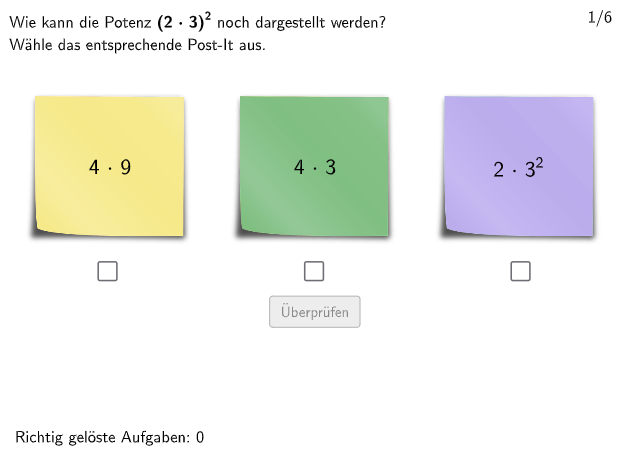
This interactive GeoGebra example helps students master the power of a product rule: (ab)ⁿ = aⁿ × bⁿ. Students need to determine whether given equations are correct and verify their answers. Construction details: Textfield command creates input boxes for student responses, Shuffle randomly orders the questions, Element extracts problems from lists, validate and showanswer enable answer checking and hints, while attemptCount and correctCount track progress. The exercises cover integer exponent operations with products, developing students' ability to describe, apply, and justify basic exponent rules. Suitable for grade 7-8 students as classroom practice or self-review.
GeoGebra Commands & Parameters
Textfield(input1) → InputBox1Textfield(input2) → InputBox2Shuffle(Sequence[Element[Shuffle[Sequence[(k * 2), k, 1, 50] \ Shuffle[Sequence[(k * 10), k, 1, 10]]], i], i, 1, 5]) → RandomList2, {78, 82, 56, 64, 22}Shuffle(Sequence[Element[Shuffle[Sequence[(k * 5), k, 1, 20] \ Shuffle[Sequence[(k * 10), k, 1, 10]]], i], i, 1, 5]) → RandomList5, {65, 15, 45, 15, 55}Shuffle(Sequence[Element[Shuffle[Sequence[(k * 10), k, 1, 10]], i], i, 1, 5]) → RandomList10, {50, 10, 10, 50, 20}Shuffle(Join[{RandomList2, RandomList5, RandomList10}]) → RandomListNum, {82, 15, 55, 15, 50, 65, 56, 20, 50, 64, 10, 22, 45, 78, 10}Shuffle({1, 2, 3, 4, 5, 6}) → ExNumList, {1, 3, 2, 5, 6, 4}Shuffle({1, 2, 3}) → Order, {2, 1, 3}Polygon(PtopLeftCornerFeedback, PtopRightCornerFeedback, PbottomRightCornerFeedback, PbottomLeftCornerFeedback) → rectangleCorrect, rectangleCorrectS3, rectangleCorrectS4, rectangleCorrectS2, rectangleCorrectS1Shuffle(Sequence[Random[0, 10], i, 1, 100]) → randomNosForX, {2, 10, 8, 4, 10, 9, 0, 1, 8, 7, 9, 3, 3, 10, 5, 7, 1, 8, 9, 10, 10, 10, 4, 8, 5, 6, 5, 9, 8, 6, 6, 8, 3, 4, 5, 10, 10, 0, 9, 3, 1, 7, 4, 3, 6, 10, 3, 9, 2, 8, 4, 5, 5, 10, 8, 0, 4, 5, 7, 5, 9, 0, 7, 6, 3, 8, 3, 7, 7, 4, 8, 10, 7, 9, 1, 7, 3, 4, 9, 5, 10, 5, 8, 4, 3, 3, 7, 5, 4, 6, 10, 8, 5, 2, 5, 8, 6, 8, 4, 1}Element(randomNosForX, Mod[questionCount, 100] + 1) → numXShuffle(Sequence[Random[0, 10], i, 1, 100]) → randomNosForY, {1, 7, 7, 9, 0, 0, 9, 2, 9, 6, 0, 7, 0, 4, 4, 8, 4, 3, 6, 3, 1, 10, 3, 9, 1, 9, 9, 0, 9, 8, 5, 5, 6, 1, 1, 9, 5, 9, 4, 6, 4, 2, 5, 8, 0, 7, 5, 0, 3, 5, 7, 7, 10, 10, 9, 6, 0, 7, 3, 5, 6, 0, 1, 0, 7, 10, 10, 9, 8, 8, 4, 10, 10, 3, 4, 0, 3, 10, 8, 4, 1, 2, 4, 7, 8, 7, 10, 6, 4, 6, 3, 5, 8, 0, 10, 5, 6, 5, 8, 4}Element(randomNosForY, Mod[questionCount, 100] + 1) → numYAppend(true, Sequence[If[randomNosForX(i) ≟ randomNosForX(i - 1), false, true], i, 2, 100]) → stayXAppend(true, Sequence[If[randomNosForY(i) ≟ randomNosForY(i - 1), false, true], i, 2, 100]) → stayYRemove(Sequence[If[stayX(i), randomNosForX(i), 0], i, 1, 100], Sequence[0, i, 1, 100]) → randomNosForXwithoutRepeatRemove(Sequence[If[stayY(i), randomNosForY(i), 0], i, 1, 100], Sequence[0, i, 1, 100]) → randomNosForYwithoutRepeatElement(randomNosForXwithoutRepeat, Mod[questionCount, Length[randomNosForXwithoutRepeat]] + 1) → numXwithoutRepeatElement(randomNosForYwithoutRepeat, Mod[questionCount, Length[randomNosForYwithoutRepeat]] + 1) → numYwithoutRepeatShuffle({1, 2}) → Vis1, {2, 1}Shuffle({1, 2}) → Vis2, {2, 1}Shuffle({1, 2}) → Vis3, {2, 1}Corner(PostIt11, 3) → PostIt1_3Corner(PostIt11, 4) → PostIt1_4Corner(PostIt21, 3) → PostIt2_3Corner(PostIt21, 4) → PostIt2_4Corner(PostIt31, 3) → PostIt3_3Corner(PostIt31, 4) → PostIt3_4Length(AuswahlAnzahlList) → auswahlanzahlText(correctText, CorrP, false, true, 0, 0) → Text4Text(PostText1Helper, A, false, true, 0, 0) → PostText1Text(PostText2Helper, B, false, true, 0, 0) → PostText2Text(PostText3Helper, C, false, true, 0, 0) → PostText3
AI Drawing Prompt Reference
Draw a graph containing multiple randomly distributed points, where the coordinates of the points are generated from two random number sequences, each number in the sequence representing a point's coordinate on the x-axis or y-axis. The graph also includes a sequence of randomly distributed points to indicate whether certain points have consecutive or repeated coordinates. Please generate these points based on the given random number sequences and plot them on the graph.
The prompt above was compiled from the original drawing commands and is for reference only.