
Polynomial Index Multiplication with Randomized Selection
Loading the math board and drawing, please wait…
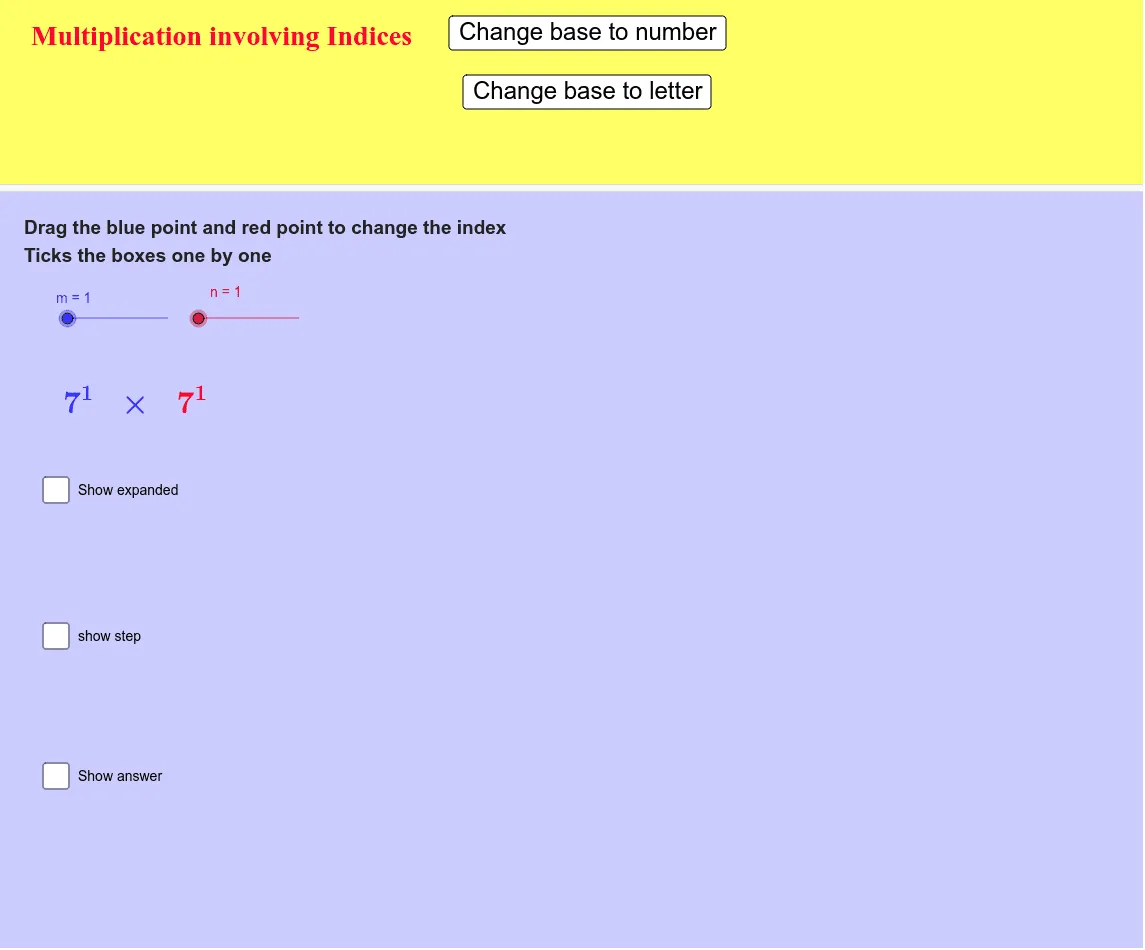
This example demonstrates how to construct a polynomial-style expression using randomized “index” choices and then apply index multiplication to form a displayed product term. It highlights dynamic algebra generation: selecting appropriate bases and index parameters, using conditional logic to determine which exponents/indices to use, and composing the resulting multiplication expression that can drive subsequent curve sketching or related visualizations. The key mathematical ideas are polynomial representation, indexed/exponent-based algebra, and building a product structure from selected indices (often useful when connecting algebraic forms to combinatorial or trigonometric curve behaviors). From the construction summary, the build uses GeoGebra commands/objects such as RandomElement (to pick from basesLetters, basesNumbers, base), If (to branch the logic controlling a1More, a1Selected, a2Selected, and related parameters like m and n), and FormulaText to assemble a readable expression in the form of an index/exponent term multiplied by another chosen component (using objects like text3/text4/text7/text9, and interactive controls button1/button2/text1). Suitable for students learning algebraic structures and using GeoGebra for interactive, visualization-driven exploration.
GeoGebra Commands & Parameters
RandomElement(basesNumbers) → baseIf(m ≤ 10, First[a1Ten, (m * 2) - 1], a1More) → a1SelectedIf(n ≤ 10, First[a1Ten, (n * 2) - 1], a1More) → a2Selected
AI Drawing Prompt Reference
Create a single canvas showing a polynomial-style algebraic product term built from randomized index choices. First randomly select a base number (base) from a predefined number set. Then, using a conditional rule based on m, choose an index/exponent option: if m ≤ 10, pick the first candidate at index (m*2)-1 from the restricted list; otherwise pick from the extended list to obtain a1Selected. Do the same for n to obtain a2Selected, again using the rule “≤ 10” with (n*2)-1 for the restricted list. Combine the selected index/exponent pieces, together with the corresponding letter/exponent relationship, into a displayed multiplication-style term so the expression structure can be used to guide later curve sketching or related visualizations.
The prompt above was compiled from the original drawing commands and is for reference only.