
Parts of a Trapezoid: Sides, Angles, and Midsegment
Loading the math board and drawing, please wait…
In collections
Properties of Trapezoids and Kites
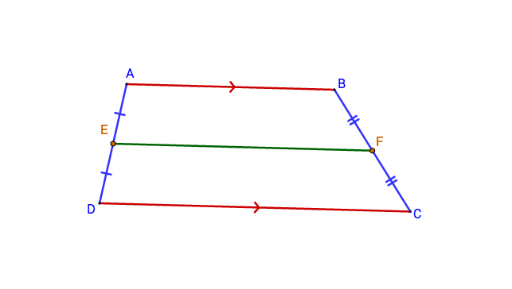
This GeoGebra example visually dissects a trapezoid, highlighting its fundamental components: the two parallel bases, the non-parallel legs, diagonals, and the midsegment connecting the midpoints of the legs. The core mathematical concepts include the definition and properties of a trapezoid, the midsegment theorem (which states the midsegment is parallel to the bases and its length is the average of the base lengths), and basic geometric construction. The construction uses GeoGebra commands such as Segment, Line, Point, and Midpoint to create the trapezoid's vertices and edges, then constructs the midsegment by finding midpoints of the legs. This resource is ideal for middle school geometry lessons introducing trapezoid anatomy, as well as for high school students reviewing foundational quadrilateral properties. It serves as an interactive visual aid for teachers and a self-exploration tool for students.
GeoGebra Commands & Parameters
Segment(A, B) → fSegment(A, D) → gLine(D, f) → hPoint(h) → CSegment(B, C) → iSegment(D, C) → jMidpoint(g) → EMidpoint(i) → FSegment(E, F) → kSegment(E, A) → lSegment(B, F) → mSegment(E, D) → nSegment(F, C) → p