
Parallelogram Heights
Loading the math board and drawing, please wait…
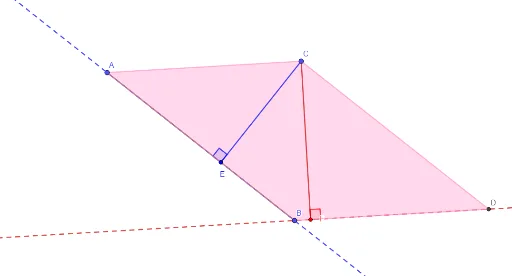
This example demonstrates the construction and properties of heights in a parallelogram. It involves core mathematical concepts like parallelograms, curve sketching, quadratic equations, geometric distribution, reflection, and arithmetic. The construction uses GeoGebra commands such as Segment, Line, Intersect, Polygon, OrthogonalLine, and Angle. It is suitable for high school mathematics education to understand the geometric properties and calculations of parallelograms.
GeoGebra Commands & Parameters
Segment(A, B) → fLine(A, C) → gLine(B, g) → hLine(C, f) → iIntersect(h, i) → DPolygon(A, C, D, B) → q1, a, c, d, bLine(A, B) → jOrthogonalLine(C, j) → kIntersect(j, k) → ESegment(C, E) → lOrthogonalLine(C, d) → mIntersect(m, h) → FSegment(C, F) → nAngle(C, E, A) → αAngle(D, F, C) → β