
Measuring Volume 4: Spatial Construction of Cubes and Prisms
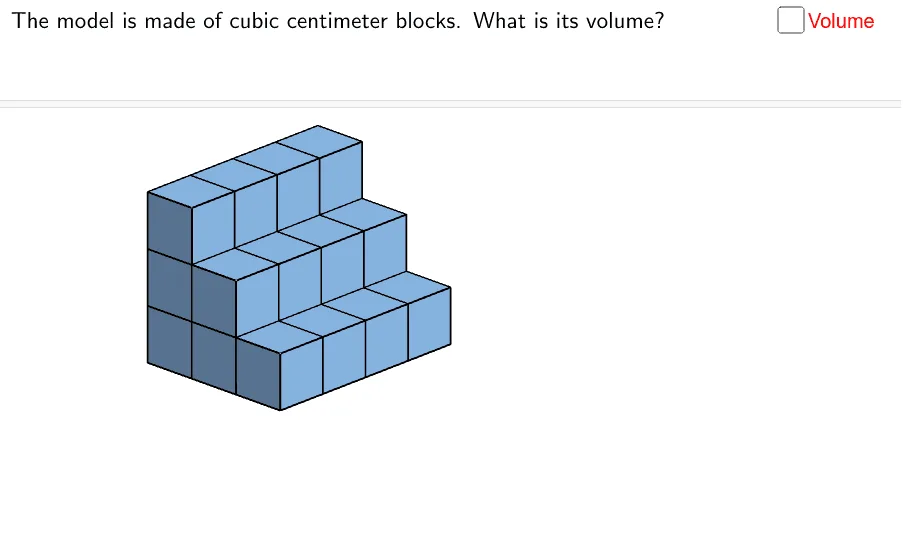
This GeoGebra applet, titled Measuring Volume 4: Spatial Construction of Cubes and Prisms, provides a comprehensive interactive environment for exploring the measurement of volume and the precise construction of three-dimensional figures in solid geometry. Utilizing core GeoGebra commands such as Point, Cube, and Translate, the applet dynamically builds complex geometric objects composed of multiple faces, vertices, and edges, including right prisms and composite cube structures. The model visually illustrates the structural characteristics and volume calculation principles of these geometric solids, making abstract spatial concepts tangible for learners.
In terms of interaction, students and educators can fully manipulate the three-dimensional workspace. Users can rotate, pan, and zoom the 3D view to examine the constructed figures from any perspective, which is essential for developing strong spatial visualization skills. By clicking and dragging foundational control points, learners can dynamically alter the side lengths and overall dimensions of the cubes and prisms. As the geometry updates in real time, students can observe exactly how these dimensional changes impact the calculated volume, reinforcing the relationship between linear measurements and cubic units.
Mathematically, the applet places a strong emphasis on spatial transformations and vector geometry. The Translate command is used explicitly to demonstrate how a two-dimensional base polygon can be extruded along a specific three-dimensional vector to form a prism. This allows students to visually trace the direction and magnitude of translation vectors, bridging the gap between algebraic vector operations and physical geometric extrusions. Furthermore, by constructing composite shapes from individual unit cubes or simpler prisms, the applet illustrates the additive property of volume, showing how complex solids can be decomposed into manageable, measurable components.
The pedagogical benefits of this applet are substantial for middle and high school solid geometry instruction. It transitions students away from rote memorization of volume formulas and toward a deep, conceptual understanding of three-dimensional space. By actively participating in the spatial construction process, students improve their geometric intuition, master the application of translation vectors in 3D space, and build a robust foundation for advanced topics in multivariable calculus and engineering design. Ultimately, this tool transforms the traditional mathematics classroom into an active laboratory for spatial discovery and geometric reasoning.
Loading the math board and drawing, please wait…