
Investigating Escher's Pegasus Tesselation
Loading the math board and drawing, please wait…
In collections
Escher's tesselations
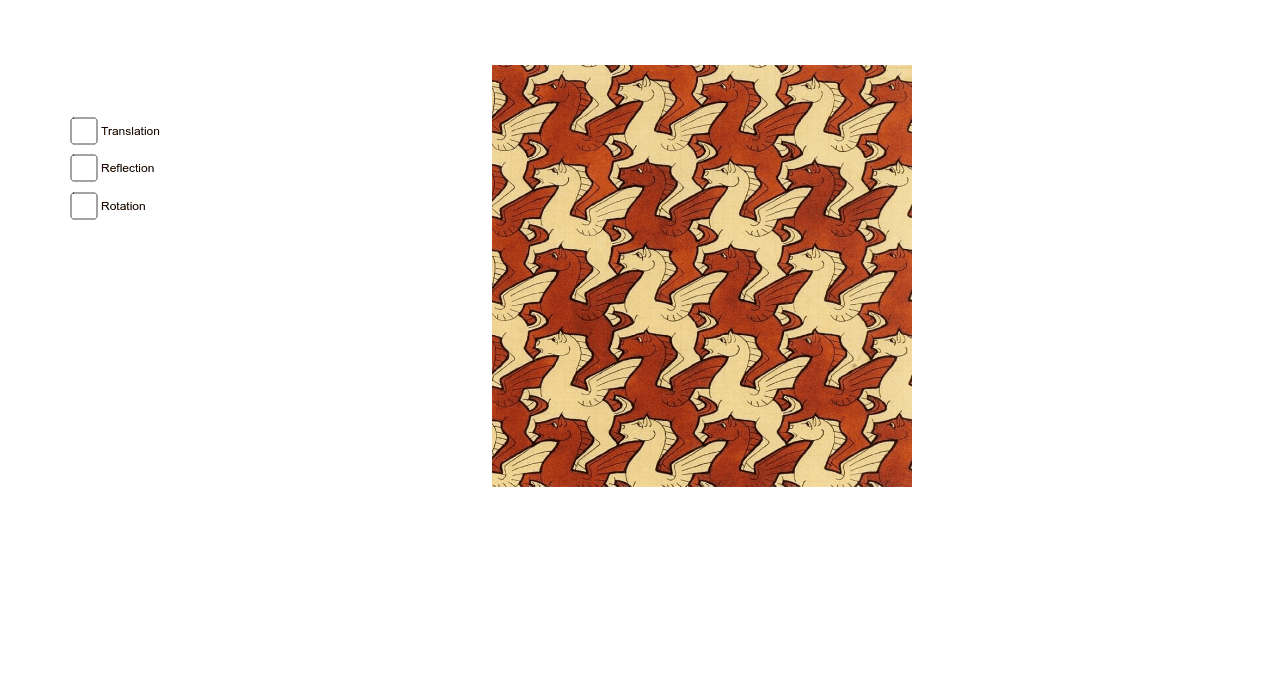
This example demonstrates the generation process and symmetry of Escher's Pegasus tessellation. Key math concepts include symmetry, trapezoid, stochastic process, area, straight lines, and line segments. Construction highlights involve using GeoGebra commands like Vector, Translate, Line, Mirror, Rotate, and objects such as C, D, u, A, B, image1. Suitable for high school and above learners to understand fractal geometry and transformation geometry.
GeoGebra Commands & Parameters
Vector(C, D) → uTranslate(image1, u) → image1'Line(E, F) → aMirror(image1, a) → image1'_1Rotate(image1, α, G) → image1'_2
AI Drawing Prompt Reference
Create Escher's Pegasus tiling. First, draw vector CD and translate image1 along vector CD to get image1'. Then, draw line EF and mirror image1 across line EF to get image1'_1. Finally, rotate image1 around point G to get image1'_2. Observe the symmetry and transformations in the pattern.
The prompt above was compiled from the original drawing commands and is for reference only.