
Investigating Adding Fractions by laura.rees-hughes
Loading the math board and drawing, please wait…
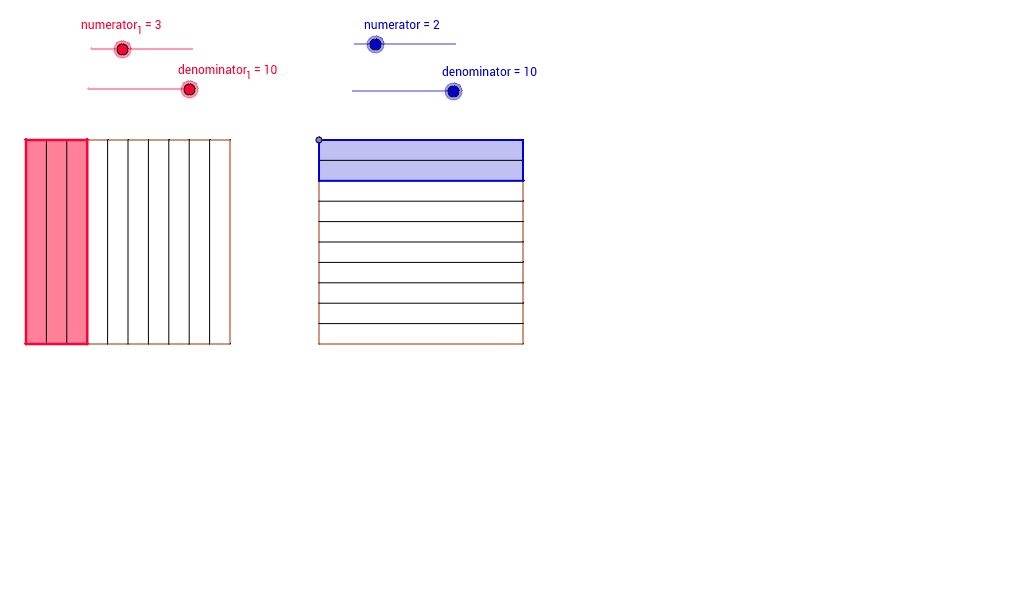
This example demonstrates how to explore the addition of fractions using GeoGebra. Key mathematical concepts include fractions and addition. Dynamic demonstrations of fraction addition are achieved using GeoGebra commands such as OrthogonalLine, Circle, Intersect, etc. Suitable for high-grade elementary and junior high school students.
GeoGebra Commands & Parameters
OrthogonalLine(A, yAxis) → eOrthogonalLine(A, e) → fCircle(A, size) → hIntersect(h, e, 1.0) → BIntersect(h, f, 2.0) → CIntersect(h, e, 1.0) → DOrthogonalLine(B, e) → iIntersect(h, f, 2.0) → EOrthogonalLine(C, f) → jIntersect(i, j) → FPolygon(A, B, F, C) → P, a_1, b_1, f_1, c_1Circle(A, VarRadius) → kIntersect(k, a_1) → G,Circle(G, A) → pIntersect(p, a_1, 2.0) → HCircle(H, G) → qIntersect(q, a_1) → I, JCircle(J, H) → rIntersect(r, a_1) → K, LCircle(L, J) → sIntersect(s, a_1) → M, NCircle(N, L) → tIntersect(t, a_1) → O, QCircle(Q, N) → d_1Intersect(d_1, a_1) → R, SCircle(S, Q) → e_1Intersect(e_1, a_1) → T, UCircle(U, S) → g_1Intersect(g_1, a_1) → V, WCircle(W, U) → h_1OrthogonalLine(G, a_1) → lOrthogonalLine(H, a_1) → mOrthogonalLine(J, a_1) → nOrthogonalLine(L, a_1) → i_1OrthogonalLine(N, a_1) → j_1OrthogonalLine(Q, a_1) → k_1OrthogonalLine(S, a_1) → l_1OrthogonalLine(U, a_1) → m_1OrthogonalLine(W, a_1) → n_1Intersect(f_1, l) → YIntersect(f_1, m) → ZIntersect(f_1, n) → A_1Intersect(f_1, i_1) → B_1Intersect(f_1, j_1) → C_1Intersect(f_1, k_1) → D_1Intersect(l_1, f_1) → E_1Intersect(f_1, m_1) → F_1Intersect(f_1, n_1) → G_1Ray(A, B) → p_1Point(p_1) → H_1Vector(A, H_1) → uTranslate(A, u) → A'Translate(B, u) → B'Translate(F, u) → F'Translate(C, u) → C'Polygon(A', B', F', C') → P', a', b', f', c'OrthogonalLine(V, a_1) → q_1Circle(V, U) → r_1Segment(G, Y) → s_1Segment(H, Z) → t_1Segment(J, A_1) → a_2Segment(L, B_1) → b_2Segment(N, C_1) → c_2Segment(Q, D_1) → d_2Segment(S, E_1) → e_2Segment(U, F_1) → f_2Segment(W, G_1) → g_2Circle(H_1, VarRadius_2) → h_2Intersect(h_2, c', 1.0) → J_1Circle(J_1, H_1) → k_2Intersect(k_2, c', 2.0) → K_1Circle(K_1, J_1) → p_2Intersect(p_2, c', 2.0) → L_1Circle(L_1, K_1) → q_2Intersect(q_2, c', 2.0) → M_1Circle(M_1, L_1) → r_2Intersect(r_2, c', 2.0) → N_1Circle(N_1, M_1) → s_2Intersect(s_2, c') → O_1, P_1Circle(P_1, N_1) → t_2Intersect(t_2, c', 2.0) → Q_1Circle(Q_1, P_1) → c_3Intersect(c_3, c', 2.0) → R_1Circle(R_1, Q_1) → d_3Intersect(d_3, c', 2.0) → S_1Circle(S_1, R_1) → e_3OrthogonalLine(J_1, c') → i_2OrthogonalLine(K_1, c') → j_2OrthogonalLine(L_1, c') → l_2OrthogonalLine(M_1, c') → m_2OrthogonalLine(N_1, c') → n_2OrthogonalLine(P_1, c') → a_3OrthogonalLine(Q_1, c') → b_3OrthogonalLine(R_1, c') → f_3OrthogonalLine(S_1, c') → g_3Intersect(b', i_2) → T_1Intersect(b', j_2) → U_1Intersect(b', l_2) → V_1Intersect(b', m_2) → W_1Intersect(b', n_2) → Y_1Intersect(b', a_3) → Z_1Intersect(b', b_3) → A_2Intersect(b', f_3) → B_2Intersect(b', g_3) → C_2Segment(J_1, T_1) → h_3Segment(U_1, K_1) → i_3Segment(L_1, V_1) → j_3Segment(W_1, M_1) → k_3Segment(N_1, Y_1) → l_3Segment(Z_1, P_1) → m_3Segment(Q_1, A_2) → n_3Segment(B_2, R_1) → p_3Segment(S_1, C_2) → q_3Circle(A, VarWidth_1) → r_3Intersect(r_3, a_1) → D_2, S_2OrthogonalLine(D_2, f_1) → s_3Intersect(s_3, f_1) → E_2OrthogonalLine(E_2, s_3) → t_3Intersect(t_3, c_1) → F_2Polygon(A, D_2, E_2, F_2) → P_2, a_4, d_4, e_4, f_4OrthogonalLine(O, a_1) → b_4Intersect(b_4, f_1) → G_2Circle(O, N) → g_4Circle(O_1, N_1) → q_4OrthogonalLine(O_1, c') → t_4Circle(H_1, VarWidth_2) → h_5Intersect(h_5, c') → F_3,OrthogonalLine(F_3, c') → i_5Intersect(i_5, b') → G_3Polygon(H_1, F_3, G_3, B') → P_3, h_6, f_6, g_6, b'_1