
Intersection of a Plane and a Cone
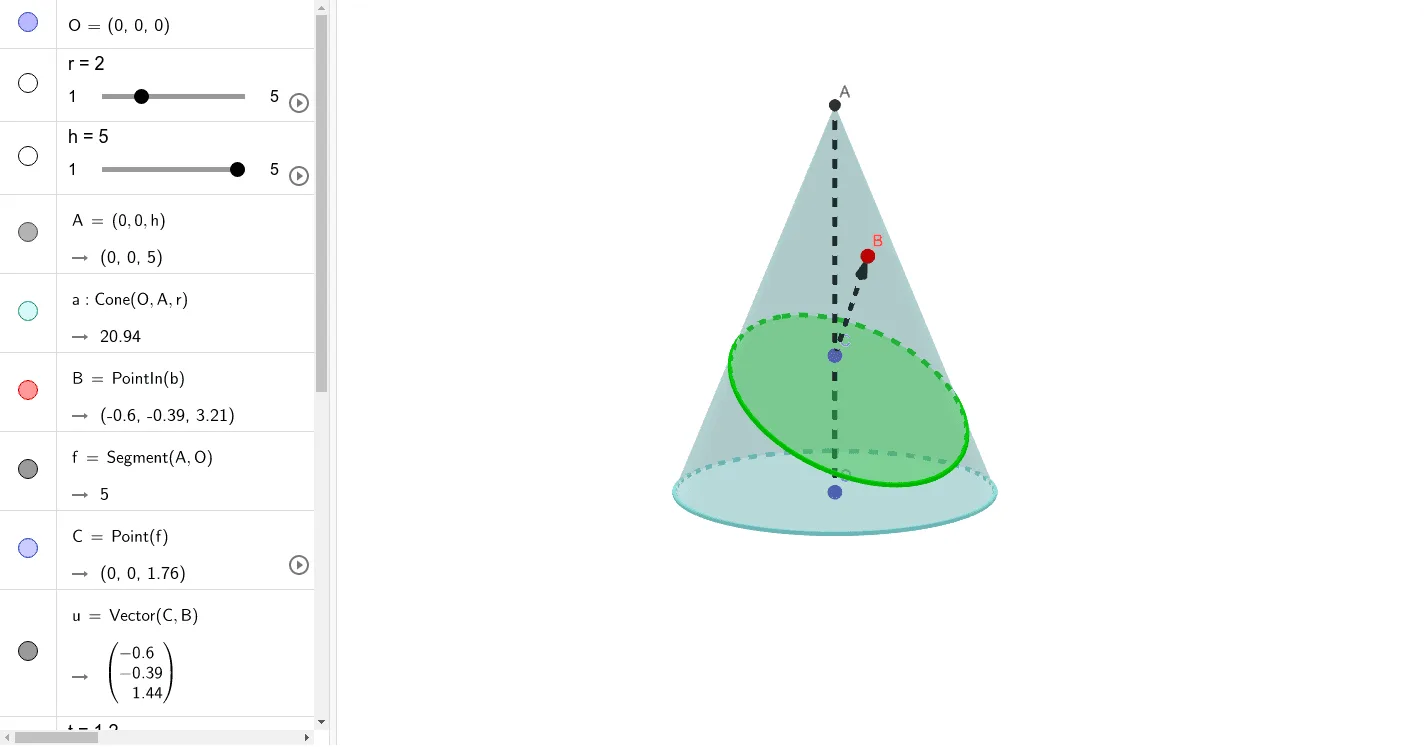
This GeoGebra applet demonstrates how conic sections are formed by the intersection of a plane and a cone. The visualization constructs a double-napped cone using geometric elements such as points, vectors, and orthogonal planes, then allows the user to dynamically adjust the angle and position of an intersecting plane. As the plane is rotated or shifted, the applet animates the resulting cross-sectional curve in real time, clearly showing how ellipses, parabolas, and hyperbolas emerge under different geometric conditions.
When the plane intersects only one nappe of the cone at an angle steeper than the cone's side, the cross-section is a closed ellipse, including the special case of a circle when the plane is perpendicular to the cone's axis. When the plane is parallel to exactly one generator line of the cone, the intersection becomes an open parabola. When the plane's angle is shallower than the cone's side and cuts through both nappes, two separate branches appear, forming a hyperbola. Degenerate cases such as a point, a single line, or intersecting lines may also be explored if the construction permits.
The applet supports interactive manipulation, enabling students to drag controls that change the inclination of the cutting plane, shift its height relative to the cone's apex, or toggle visibility of individual geometric components. This hands-on exploration fosters a deep spatial understanding of why each conic section arises from a specific angular relationship between the plane and the cone. Rather than relying on memorization, learners observe the continuous transition from ellipse to parabola to hyperbola, gaining insight into the unified geometric origin of all conic curves.
Educators can use this applet in classroom settings or for independent study to reinforce topics in solid geometry, analytic geometry, and pre-calculus. The dynamic nature of the visualization helps bridge the gap between abstract algebraic definitions of conics and their concrete geometric construction, making it a valuable tool for building mathematical intuition. By actively engaging with the model, students develop a stronger conceptual foundation that supports later work with conic section equations, properties, and applications.
In collections
Cross-Sections of Common 3D Shapes
Loading the math board and drawing, please wait…