
Incenter and Incircle of a Triangle
Loading the math board and drawing, please wait…
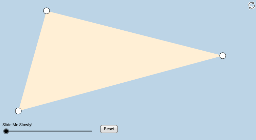
This applet dynamically illustrates the properties of the incenter and incircle of a triangle. Key mathematical concepts include the definition of the incenter and the properties of the incircle. Using GeoGebra commands such as Line, Circle, Incircle, etc., the relationship between the incenter and the incircle can be observed. Suitable for students at the middle school level and above to learn triangle geometry.
GeoGebra Commands & Parameters
Line(A, B) → dSlope(d) → aPointIn(c) → CLine(A, C) → eLine(B, C) → fAngle(B, A, C) → αAngle(A, C, B) → βAngle(C, B, A) → γSegment(A, C) → gSegment(C, B) → hSegment(B, A) → iMin(list1) → jCircle(C, (0.2 * j)) → qCircle(A, (0.2 * j)) → pCircle(B, (0.2 * j)) → kIntersect(q, f, 2) → DIntersect(q, e, 1) → EIntersect(q, e, 2) → FIntersect(p, e, 2) → GIntersect(p, d, 1) → HIntersect(k, f, 2) → I_2Intersect(k, d, 2) → JIntersect(d, i) → KIntersect(d, i) → LIntersect(k, f, 1) → NIntersect(p, e, 1) → OIntersect(p, d, 2) → PAngle(D, C, E) → δAngle(O, A, P) → εAngle(J, B, I_2) → ηAngle(G, A, H) → θIncircle(A, B, C) → rCenter(r) → ILine(C, I) → lLine(A, I) → nLine(B, I) → sIntersect(e, s) → RIntersect(d, l) → SIntersect(f, n) → TPolygon(A, B, C) → poly1, c_1, a_1, b_1Rotate(D, δ / 2, C) → D'Angle(D, C, D') → κRotate(J, η / 2, B) → J'Angle(J, B, J') → λRay(C, D') → tRay(B, J') → e_1Rotate(O, ε / 2, A) → O'Angle(O, A, O') → ιRay(A, O') → d_1Segment(C, S) → f_1Segment(A, T) → g_1Segment(B, R) → h_1Intersect(q, f_1, 1) → UIntersect(q, f, 1) → VIntersect(p, g_1, 1) → WIntersect(k, h_1, 1) → ZCircleSector(C, E, U) → k_1CircleSector(A, P, W) → q_1CircleSector(B, I_2, Z) → p_1Dilate(C, If[0 < m ≤ 1, 1 - m, 0], S) → C'Segment(C, C') → i_1Rotate(k_1, If[1 < m ≤ 2, ((m - 1) * β / 2), β / 2], C) → r_1Dilate(B, If[2 < m ≤ 3, 3 - m, 0], R) → B'Segment(B, B') → j_1Rotate(p_1, If[3 < m ≤ 4, ((m - 3) * γ / 2), γ / 2], B) → s_1Dilate(A, If[4 < m ≤ 5, 5 - m, 0], T) → A'Segment(A, A') → l_1Rotate(q_1, If[5 < m ≤ 6, ((m - 5) * α / 2), α / 2], A) → t_1OrthogonalLine(I, f) → m_1OrthogonalLine(I, d) → n_1OrthogonalLine(I, e) → a_2Intersect(f, m_1) → MIntersect(d, n_1) → A_1Intersect(e, a_2) → B_1Segment(I, M) → b_2Circle(M, (0.2 * b_2)) → c_2Intersect(c_2, f, 1) → C_1Intersect(c_2, b_2, 1) → D_1Intersect(c_2, f, 2) → E_1CircleSector(M, E_1, D_1) → d_2Dilate(I, If[6 < m ≤ 7, 7 - m, 0], M) → Q'Segment(I, Q') → e_2Rotate(d_2, If[7.5 < m ≤ 8.5, ((m - 7.5) * π / 2), 1.5707963267948966], M) → f_2Segment(I, B_1) → g_2Segment(I, A_1) → h_2Circle(B_1, (0.2 * g_2)) → k_2Circle(A_1, (0.2 * h_2)) → p_2Intersect(k_2, e, 2) → F_1Intersect(k_2, g_2, 1) → G_1Intersect(k_2, e, 1) → H_1Intersect(p_2, d, 2) → I_1Intersect(p_2, h_2, 1) → J_1Intersect(p_2, d, 1) → K_1Dilate(I, If[8.5 < m ≤ 9.5, 9.5 - m, 0], B_1) → Q'_1Segment(I, Q'_1) → i_2CircleSector(B_1, H_1, G_1) → q_2CircleSector(A_1, I_1, J_1) → r_2Rotate(q_2, If[10 < m ≤ 11, ((m - 10) * π / 2), 1.5707963267948966], B_1) → s_2Dilate(I, If[11 < m ≤ 12, 12 - m, 0], A_1) → Q'_2Segment(I, Q'_2) → j_2Rotate(r_2, If[12.5 < m ≤ 13.5, ((m - 12.5) * π / 2), 1.5708], A_1) → t_2Angle(M, I, B_1) → ζAngle(B_1, I, A_1) → μAngle(A_1, I, M) → νRotate(I, If[14 < m ≤ 15, ((m - 14) * ζ), ζ], I) → Q'_3Rotate(Q', If[14 < m ≤ 15, ((m - 14) * ζ), ζ], I) → Q''Segment(Q'_3, Q'') → l_2Rotate(Q'_3, If[15 < m ≤ 16, ((m - 15) * μ), μ], I) → L_1Rotate(Q'', If[15 < m ≤ 16, ((m - 15) * μ), μ], I) → Q'''Segment(L_1, Q''') → m_2Rotate(A_1, If[16 < m ≤ 18, ((m - 16) * π), 6.28319], I) → M'Intersect(m_1, f) → QCircle(I, Q) → d_3Line(A, B) → n_2CircleArc(I, A_1, M') → c_3