
HW Exercise 1.3 (#15 Constructions)
Loading the math board and drawing, please wait…
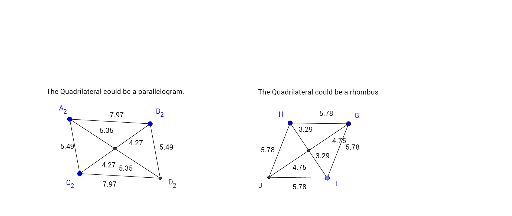
This GeoGebra example demonstrates a step-by-step geometric construction exercise, likely from a homework set, involving the creation of equilateral triangles, circles, perpendicular lines, midpoints, and other geometric elements. The core mathematical concepts include classical geometric construction rules, properties of equilateral triangles, relationships between lines and circles, and the use of perpendiculars and midpoints. The construction utilizes GeoGebra commands such as Line, Segment, Intersect, Midpoint, Circle, Point, OrthogonalLine, and Distance, along with numerous labeled objects (points, lines, circles, and text) to build the final figure. This is suitable for high school or introductory college geometry courses, helping students practice and understand the logical sequence of geometric constructions.
GeoGebra Commands & Parameters
Line(A_2, B_2) → fSegment(A_2, C_2) → gLine(C_2, f) → hLine(B_2, g) → iIntersect(h, i) → D_2Segment(B_2, D_2) → jSegment(C_2, D_2) → kSegment(A_2, B_2) → lSegment(C_2, B_2) → mSegment(A_2, D_2) → nMidpoint(m) → E_2Midpoint(n) → FSegment(C_2, E_2) → pSegment(E_2, A_2) → qSegment(E_2, B_2) → rSegment(E_2, D_2) → sSegment(G, H) → tCircle(G, H) → cPoint(c) → ISegment(G, I) → aLine(I, t) → bLine(H, a) → dIntersect(b, d) → JSegment(H, J) → eSegment(I, J) → f_1Segment(J, G) → g_1Segment(H, I) → h_1Midpoint(h_1) → KMidpoint(g_1) → LSegment(H, K) → i_1Segment(J, K) → j_1Segment(K, G) → k_1Segment(K, I) → l_1Segment(M, N) → m_1OrthogonalLine(M, m_1) → n_1OrthogonalLine(N, m_1) → p_1Point(n_1) → OLine(O, m_1) → q_1Intersect(p_1, q_1) → PSegment(O, P) → r_1Segment(M, O) → s_1Segment(N, P) → t_1Segment(M, P) → a_1Segment(N, O) → b_1Midpoint(a_1) → QMidpoint(b_1) → RSegment(M, Q) → c_1Segment(O, Q) → d_1Segment(Q, N) → e_1Segment(Q, P) → f_2Segment(S, T) → g_2Circle(S, T) → c_2OrthogonalLine(S, g_2) → h_2OrthogonalLine(T, g_2) → i_2Intersect(c_2, h_2, 2) → ULine(U, g_2) → j_2Intersect(i_2, j_2) → VSegment(U, V) → k_2Segment(V, T) → l_2Segment(S, U) → m_2Segment(T, U) → n_2Segment(S, V) → p_2Midpoint(n_2) → WMidpoint(p_2) → ZSegment(T, W) → q_2Segment(W, V) → r_2Segment(W, S) → s_2Segment(W, U) → t_2Circle(A, B) → d_2Point(d_2) → CPoint(d_2) → DPoint(d_2) → ESegment(C, B) → a_2Segment(C, D) → b_2Segment(D, E) → e_2Segment(E, B) → f_3Segment(C, E) → g_3Segment(D, B) → h_3Intersect(g_3, h_3) → A_1Segment(D, A_1) → i_3Segment(C, A_1) → j_3Segment(A_1, B) → k_3Segment(A_1, E) → l_3Distance(j_3, k_3) → o