
Hexagons and Related Geometric Constructions
Loading the math board and drawing, please wait…
In collections
polygons (GER)
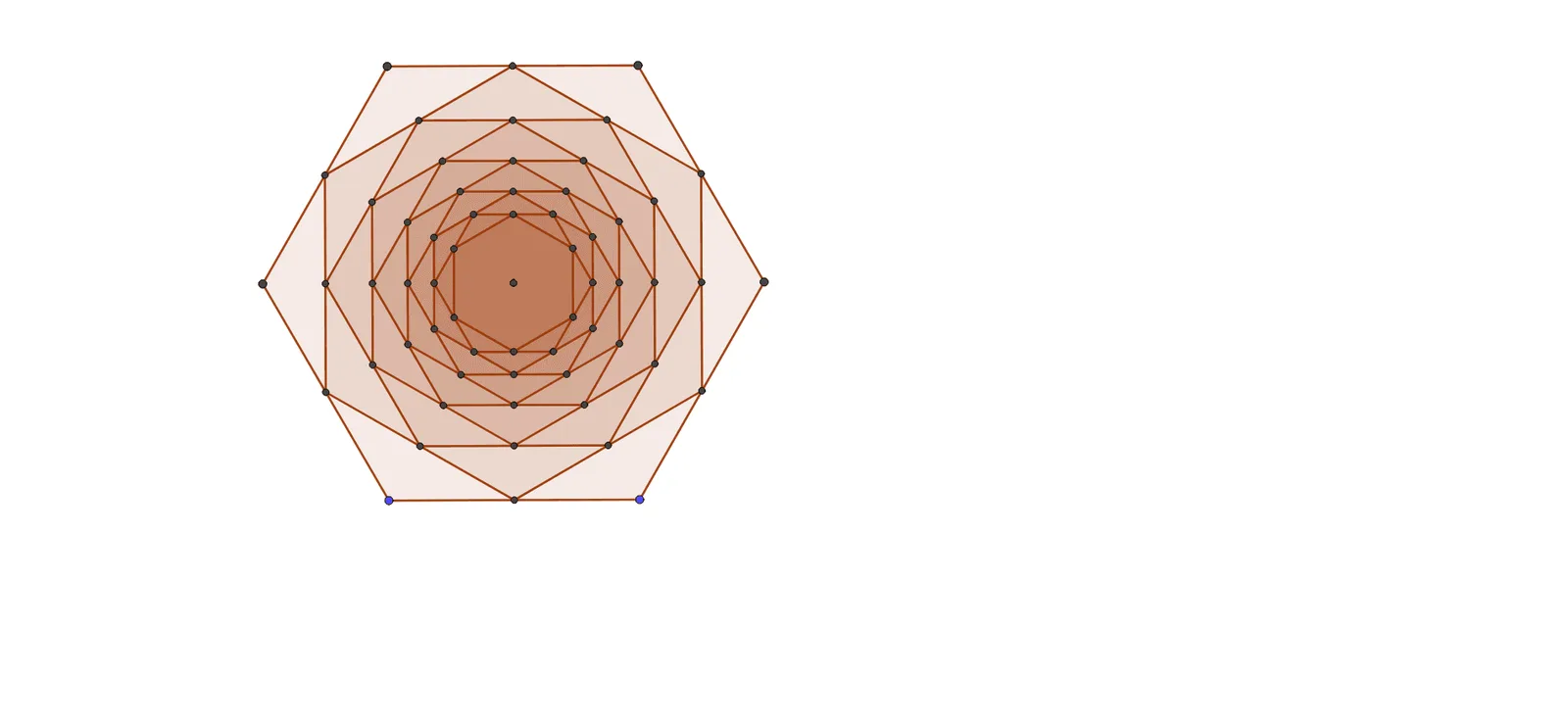
This example demonstrates the construction of hexagons and their relationships with inscribed circles, centers, midpoints, centroids, and other geometric elements. Key math concepts include polygon construction, trigonometric functions, coordinate geometry, properties of incircles, and stochastic processes. GeoGebra commands/objects used are Polygon, Midpoint, Centroid, etc. Suitable for high school mathematics teaching, geometric construction practice, and function graph analysis.
GeoGebra Commands & Parameters
Polygon(A, B, 6) → poly1, f, F, g, h, i, j, k, C, D, EMidpoint(f) → GMidpoint(k) → HPolygon(H, G, 6) → poly2, l, L, m, n, p, q, r, I, J, KCentroid(poly1) → MMidpoint(r) → NMidpoint(l) → OPolygon(N, O, 6) → poly3, s, S, t, a, b, c, d, P, Q, RMidpoint(N, O) → TMidpoint(N, S) → UPolygon(U, T, 6) → poly4, e, A_1, f_1, g_1, h_1, i_1, j_1, V, W, ZMidpoint(f_1) → B_1Centroid(poly3) → C_1Midpoint(e) → D_1Polygon(D_1, B_1, 6) → poly5, k_1, H_1, l_1, m_1, n_1, p_1, q_1, E_1, F_1, G_1Centroid(poly5) → I_1Centroid(poly5) → J_1Midpoint(k_1) → K_1Midpoint(q_1) → L_1Polygon(L_1, K_1, 6) → poly6, r_1, P_1, s_1, t_1, a_1, b_1, c_1, M_1, N_1, O_1Midpoint(r_1) → Q_1Midpoint(s_1) → R_1Polygon(Q_1, R_1, 6) → poly7, d_1, V_1, e_1, f_2, g_2, h_2, i_2, S_1, T_1, U_1Midpoint(d_1) → W_1Centroid(poly7) → Z_1Midpoint(e_1) → A_2Polygon(W_1, A_2, 6) → poly8, j_2, E_2, k_2, l_2, m_2, n_2, p_2, B_2, C_2, D_2Midpoint(j_2) → F_2Midpoint(k_2) → G_2Polygon(F_2, G_2, 6) → poly9, q_2, K_2, r_2, s_2, t_2, a_2, b_2, H_2, I_2, J_2Centroid(poly8) → L_2Midpoint(b_2) → M_2Midpoint(q_2) → N_2Polygon(M_2, N_2, 6) → poly10, c_2, R_2, d_2, e_2, f_3, g_3, h_3, O_2, P_2, Q_2
AI Drawing Prompt Reference
Start with two arbitrary points and construct a regular hexagon. Take the midpoints of two opposite sides of this hexagon and use them as adjacent vertices to construct another regular hexagon. Repeat this process: each time, use midpoints of sides or pairs of opposite sides from the current hexagon, along with centers or midpoints from previous hexagons, as adjacent vertices for the next hexagon, generating a series of nested regular hexagons. Along the way, mark centers, side midpoints, and smaller hexagons formed by these points, creating a layered geometric pattern.
The prompt above was compiled from the original drawing commands and is for reference only.